凯瑞尔电子材料
1. Introduction
In the realm of Surface Mount Technology (SMT) packaging, the reliability and efficiency of component packaging directly impact downstream assembly yields. The fully automatic CCD taping machine with vibratory bowl feeder represents a critical advancement in automating the packaging of small, high-volume components such as resistors, capacitors, diodes, and connectors. This article delves into the technical intricacies of this advanced packaging solution, exploring its structure, process control, common challenges, quality standards, and selection criteria. By integrating vibratory bowl feeding, CCD vision inspection, automatic marking, and sealing, this machine addresses the industry’s demand for high-speed, high-precision, and defect-free packaging. Throughout this discussion, we will reference specific models and parameters from Kairuie Electronic Materials Co., Ltd., a leader in SMT packaging equipment.
2. Product Structure & Material Composition
2.1 Machine Architecture and Key Modules
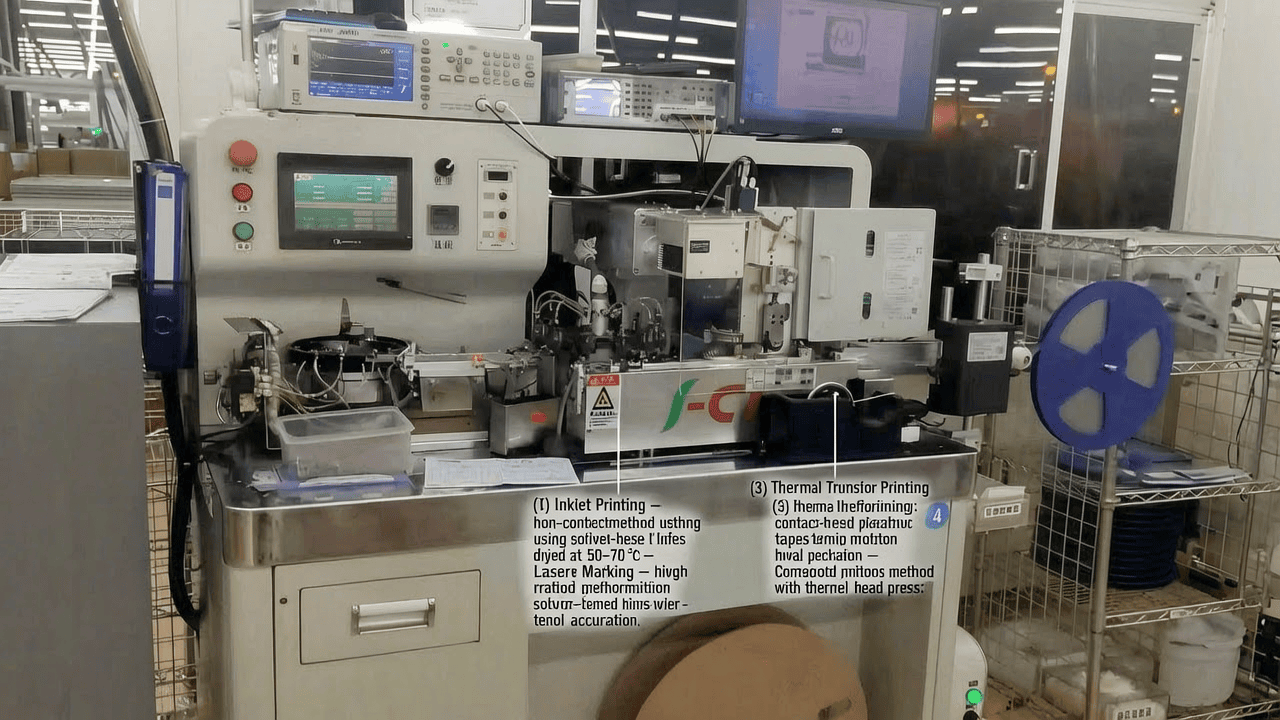
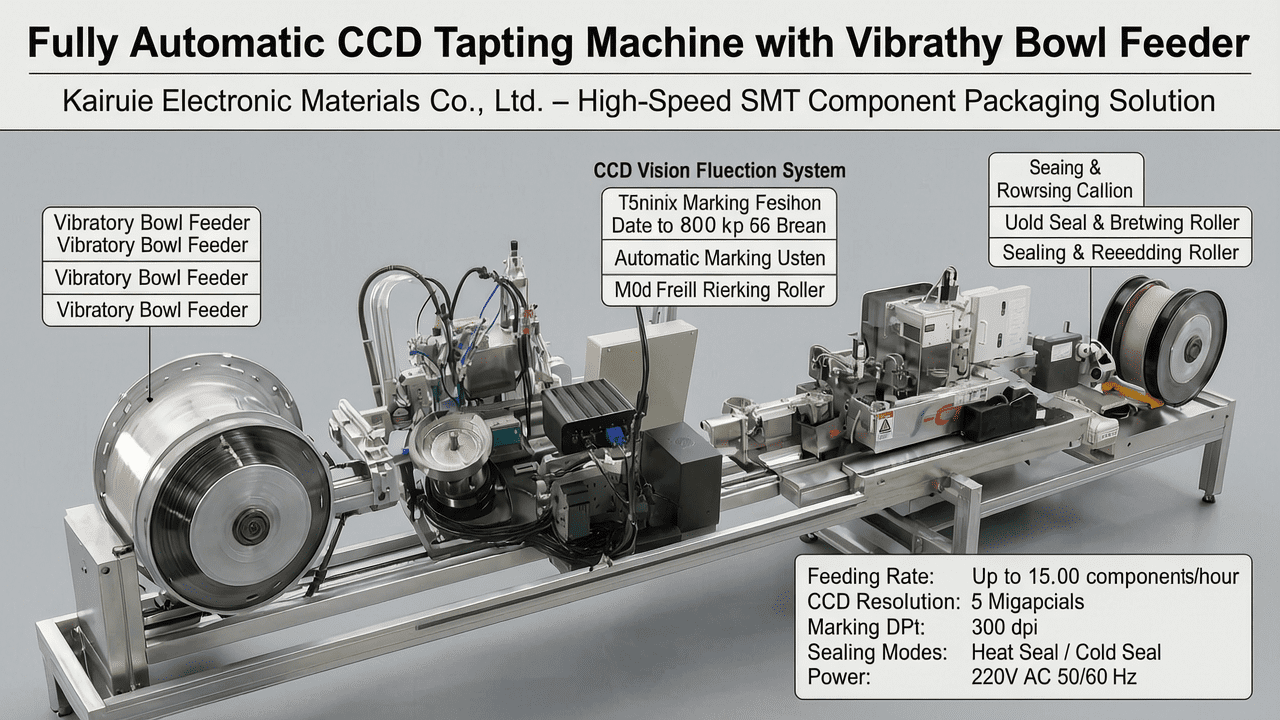
The fully automatic CCD taping machine comprises several integrated modules: a vibratory bowl feeder for component orientation and feeding, a CCD vision inspection system for real-time quality control, an automatic marking unit for traceability, and a sealing and rewinding station. The machine is customizable to accommodate carrier tape widths from 8mm to 56mm, with optional extension to 88mm for larger components. The sealing mechanism supports both heat seal and self-adhesive (cold seal) modes, switchable based on material requirements.
2.2 Carrier Tape and Cover Tape Specifications
The carrier tape typically consists of a base layer of polystyrene (PS) or polycarbonate (PC) with a thickness of 0.3mm to 0.5mm, featuring embossed pockets for component placement. The cover tape is a multilayer structure: a PET base film (typically 0.06mm thick) with an adhesive layer (hot melt or pressure-sensitive) and a release treatment for smooth peeling. Surface resistivity of the carrier tape is controlled between 10^6 and 10^9 ohms/square to prevent static discharge. For heat seal applications, the adhesive activates at temperatures between 120°C and 180°C, while self-adhesive tapes require a consistent pressure of 0.2–0.5 MPa.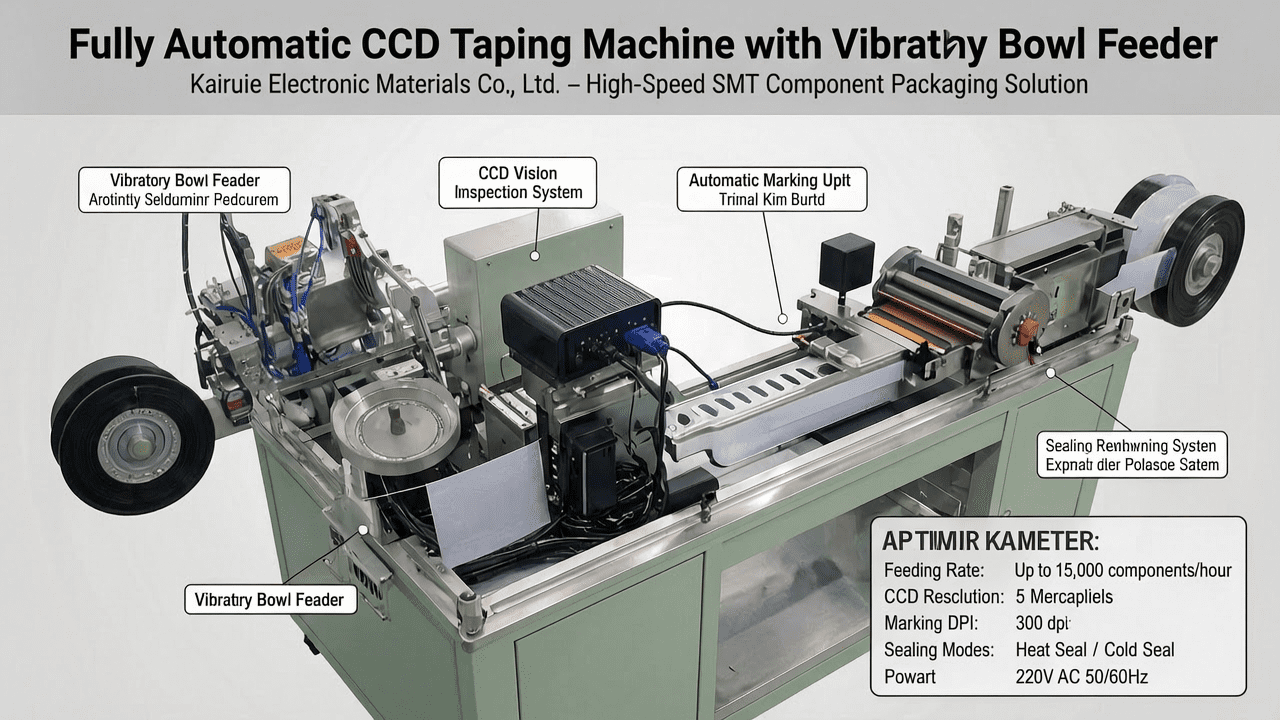
2.3 Key Parameters of Kairuie Models
Kairuie’s fully automatic CCD taping machine features a vibratory bowl feeder with a feeding rate of up to 15,000 components per hour (depending on component size). The CCD camera resolution is 5 megapixels, enabling detection of defects as small as 0.1mm. The marking unit uses a thermal inkjet printer with 300 dpi resolution. The machine’s overall dimensions are 1800mm (L) x 1200mm (W) x 1600mm (H), and it operates on 220V AC, 50/60 Hz power.
3. Core Process Parameter Control
3.1 Temperature, Pressure, and Time Settings
For heat seal mode, the sealing head temperature must be maintained within ±2°C of the setpoint, typically 150°C for standard PET cover tape. The pressure applied by the sealing roller should be 0.3–0.5 MPa, with a dwell time of 0.5–1.0 seconds per pocket. For self-adhesive mode, temperature is not required, but pressure should be increased to 0.4–0.6 MPa with a dwell time of 0.3–0.5 seconds. The vibratory bowl feeder frequency is set between 50–100 Hz, with amplitude adjusted to achieve a consistent component feed rate without jamming.
3.2 Impact of Parameters on Quality
Incorrect temperature can cause incomplete sealing (too low) or cover tape shrinkage (too high). Excessive pressure may deform carrier tape pockets, while insufficient pressure leads to weak seals and component loss during handling. Dwell time must be optimized to balance throughput and seal integrity. The CCD inspection system’s lighting intensity and threshold settings directly affect defect detection accuracy—typical settings include a light intensity of 500–1000 lux and a gray threshold of 128 for binary image analysis.
3.3 Process Window Optimization
To maximize yield, a design of experiments (DOE) approach is recommended. For a 12mm wide carrier tape with 8mm pocket pitch, optimal parameters are: sealing temperature 155°C, pressure 0.4 MPa, dwell time 0.7 seconds. The vibratory bowl feeder should be tuned to a frequency of 75 Hz with an amplitude of 2mm. Regular calibration of the CCD camera using a standard calibration grid ensures consistent defect detection across production runs.
4. Common Issues & Troubleshooting
| Symptom | Root Cause | Solution |
|---|---|---|
| Cover tape peeling off after sealing | Insufficient sealing temperature or pressure | Increase temperature by 5°C or pressure by 0.05 MPa; verify adhesive activation time |
| Component misalignment in pocket | Vibratory bowl feeder orientation error or incorrect pickup placement | Adjust bowl feeder tooling; check pick-and-place vacuum pressure (min. -0.05 MPa) |
| Frequent false rejects by CCD | Dust on lens or incorrect lighting settings | Clean lens with isopropyl alcohol; recalibrate lighting to 800 lux; update defect threshold |
| Carrier tape jamming in sealing station | Worn sealing roller or improper tape tension | Replace roller if diameter < 20mm; adjust tension to 0.5–1.0 N |
| Marking smudged or incomplete | Ink nozzle clogged or incorrect drying time | Perform nozzle cleaning cycle; increase drying time by 0.2 seconds |
5. Quality Inspection Standards
5.1 Incoming Quality Control (IQC)
All incoming materials (carrier tape, cover tape, components) must undergo visual inspection for contamination, dimensions (carrier tape width tolerance ±0.1mm, pocket depth ±0.05mm), and peel strength of cover tape (0.2–0.8 N/cm per EIA-481). A sample of 20 pieces from each lot is tested using a peel tester at 180° angle and 300 mm/min speed.
5.2 In-Process Quality Control (IPQC)
During production, sampling is performed every 30 minutes or every 5000 components, whichever comes first. Acceptance criteria: no missing components, no misalignment >0.2mm, seal width within 1.0–1.5mm, and cover tape peel strength within specification. If defects exceed 2% in a sample, the entire lot is quarantined and the process parameters are adjusted.
5.3 Reliability Testing
Reliability tests include: (1) Aging test: packaged reels stored at 40°C/90% RH for 48 hours, then peel strength rechecked. (2) High/low temperature cycle: -40°C to 85°C for 100 cycles, with no cover tape delamination. (3) Transportation simulation: vibration test at 5–500 Hz, 2g acceleration for 60 minutes per axis, followed by visual inspection for component displacement.
6. Selection Guide
| Application Scenario | Recommended Solution | Key Considerations |
|---|---|---|
| High-volume passives (0402/0603 chips) | Fully automatic CCD with vibratory bowl feeder, heat seal mode | Feeding rate >12,000 pcs/hr; CCD detects polarity and marking |
| Medium-volume connectors (pitch >0.5mm) | CCD semi-automatic with manual placement | Flexibility for different sizes; CCD ensures pin alignment |
| Small-batch custom components (QFN, BGA) | Semi-automatic manual taping machine | Cost-effective; operator can inspect manually |
| High-reliability automotive components | Fully automatic CCD with automatic marking and dual-seal verification | Requires traceability; use heat seal for stronger bond |
7. Conclusion
The fully automatic CCD taping machine with vibratory bowl feeder represents the pinnacle of SMT packaging automation, offering unmatched speed, precision, and reliability. By integrating advanced vision inspection, automatic marking, and flexible sealing options, it ensures defect-free packaging for a wide range of components. Kairuie Electronic Materials Co., Ltd. (www.kairuie.com) is at the forefront of this technology, providing customizable solutions that meet the stringent demands of modern electronics manufacturing. We invite industry peers to collaborate and exchange ideas on optimizing packaging processes for the future of SMT assembly.