凯瑞尔电子材料
1. Introduction
In the rapidly evolving landscape of Surface Mount Technology (SMT), the integrity of the supply chain relies heavily on precise component identification and traceability. As electronic components shrink in size and increase in complexity—ranging from 01005 chip resistors to fine-pitch QFPs—the packaging process becomes a critical bottleneck for data management. For manufacturers utilizing automatic taping machines, the selection of the marking technology is not merely an accessory choice; it is a fundamental determinant of production efficiency, compliance with industry standards (such as IPC), and long-term archival reliability.
Kairuie Electronic Materials Co., Ltd. stands at the forefront of this domain, offering highly customizable taping solutions designed to meet diverse production needs. Central to our customizable functionality is the ability to integrate advanced marking systems. This article provides an in-depth technical analysis of the three primary marking methodologies available in modern SMT packaging: Inkjet Printing, Laser Marking, and Thermal Transfer Printing. By dissecting their operational principles, material compatibilities, and process controls, we aim to equip engineers and procurement specialists with the knowledge necessary to optimize their taping lines for maximum throughput and quality assurance.
2. Product Structure & Material Composition
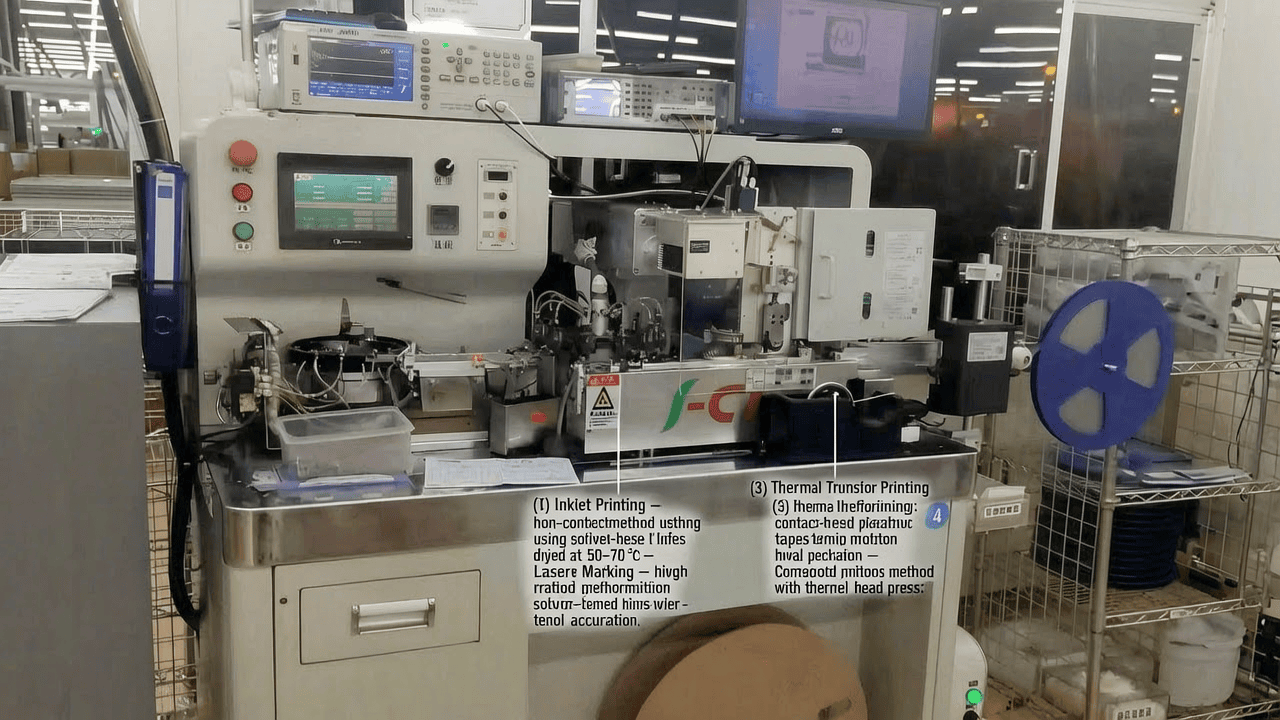
To understand the efficacy of different marking technologies, one must first examine the structural composition of the carrier tape and the mechanical interface of the taping machine. Kairuie’s taping machines are engineered to handle a versatile range of carrier tape specifications, specifically supporting custom widths from 8mm to 88mm. This broad compatibility necessitates a robust understanding of material properties to ensure mark adhesion and durability.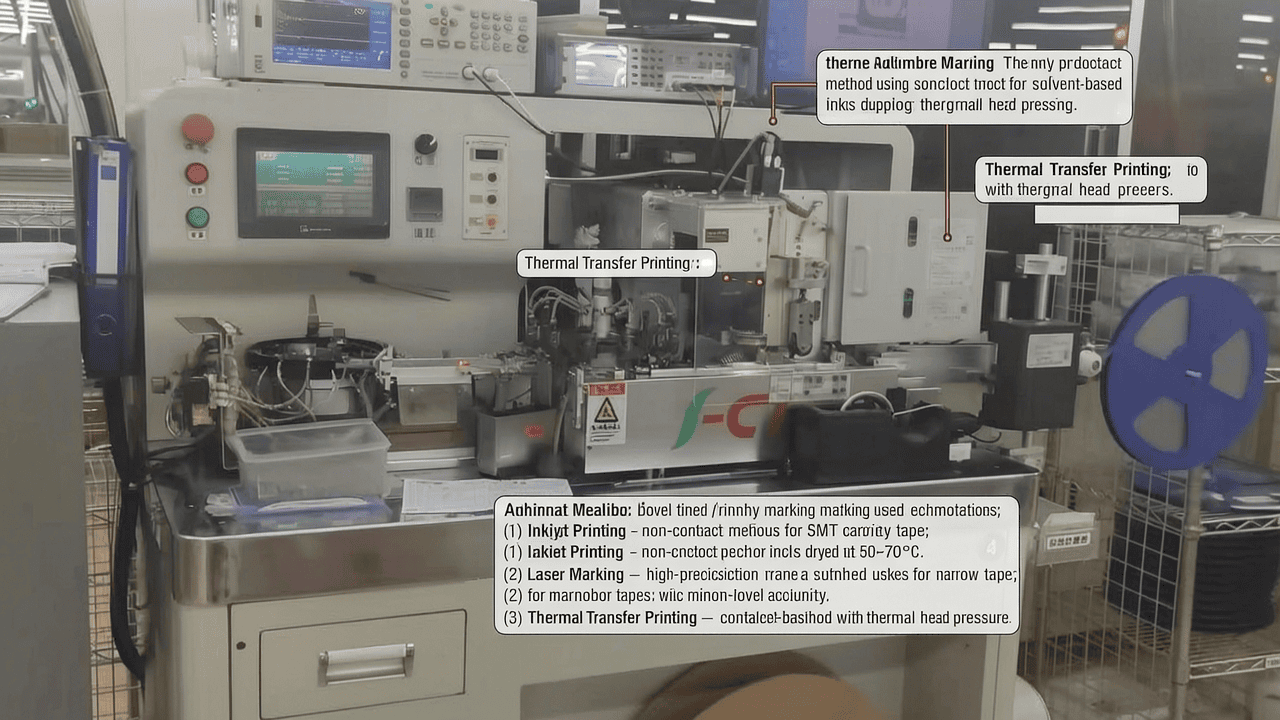
2.1 Carrier Tape Layer Architecture
The standard carrier tape used in SMT packaging typically consists of two primary layers that interact differently with marking technologies:
1. Base Substrate Layer (Conductive/Non-conductive): This is the structural backbone. It is predominantly manufactured from Polystyrene (PS) or Polyethylene Terephthalate (PET). In Kairuie’s configurations, the thickness of this layer varies based on the pocket depth requirements (e.g., for components with varying body thicknesses). PS is the most common substrate due to its cost-effectiveness and formability. However, its surface energy is low, which poses challenges for ink adhesion in inkjet applications unless treated. PET, while more expensive, offers higher thermal stability, making it ideal for high-temperature processes or laser marking.
2. Conductive Treatment Layer (Top Coat): To prevent Electrostatic Discharge (ESD) damage to sensitive ICs, carrier tapes often feature a conductive coating. This layer can be carbon-loaded or coated with a surfactant. The presence and type of this conductive layer significantly influence the contrast and permanence of laser marks and the absorption of thermal transfer inks. Kairuie machines are calibrated to account for these variations, ensuring that the marking head maintains optimal focal distance or contact pressure regardless of the tape’s topography.
2.2 Marking Mechanism Integration
Kairuie’s modular design allows for the seamless integration of marking units onto the main taping frame. Whether the customer selects a pneumatic or electric configuration, the marking station is synchronized with the indexing mechanism. For instance, when utilizing Inkjet Printing, the system accounts for the volatility of solvents on plastic carrier tapes. When opting for Laser Marking, the machine’s rigid construction minimizes vibration, which is crucial for maintaining the micron-level precision required for 2D Data Matrix codes on narrow 8mm tapes.
3. Core Process Parameter Control
Achieving a high-quality mark requires rigorous control over process variables. Unlike the sealing process (which deals with heat and pressure on cover tape), marking involves distinct physical interactions. Below, we analyze the critical control parameters for each technology supported by Kairuie equipment.
3.1 Inkjet Printing Parameters
Inkjet technology, particularly Continuous Inkjet (CIJ) or Drop-on-Demand (DOD), is favored for its speed and non-contact nature. Key parameters include:
- Drying/Curing Temperature: For plastic carrier tapes (PS/PET), solvent-based inks require evaporation. Recommended drying temperatures typically range between 50°C and 70°C. Exceeding this may warp the tape; falling short results in smudging during the reel winding process.
- Drop Volume & Resolution: To ensure readability of QR codes on small 8mm-12mm tapes, the drop volume must be minimized (picoliter range) to prevent spreading, maintaining a resolution of at least 300 dpi.
3.2 Laser Marking Parameters
Laser marking offers permanent, consumable-free coding. It is highly sensitive to power settings.
- Laser Power & Frequency: For standard black PS tape, a fiber laser source with power ranging from 20W to 30W is usually sufficient. The frequency (kHz) determines the pulse overlap. High frequency creates smoother lines but generates heat-affected zones (HAZ) that could melt the pocket edges if not controlled.
- Marking Speed (mm/s): To maintain line efficiency, speeds often exceed 500 mm/s. However, faster speeds require higher peak power to achieve sufficient contrast (foaming or charring effect on the polymer).
- Focal Distance: Maintaining a constant focal distance (typically f = 160mm or 254mm depending on the lens) is vital. Kairuie’s precision guides ensure the tape plane does not deviate by more than ±0.5mm.
3.3 Thermal Transfer Parameters
This method uses heat to transfer ink from a ribbon to the tape (often paper or specialty coated films).
- Print Head Temperature: Critical for ink viscosity. Settings usually fall between 120°C and 180°C. Too low leads to faint print; too high causes ribbon sticking or head degradation.
- Print Pressure (N/cm²): The platen roller pressure ensures intimate contact. For textured carrier tapes, higher pressure (0.4 – 0.6 MPa) is needed to force ink into recessed areas.
- Peel-off Angle: The angle at which the ribbon separates from the tape affects edge sharpness. An acute angle (approx. 30°) is standard.
4. Common Issues & Troubleshooting
Even with advanced Kairuie machinery, environmental factors and material variances can lead to defects. The following table outlines typical symptoms, root causes, and corrective actions for marking processes.