凯瑞尔电子材料
1. Introduction
In the demanding world of Surface Mount Technology (SMT), the integrity of electronic components from manufacture to final assembly is non-negotiable. The three-piece packaging system—carrier tape, cover tape, and reel—forms the backbone of automated pick-and-place operations, ensuring that tiny SMD components are protected from physical damage, electrostatic discharge (ESD), and environmental contamination. Kairuie Electronic Materials Co., Ltd. has engineered a complete portfolio of packaging solutions, including the KRT-C carrier tape, KCT-P cover tape, and KRL-R reel series, designed to meet the stringent requirements of modern high-speed manufacturing. This article provides a deep technical analysis of each component, exploring material composition, critical process parameters, common failure modes, quality inspection standards, and a practical selection guide to help users optimize their packaging processes.
2. Product Structure & Material Composition
2.1 Carrier Tape: KRT-C Series
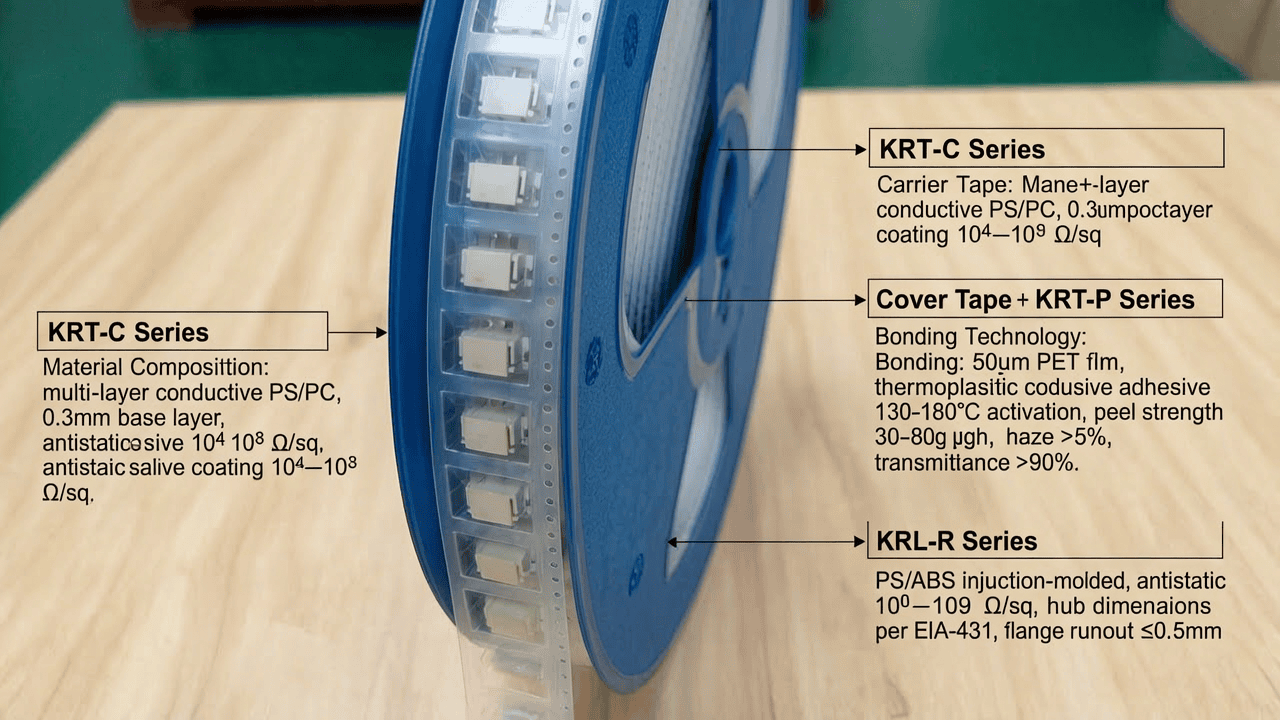
Carrier tape is the foundational element that holds components in precision-molded pockets. Kairuie’s KRT-C series utilizes a multi-layer conductive polystyrene (PS) or polycarbonate (PC) structure, depending on thermal and mechanical requirements. The base layer is typically 0.3mm thick, with optional antistatic coatings achieving a surface resistivity between 104 and 108 Ω/sq. Pocket dimensions are engineered to tight tolerances, for example, the KRT-C08 (8mm wide) for 0402 passive components features a pocket depth of 0.50±0.05mm and length/width of 1.10±0.05mm. For larger ICs, the KRT-C24 (24mm) offers a pocket depth up to 8.5mm with ESD-safe carbon-loaded materials. The top surface includes sprocket holes with a cumulative pitch error of less than ±0.2mm over 20 pitches, ensuring reliable indexing in feeders.
2.2 Cover Tape: KCT-P Series
Cover tape seals the carrier pockets and is available in two primary bonding technologies: heat-activated (KCT-PH) and pressure-sensitive adhesive (KCT-PP). The heat-seal variant consists of a 50μm PET film with a thermoplastic adhesive layer that activates at 130–180°C, providing a peel strength of 30–80g. The pressure-sensitive type uses an acrylic adhesive system, allowing room temperature application and peel forces of 40–120g, ideal for temperature-sensitive components. Both versions are available with antistatic treatment, offering surface resistivity of 105–109 Ω/sq on the outer side. Optical clarity is critical for vision inspection; KCT-P tapes maintain a haze value below 5% and light transmittance above 90%, enabling reliable component detection. The adhesive is formulated to leave no residue on the carrier tape after peeling, meeting ANSI/EIA-481 standards.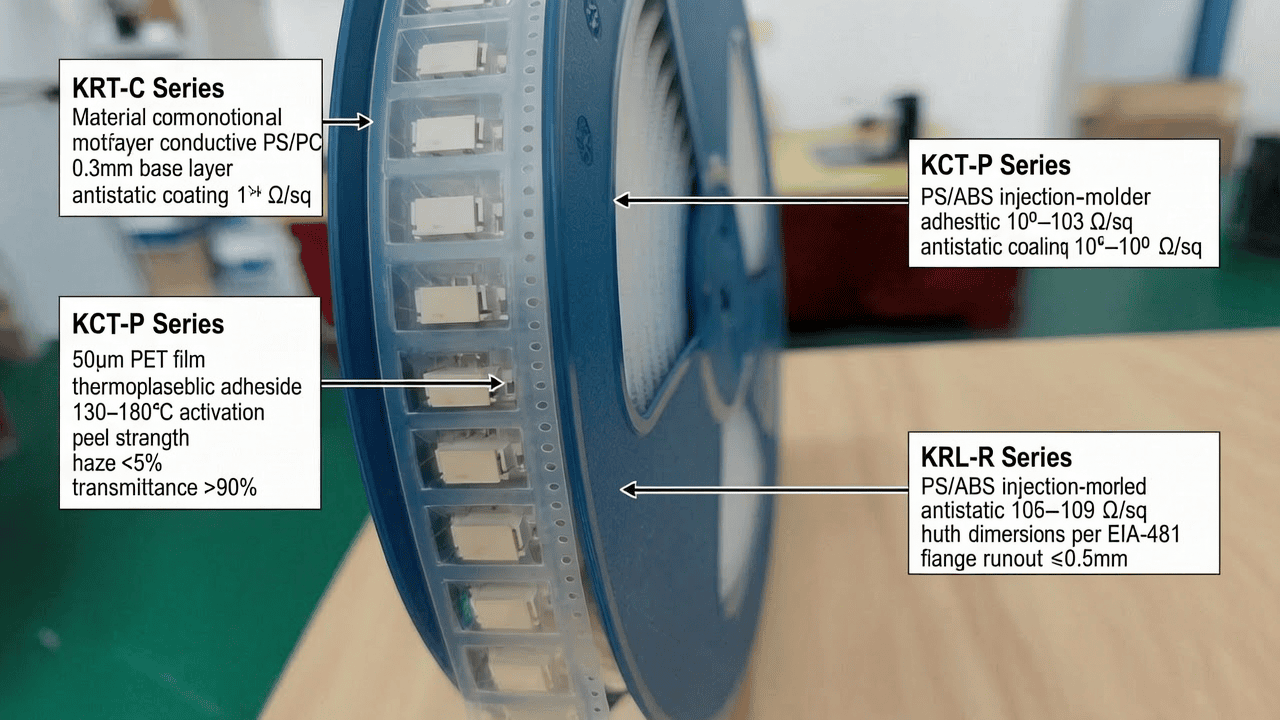
2.3 Reel: KRL-R Series
Reels provide mechanical support for the wound tape and must withstand transportation stresses. Kairuie’s KRL-R reels are injection-molded from durable polystyrene (PS) or ABS, with antistatic properties (surface resistivity 106–109 Ω/sq). Standard sizes include 7-inch (KRL-R7) and 13-inch (KRL-R13) diameters, with hub dimensions per EIA-481. The flange runout is controlled to ≤0.5mm to prevent tape edge damage during high-speed unwinding. Reels are designed with a label area for barcode placement and a write-on surface. For moisture-sensitive devices (MSD), the KRL-R series can be paired with desiccant packs and humidity indicator cards, ensuring compliance with IPC/JEDEC J-STD-033.
3. Core Process Parameter Control
3.1 Sealing Parameters: Temperature, Pressure, and Time
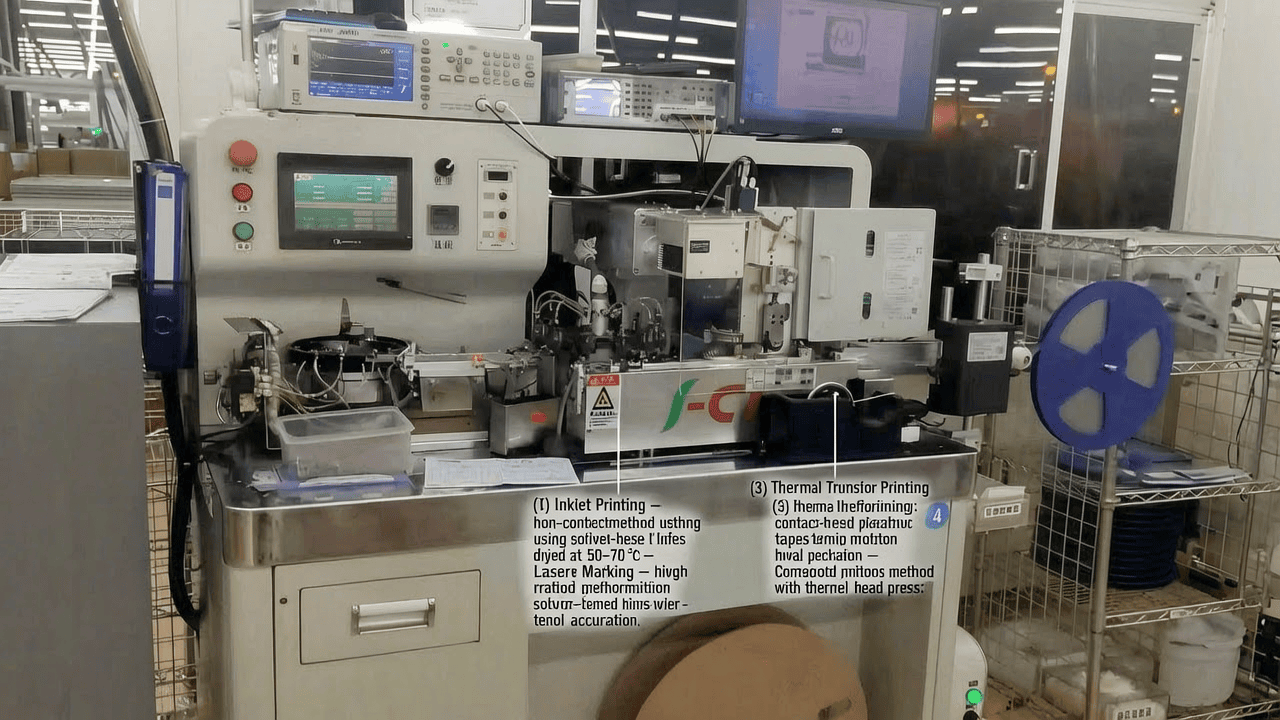
For heat-seal cover tape, the optimal sealing window is critical. KCT-PH tapes require a platen temperature of 140–160°C, applied pressure of 3–5 kg/cm², and dwell time of 0.8–1.5 seconds. If temperature falls below 130°C, incomplete adhesive melting results in weak seals and potential cover tape peeling during transport. Conversely, exceeding 180°C may distort the carrier tape pockets or cause adhesive ooze. Pressure must be uniform across the seal width; deviations lead to local unsealing. Dwell time correlates with production speed—insufficient time (<0.5s) prevents adequate bond formation, while excessive time (>2s) reduces throughput and risks heat damage to components. Kairuie recommends periodic seal strength testing using a pull tester with a 180° peel angle at 300mm/min to maintain quality.
3.2 Winding Tension Control
Winding the sealed tape onto the reel demands precise tension management. Recommended winding tension for 8–16mm tapes is 50–150g, while for 24–44mm tapes it increases to 150–400g. Excessive tension compresses pockets, potentially cracking components or distorting the pocket shape. Insufficient tension causes loose winding, leading to tape telescoping during shipment. Kairuie’s reel winding machines incorporate closed-loop tension sensors and tapered tension profiles to ensure tight, even wraps without compressive damage. Periodic calibration of tension devices and checking of reel hub expansion after winding are essential IPQC steps.
4. Common Issues & Troubleshooting
| Symptom | Root Cause | Solution |
|---|---|---|
| Cover tape peels during reeling or transport | Insufficient sealing temperature/pressure, contaminated sealing surfaces, or expired adhesive | Verify and adjust platen temperature to 140–160°C; clean platens; check adhesive shelf life; increase peel strength target within 30–80g range |
| Component flipping or rotation in pocket | Excessive pocket clearance, inadequate winding tension, or static attraction | Tighten pocket dimensional tolerances; increase winding tension within recommended range; verify carrier tape resistivity <108 Ω/sq |
| Static damage to components (ESD failure) | Non-conductive carrier/cover tape or improper grounding during packaging | Specify tapes with surface resistivity 104–108 Ω/sq; ensure all reels and equipment are grounded; test per ANSI/ESD STM11.11 |
| Tape breakage at sprocket holes | Excessive winding tension, misaligned sprocket, or material brittleness at low temperatures | Reduce tension; inspect sprocket hole pitch and burrs; store tapes at 15–30°C; consider PC-based carrier for brittle applications |
| Cover tape clouding or haze | Contamination during slitting or excessive heat exposure | Maintain clean processing environment; verify sealing temperature does not exceed 180°C; use low-haze KCT-P tapes |
5. Quality Inspection Standards
5.1 Incoming Quality Control (IQC)
Upon receipt, all packaging materials undergo rigorous IQC. Carrier tape is inspected visually for cracks, discoloration, and pocket deformation; dimensions are verified using a profile projector, with pocket width tolerance held to ±0.1mm. Surface resistivity is tested using a concentric ring probe per ASTM D257, ensuring values within specified ranges (e.g., 104–108 Ω/sq). Cover tape peel strength is sampled per batch using a 180° peel test on a standard substrate, targeting 30–80g for heat-seal and 40–120g for PSA types. Reels are checked for flange diameter, runout, and antistatic properties. Any shipment with more than 5% defects is rejected and subject to vendor corrective action.
5.2 In-Process Quality Control (IPQC)
During packaging operations, IPQC ensures consistent seal integrity. Seal strength is tested at machine start-up and every 100m thereafter, with acceptance criteria of 30–80g peel force. Visual inspection under 10x magnification verifies that seals are continuous without voids or adhesive squeeze-out. Winding tension is monitored in real-time, and samples are taken to check pocket geometry for compression. AQL 0.65 is applied for critical defects such as unsealed pockets or component damage. Statistical process control (SPC) charts for peel strength and tension are maintained to detect trends.
5.3 Reliability Testing
Finished packaged reels undergo accelerated aging tests: 85°C/85% relative humidity for 500 hours to simulate long-term storage, followed by a peel strength check (retention >80% of initial). Temperature cycling from -40°C to +125°C, 1000 cycles, is conducted per JEDEC JESD22-A104. Transportation simulation includes random vibration (MIL-STD-810) and 1.2m drop tests on six faces. Kairuie’s packaging has been validated to survive these conditions without tape breakage, component shift, or ESD degradation, affirming its reliability for global logistics.
6. Selection Guide
| Component Type | Carrier Tape Recommendation | Cover Tape Type | Reel Size | Key Considerations |
|---|---|---|---|---|
| 0201/0402 Chip Resistors | KRT-C08 (0.3mm thick, 106 Ω/sq PS) | KCT-PH (heat-seal, 30–50g peel) | KRL-R7 (7-inch) | High-speed placement; ultra-low pocket debris; antistatic |
| 0603/0805 Capacitors | KRT-C12 (12mm, conductive PS) | KCT-PH or KCT-PP | KRL-R7/KRL-R13 | Larger pocket for capacitor body; ESD protection mandatory |
| SOIC/TSSOP ICs | KRT-C16 (16mm, PC for thermal stability) | KCT-PP (PSA, 60–120g peel) | KRL-R13 | Precision pocket depth; low outgassing adhesive; moisture barrier |
| QFP/QFN Packages | KRT-C24/32 (carbon-loaded PS, 104–106 Ω/sq) | KCT-PH antistatic (105–109 Ω/sq) | KRL-R13/KRL-R15 | Durable pockets for heavy components; ESD and MSD protection |
| Connectors/Relays | KRT-C44 (44mm, ABS for rigidity) | KCT-PP (high peel strength >100g) | KRL-R15/KRL-R22 | Large pocket capacity; robust seal for odd shapes; handling convenience |
7. Conclusion
The carrier tape, cover tape, and reel trio is far more than a logistical necessity—it is a precision-engineered system that directly influences SMT yield, placement speed, and component reliability. Kairuie Electronic Materials Co., Ltd. delivers this system through its KRT-C, KCT-P, and KRL-R product lines, each designed with exacting material control and process compatibility. By adhering to the process parameters, inspection protocols, and selection guidance outlined in this article, manufacturers can minimize defects, enhance ESD safety, and streamline their packaging operations. Kairuie continues to invest in material science innovation, offering customized solutions for emerging components such as ultra-miniature 01005s and high-frequency modules. We invite industry colleagues to explore our comprehensive catalog and technical support services at www.kairuie.com. Together, we can advance the standards of electronic packaging for a more reliable future.