凯瑞尔电子材料
1. Introduction
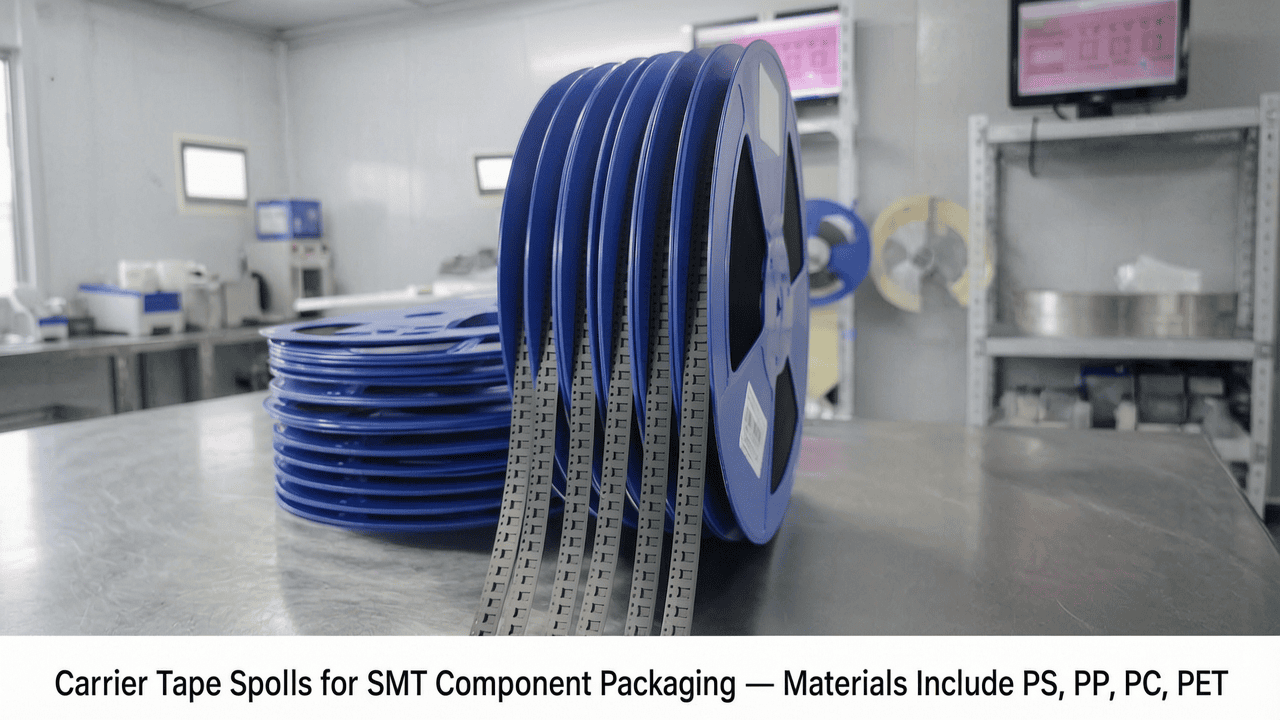
In the intricate ecosystem of Surface Mount Technology (SMT), the carrier tape—often overlooked—plays a pivotal role in the integrity of the global electronics supply chain. As the primary vessel for transporting passive components, integrated circuits (ICs), and sensitive semiconductors from the fabrication facility to the pick-and-place machine, the carrier tape must balance mechanical protection with precise dimensional stability. For Kairuie Electronic Materials Co., Ltd., a leader in this domain, understanding the nuances of raw material selection is not merely a manufacturing step; it is the foundation of assembly yield optimization.
The selection of base material—whether Polystyrene (PS), Polypropylene (PP), Polycarbonate (PC), or Polyethylene Terephthalate (PET)—dictates the thermal limits, mechanical rigidity, and cost-efficiency of the packaging solution. With the increasing miniaturization of components (such as 01005 chip resistors) and the sensitivity of optical devices, a generic approach to carrier tape is no longer viable.
This article serves as a definitive technical guide for engineers and procurement specialists. We will dissect the structural composition of these four primary polymers, analyze the critical thermoforming process windows required to achieve EIA-481 compliance, and provide a robust framework for troubleshooting common defects. Furthermore, we will outline rigorous quality inspection protocols that distinguish premium packaging from standard commodities, ultimately guiding you toward the optimal material solution for your specific application scenarios.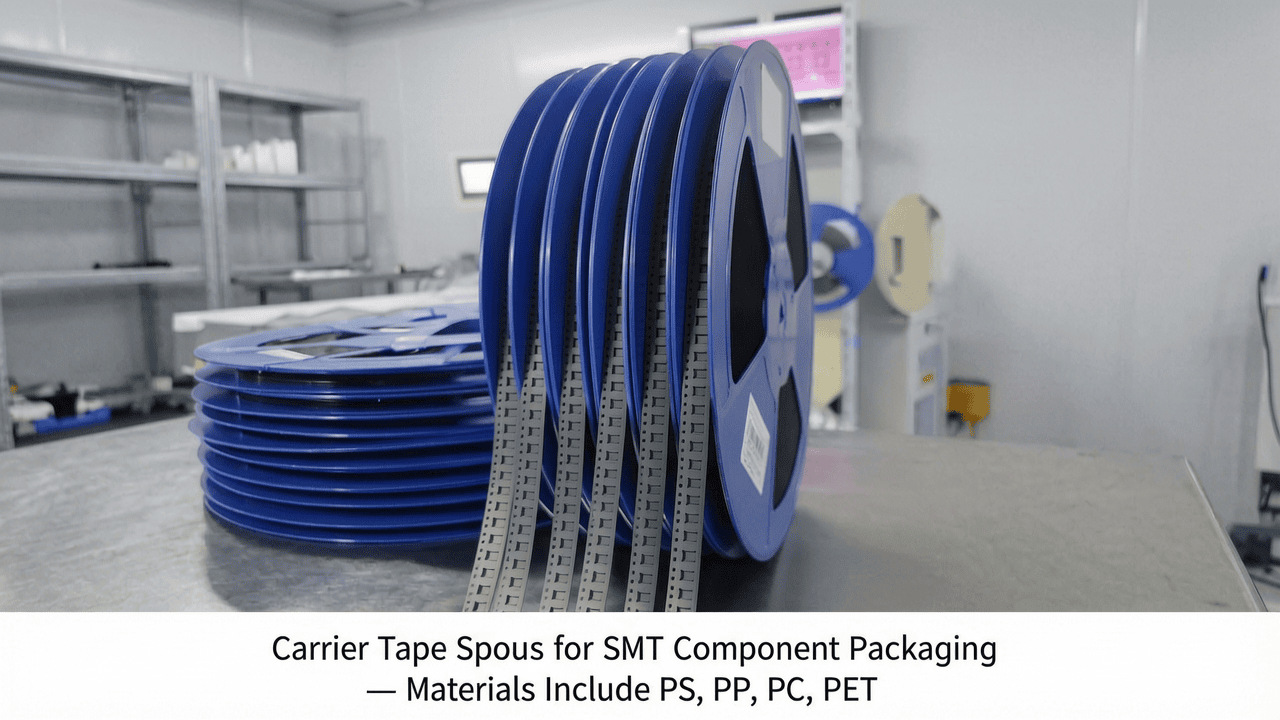
2. Product Structure & Material Composition
To make an informed decision regarding carrier tape specifications, one must first understand the microstructure and macro-properties of the candidate materials. At Kairuie, our product lines—ranging from the standard KR-PS-Series to the high-performance KR-PET-Pro Series—are engineered to meet distinct physical challenges.
2.1 Polystyrene (PS): The Industry Standard
Polystyrene remains the most widely used material for carrier tapes due to its excellent balance of cost, clarity, and ease of processing. Chemically, it is a synthetic aromatic hydrocarbon polymer made from the monomer styrene. In our KR-PS-0812 model, we utilize General Purpose Polystyrene (GPS) with a thickness tolerance of ±0.02mm.
Key Technical Parameters:
- Glass Transition Temperature (Tg): Approximately 80°C – 95°C. This makes PS suitable for standard soldering processes but limits its use in high-heat applications.
- Transparency: >90% light transmission, allowing for automated optical inspection (AOI) of components within the pocket.
- Stiffness: High flexural modulus ensures the tape does not sag in the magazine during high-speed picking.
However, PS is inherently brittle. To mitigate fracture risks during high-speed punching or extreme cold conditions, Kairuie often recommends our modified KR-HIPS (High Impact PS) variants for larger pocket formats.
2.2 Polypropylene (PP): Flexibility and Heat Resistance
Polypropylene offers a semi-crystalline structure that provides superior thermal resistance compared to PS. Our KR-PP-HT (High Temperature) series is specifically engineered for components that undergo secondary reflow processes or are used in automotive under-hood environments.
Key Technical Parameters:
- Melting Point: Ranging from 160°C to 170°C, significantly higher than PS.
- Moisture Absorption: Extremely low (<0.01%), making it ideal for moisture-sensitive devices.
- Density: 0.905 g/cm³, offering a lighter weight profile which reduces shipping costs over large volumes.
The trade-off with PP lies in its shrinkage rate. Because PP is semi-crystalline, it has a higher molding shrinkage than amorphous PS. Our engineering team compensates for this in the tooling design of our KR-PP-Custom molds to ensure pitch accuracy remains within ±0.05mm.
2.3 Polycarbonate (PC): Impact Strength and Durability
For heavy connectors or components requiring robust physical protection, Polycarbonate is the material of choice. Featured in our KR-PC-HeavyDuty line, PC possesses exceptional impact strength and dimensional stability across a wide temperature range.
Key Technical Parameters:
- Tg: Up to 147°C, allowing for sterilization or high-heat storage.
- Tensile Strength: Approx. 70 MPa, nearly double that of standard PS.
- Optical Properties: While naturally transparent, PC can yellow slightly after prolonged UV exposure; however, for internal SMT packaging, this is rarely a concern.
PC requires higher processing temperatures during thermoforming, necessitating advanced heating elements in the carrier tape production line to ensure uniform pocket formation without material degradation.
2.4 Polyethylene Terephthalate (PET): Precision and Barrier Properties
PET represents the premium tier of carrier tape materials, utilized primarily for precision ICs and moisture-sensitive applications. The KR-PET-Precision series combines high stiffness with excellent gas barrier properties (low oxygen transmission rate).
Key Technical Parameters:
- Dimensional Stability: Excellent creep resistance, maintaining pocket depth even under load stacking.
- Surface Finish: Can be manufactured with conductive carbon coating (surface resistivity 10^4 – 10^9 ohm/sq) to prevent Electrostatic Discharge (ESD).
- Chemical Resistance: Resistant to oils and solvents often found in industrial environments.
3. Core Process Parameter Control
Manufacturing a carrier tape that meets EIA-481-D standards requires precise control over the thermoforming process. Whether dealing with PS or PET, the interplay between Temperature, Pressure, and Time defines the final geometry of the pockets.
3.1 Temperature Management: The Thermal Profile
Temperature is the most critical variable. If the sheet is under-heated, the material will not flow into the mold corners, resulting in thin corners or incomplete formation (short shots). If overheated, the material degrades, leading to yellowing (in PC/PS) or excessive thinning at the bottom of the pocket.
Recommended Ranges (Kairuie Process Standards):
| Material Type | Heating Zone Temp (°C) | Mold Temp (°C) | Cooling Method |
|---|---|---|---|
| PS (Standard) | 140 – 160 | 40 – 60 | Air/Fan |
| PP (High Temp) | 155 – 175 | 50 – 70 | Air/Water Mist |
| PC (Engineering) | 170 – 190 | 80 – 100 | Heated Mold Required |
| PET (Precision) | 165 – 185 | 60 – 80 | Controlled Air Flow |
For our KR-PET-Precision products, we utilize a dual-zone heating system to ensure the edges do not cool faster than the center, preventing warpage (bow and twist).
3.2 Forming Pressure and Vacuum Level
Once the plastic reaches the pliable state, vacuum pressure draws the material into the cavity. Standard industrial vacuum pumps operate at roughly 0.8 – 0.9 bar. However, for deeper pockets (e.g., DIP switches or large relays), Kairuie employs Plug-Assist Forming. This technique uses a mechanical plug to pre-stretch the material into the cavity before full vacuum is applied, ensuring uniform wall thickness distribution. Without this, the corners of a PS pocket might be 50% thinner than the top surface, risking puncture during cover tape sealing.
3.3 Cycle Time Optimization
Cycle time directly impacts production cost. While faster cycles increase throughput, they reduce cooling time, leading to dimensional distortion as the part exits the machine. For KR-PS-0812, a cycle time of 1.5 seconds is achievable. However, for KR-PC-HeavyDuty, the cycle time may extend to 3.0-4.0 seconds to allow for proper crystallization control and stress relief. Rushing the PC cooling process results in internal stresses that cause the tape to crack later during the taping (cover-tape application) process.
4. Common Issues & Troubleshooting
Even with optimized parameters, deviations occur. Below is a troubleshooting matrix derived from Kairuie’s 15 years of manufacturing experience. This table assists process engineers in rapidly identifying root causes when quality deviations arise.
| Symptom | Root Cause | Solution |
|---|---|---|
| Incomplete Pocket Formation (Short Shot) | 1. Heating temperature too low. 2. Sheet thickness variation. 3. Vacuum leak or low pressure. |
1. Increase heater temp by 5-10°C. 2. Verify incoming IQC material specs. 3. Check vacuum pump seals and filters. |
| Pocket Wall Thickness Imbalance | 1. Uneven heating (hot spots). 2. Improper plug-assist timing. 3. Material rheology mismatch. |
1. Calibrate infrared heaters. 2. Adjust plug delay timer. 3. Switch to higher Melt Flow Index (MFI) resin grade. |
| Tape Warpage (Bow/Twist) | 1. Insufficient cooling time. 2. Asymmetric cooling (top vs bottom). 3. Internal residual stress. |
1. Reduce line speed. 2. Balance cooling fan airflow. 3. Anneal the material if possible; check reheat settings. |
| Dimensional Pitch Deviation (>±0.1mm) | 1. Chain sprocket wear. 2. Material shrinkage not compensated. 3. Tension control fluctuation. |
1. Replace indexing sprocket. 2. Adjust mold scaling factor (shrinkage allowance). 3. Recalibrate dancer roller tension sensors. |
| Static Electricity Build-up (ESD Failure) | 1. Humidity too low (<30%). 2. Antistatic agent degraded. 3. Friction on metal guides. |
1. Install humidifiers in production area. 2. Check raw material shelf life/concentration. 3. Install ionizing air knives at exit. |
5. Quality Inspection Standards
Quality assurance at Kairuie is not a single checkpoint but a holistic system spanning Incoming Quality Control (IQC) to Reliability Testing. Adherence to these standards ensures that every reel of carrier tape performs flawlessly on Siemens, Fuji, or Panasonic placement machines.
5.1 Incoming Quality Control (IQC)
Before production begins, raw film reels are inspected. For the KR-PET-Conductive series, we measure surface resistivity using a concentric ring probe (ASTM D257). Acceptable range is typically 10^6 to 10^9 Ohms/square. Additionally, thickness is measured via laser micrometers at 9 points across the web width. Any deviation beyond ±0.01mm triggers a rejection to prevent pocket depth inconsistencies downstream.
5.2 In-Process Quality Control (IPQC)
During the run, sampling occurs every 2 hours (or per shift start). Key metrics include:
- Pocket Depth: Measured with pin gauges. Tolerance is usually +0.1mm / -0.05mm.
- Pitch Accuracy: Verified using a Vision Measurement System (VMS) over a span of 10 pockets to detect cumulative error.
- Burr Formation: Visual and tactile inspection of punched edges (for punched tapes) to ensure no loose particles (foreign matter) could contaminate the component pocket.
5.3 Reliability Testing
To guarantee performance in global logistics, finished samples undergo accelerated aging tests:
- High-Temp Storage: 72 hours at 60°C / 60% RH to simulate warehouse conditions.
- Low-Temp Test: 24 hours at -40°C to ensure brittleness does not occur (critical for PS types).
- Transportation Simulation: Random vibration testing per ASTM D4169 to ensure the seal between carrier tape and cover tape remains intact, preventing component migration.
6. Selection Guide
Selecting the correct carrier tape is a strategic decision that impacts both cost and reliability. The following guide maps common electronic components to the optimal Kairuie material solutions.
| Component Category | Primary Challenges | Recommended Material | Kairuie Product Model | Rationale |
|---|---|---|---|---|
| Chip Resistors/Capacitors (0201 – 1206) | Cost sensitivity, high volume, standard reflow. | PS (Conductive/Anti-static) | KR-PS-Std-Cond | Lowest cost, sufficient heat resistance for standard Sn-Pb or SAC reflow profiles. |
| LEDs & Optical Sensors | UV sensitivity, clarity requirement, static damage. | PS (Black/Opaque) or PET | KR-PS-Black / KR-PET-Clear | Black PS prevents light leakage affecting sensors; PET offers better stiffness for long strips. |
| Automotive ICs (QFP, SOP) | High reliability, wide temp range, vibration. | ESD Safe PET or PC | KR-PET-Auto / KR-PC-Eng | PET provides superior dimensional stability; PC offers maximum impact resistance for rough handling. |
| Connectors (USB, FPC) | Irregular shapes, heavy weight, sharp edges. | PC or HIPS | KR-PC-Conn / KR-HIPS-Flex | HIPS prevents cracking around pocket edges caused by connector insertion forces. |
| Power Devices (Mosfets, Transformers) | Heat generation, weight, secondary reflow. | PP (High Heat) | KR-PP-HT-Series | Withstands lead-free reflow peaks (>240°C) without deforming during board mounting. |
7. Conclusion
The evolution of SMT technology demands a parallel advancement in packaging materials. As components become smaller, thinner, and more sensitive to environmental factors, the choice between PS, PP, PC, and PET carrier tapes transitions from a simple purchasing decision to a critical engineering parameter. Through this analysis, we have demonstrated that while PS remains the workhorse for general applications, specialized solutions utilizing PET and PC are indispensable for high-reliability sectors such as automotive, aerospace, and medical electronics.
At Kairuie Electronic Materials Co., Ltd., we are committed to pushing the boundaries of material science in packaging. Our portfolio, ranging from the economical KR-PS series to the engineering-grade KR-PC solutions, is designed to address the full spectrum of modern manufacturing challenges. By adhering to stringent process controls and international quality standards, we ensure that your components arrive at the placement machine in pristine condition, ready for assembly.
We invite industry peers, process engineers, and procurement managers to visit our website at www.kairuie.com to explore our complete catalog and technical datasheets. Let us collaborate to optimize your packaging lines, reduce defect rates, and drive the future of electronics manufacturing together.