凯瑞尔电子材料
1. Introduction
The Challenge of Packaging Dual-Port Network Connectors
In modern electronics manufacturing, dual-port network connectors—such as RJ45 jacks with stacked or side-by-side ports—are essential for high-density communication interfaces. These components feature complex geometries, high pin counts, and substantial weight, posing significant challenges for SMT tape-and-reel packaging. The carrier tape must provide precise pocket dimensions, robust mechanical protection, and reliable sealing to ensure that connectors survive automated pick-and-place, transportation, and environmental stresses without lead damage or contamination. Kairuie Electronic Materials Co., Ltd., a leader in SMT packaging solutions, has developed advanced embossed carrier tapes tailored specifically for such demanding applications. This article explores the comprehensive design solution for dual-port network connector carrier tape packaging, covering material selection, process parameter optimization, quality control, and selection guidance, drawing on Kairuie’s extensive expertise and product portfolio.
The following chapters will detail the multilayer structure that forms the backbone of Kairuie’s carrier tapes, the critical process parameters that govern seal integrity and peel strength, a troubleshooting guide for common issues, rigorous inspection standards, and a comparative selection table to help engineers choose the optimal tape for their specific connector type. By adhering to these guidelines, manufacturers can achieve first-pass yields above 99.5% and reduce line downtime caused by feeding errors.
2. Product Structure & Material Composition
Layer Structure and Material Selection
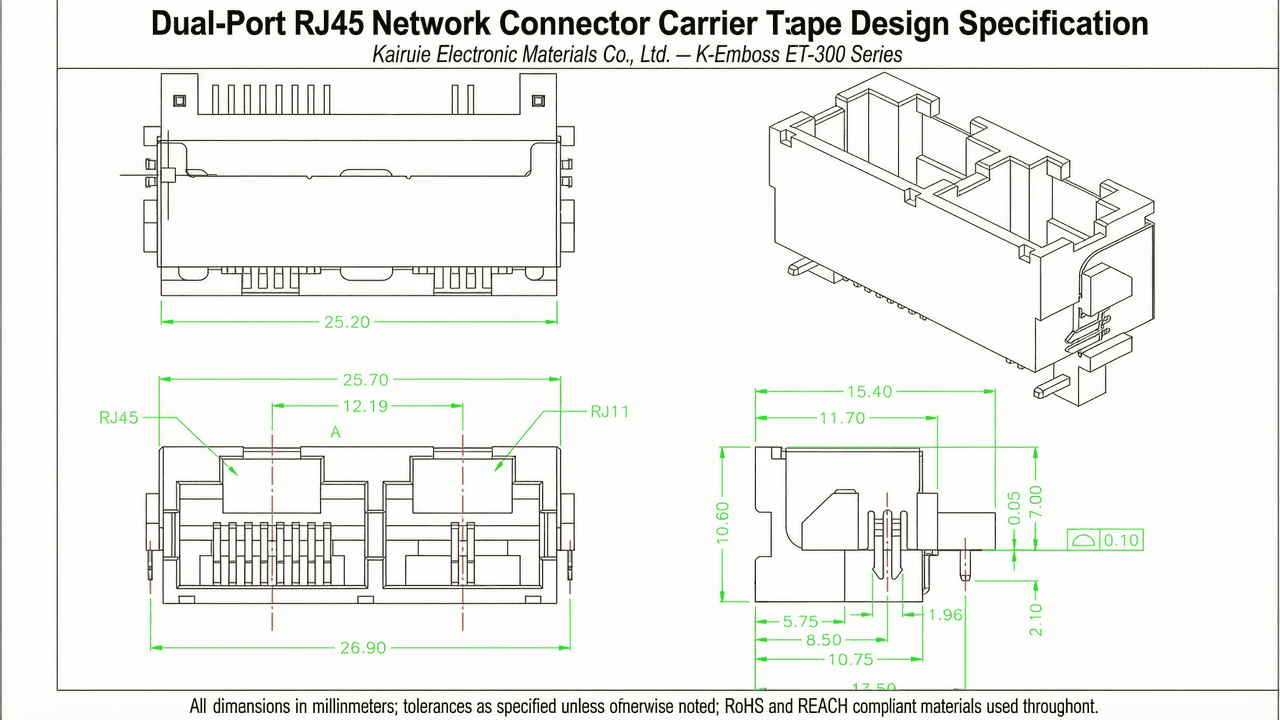
Kairuie’s embossed carrier tapes for dual-port network connectors employ a tri-layer composite design to achieve an optimal balance of strength, flexibility, and static dissipation. The base layer is composed of polyethylene terephthalate (PET) with a thickness ranging from 0.25 mm to 0.35 mm, selected for its high tensile strength (≥ 150 MPa), dimensional stability under thermal cycling (−40°C to +85°C), and excellent formability for deep pockets. The adhesive layer is a heat-activated (HAA) copolymer blend that bonds securely to the cover tape at sealing temperatures between 150 °C and 180 °C, ensuring a consistent peel strength of 30–70 g according to EIA-481 standards. The innermost treatment layer features an antistatic coating that imparts a surface resistivity of 10⁶–10⁹ Ω/sq, protecting sensitive contacts from electrostatic discharge (ESD). This layered construction is embodied in Kairuie’s K-Emboss ET-300 series, specifically engineered for connectors with standoff heights up to 8.5 mm and pocket pitches of 16 mm or 24 mm.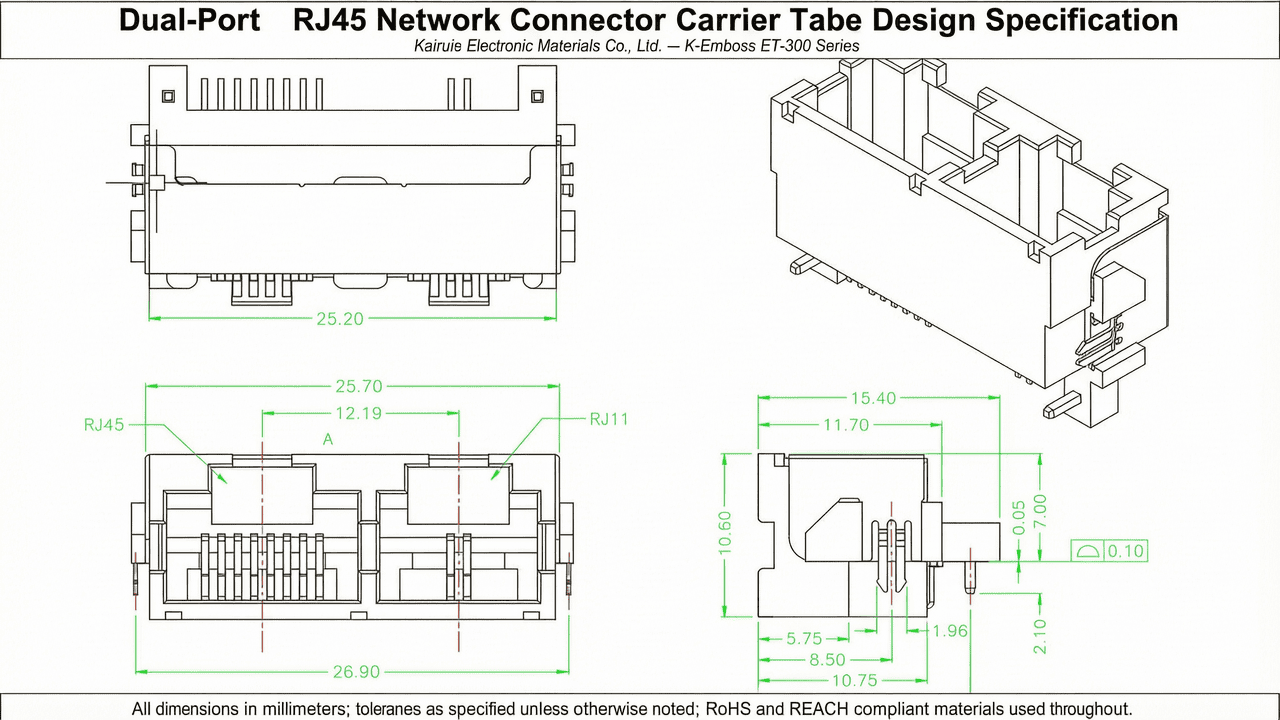
Key Material Parameters of Kairuie Carrier Tapes
Precision in material parameters is non-negotiable for dual-port connectors, where even minor deviations can lead to mispicks or component damage. Kairuie specifies the following critical parameters for its K-Emboss ET-300 and ET-400 series tapes: PET thickness tolerance of ±0.02 mm to maintain pocket depth consistency, a sprocket hole pitch of 4.00 ± 0.05 mm to ensure smooth indexing on SMT feeders, and a camber of less than 1.0 mm over 250 mm length to prevent jamming. The pocket dimensions are custom-machined to match the connector’s footprint: for a typical 1×2 dual-port RJ45, the pocket width is 31.50 ± 0.10 mm, length 16.70 ± 0.10 mm, and depth 16.80 ± 0.10 mm, with draft angles of 3–5° to facilitate release. The cover tape, such as Kairuie’s K-Cover HA-210, is a 0.06 mm thick PET film with a heat-seal coating, providing a nominal peel strength of 40 g and a clarity >85% for automated optical inspection. All materials comply with RoHS and REACH regulations, and the antistatic performance is verified to ANSI/ESD S20.20.
3. Core Process Parameter Control
Sealing Temperature, Pressure, and Dwell Time Optimization
Reliable sealing of dual-port connector carrier tape hinges on tight control of three process parameters: temperature, pressure, and dwell time. Kairuie’s extensive application testing has established the following optimal ranges for its HAA cover tape systems: sealing temperature 160 ± 5 °C, sealing pressure 0.35 ± 0.05 MPa, and dwell time 0.6 ± 0.1 seconds. These values are calibrated for a production speed of 40–50 pockets per minute. Operating outside these windows can compromise peel strength: too low a temperature or short dwell time results in weak bonds (peel strength <20 g), causing premature cover tape detachment during transport; excessive heat or pressure may push adhesive into the pocket, contaminating connector leads, or cause permanent deformation of the PET base, altering pocket geometry by more than 0.15 mm. Kairuie’s technical team recommends a statistical process control (SPC) approach, using X-bar and R charts to monitor peel strength and pocket dimensions, with a process capability index Cpk ≥ 1.33 for high-volume production.
Impact of Process Parameters on Peel Strength and Pocket Integrity
Peel strength is the most sensitive indicator of seal quality and directly influences the smoothness of cover tape removal at the pick-up station. In the K-Emboss ET-300 system, a variation of just 5 °C in sealing temperature can shift peel strength by ±10 g, potentially throwing it out of the 30–70 g specification. Kairuie’s research shows that the optimal peel strength profile is a consistent plateau across the tape width, achieved by uniform pressure distribution through precisely ground sealing shoes. Pocket integrity—maintaining the designed cavity shape—is equally critical. The embossed pocket must resist compressive forces during reeling; Kairuie validates this by a static load test where a 5-kg weight is applied on a stack of 5 tapes for 24 hours, with allowable pocket deformation <0.10 mm. Additionally, the heat-sealing process must not induce thermal shrinkage in the PET layer; Kairuie’s PET formulation limits shrinkage to <1.0% at 160 °C for 10 minutes. These stringent controls ensure that dual-port connectors are always presented to the pick-and-place nozzle in the correct orientation and location.
4. Common Issues & Troubleshooting
Typical Problems and Corresponding Solutions
Despite rigorous process controls, issues can arise during carrier tape packaging. The table below summarizes the five most common problems encountered with dual-port network connector tapes, along with their root causes and corrective actions. These solutions are derived from Kairuie’s field service database and have proven effective in over 500 production lines worldwide.
| Symptom | Root Cause | Solution |
|---|---|---|
| Cover tape peels too easily (peel strength <20 g) | Sealing temperature too low or dwell time insufficient | Increase temperature by 3–5 °C and verify with peel strength tester; ensure consistent heater calibration |
| Cover tape tears during unsealing | Excessive sealing pressure or overheating causing adhesive migration | Reduce pressure to 0.30 MPa and check for residue on sealing shoe; clean shoe daily |
| Connector leads protrude from pocket (component stand-off) | Pocket depth insufficient or part orientation error during loading | Verify pocket depth against connector drawing; use vision system to check orientation; increase pocket depth by 0.2 mm if needed |
| Tape jams in feeder due to high camber | Incorrect winding tension or PET material stress relaxation | Maintain winding tension at 1.0–1.5 N; store reels at 23 ± 2 °C and 50% RH for 48 hours before use |
| Static damage to connectors (ESD events) | Surface resistivity out of spec due to worn antistatic coating | Replace carrier tape with verified resistivity batch; use ionization bars at critical locations |
Addressing these issues promptly minimizes downtime and avoids scrap. Kairuie provides detailed trouble-shooting guides with each reel shipment and offers on-site support through its global network of application engineers.
5. Quality Inspection Standards
Incoming Quality Control (IQC): Setting the Baseline
Before any carrier tape reaches the SMT floor, Kairuie’s IQC protocol ensures that only defect-free material is released. Visual inspection under 10x magnification checks for cracks, burrs, contamination, and inconsistent embossing. Dimensional verification employs a coordinate measuring machine (CMM) or laser profile scanner on a statistical sample (AQL 0.65, Level II per ISO 2859) to confirm pocket length, width, depth, and sprocket hole pitch within ±0.05 mm of nominal. Peel strength is tested on 10 specimens per batch using a universal tensile tester at a 180° peel angle and 300 mm/min pulling speed, with an acceptance range of 30–70 g. Surface resistivity is measured with a concentric ring probe per ANSI/ESD STM11.11, requiring values between 10⁶ and 10⁹ Ω. Only lots meeting all criteria are accepted, and long-term supplier performance is tracked via a supplier scorecard.
In-Process Quality Control (IPQC): Ensuring Continuous Conformance
During tape-and-reel production, IPQC acts as a real-time safeguard. Kairuie recommends a sampling frequency of 1 reel per 100 produced, with each sampled reel subjected to a shortened test suite: visual inspection of first and last 500 mm, peel strength on 5 pockets, and pocket depth measurement on 5 pockets using a drop gauge. Process parameters (temperature, pressure, speed) are continuously logged and automatically alarmed if they deviate beyond ±2% of the setpoint. Statistical process control charts for peel strength and pocket dimensions are updated every shift; any point outside control limits triggers a containment action. Additionally, a progressive cavity checking method is employed: a specially designed gage pin is inserted into a sequence of 50 pockets to detect any dimensional drift. This multi-layered IPQC approach has enabled Kairuie’s customers to achieve defect rates below 50 dpm (defects per million) for connector packaging.
Reliability Testing: Validation for Harsh Environments
To guarantee that dual-port network connectors remain protected throughout their lifecycle, Kairuie conducts a battery of reliability tests. Thermal aging is performed by exposing sealed reels to 85 °C for 96 hours, after which peel strength must remain within 80–120% of initial values and pocket dimensions must not change by more than 0.05 mm. Low-temperature robustness is verified at −40 °C for 72 hours, followed by a drop test from 1.5 m to ensure no cover tape delamination. Transportation vibration simulation per ISTA-3A (random vibration, 0.5 Grms for 60 minutes) is followed by functional peel tests; any tape exhibiting peel strength drift >15% is rejected. A bonus test for dual-port connectors is a “shock and tilt” test: a reel is angled at 45° and subjected to 10 mechanical shocks of 50 G; then the tape is fed through a feeder, and no component should have shifted. These rigorous validations mirror real-world logistics and assembly conditions, earning Kairuie’s tapes the trust of Tier-1 automotive and networking OEMs.
6. Selection Guide
Comparing Carrier Tape Solutions for Network Connectors
Selecting the right carrier tape for a given network connector requires balancing component geometry, production volume, and environmental requirements. Kairuie’s product matrix covers a spectrum of needs, from standard single-port RJ45 to high-density dual-port and shielded variants. The table below provides a quick-reference comparison of recommended solutions, pairing embossed carrier tape models with compatible cover tapes.
| Connector Type | Pocket Layout | Recommended Carrier Tape (Kairuie Series) | Tape Width (mm) | Pocket Pitch (mm) | Cover Tape Recommendation |
|---|---|---|---|---|---|
| Single-port RJ45, through-hole | Single cavity, 8P8C | K-Emboss ET-200 | 32 | 16 | K-Cover HA-210 |
| Single-port RJ45, SMT, with LEDs | Deep cavity, 11.5 mm depth | K-Emboss ET-300 | 44 | 20 | K-Cover HA-215 (higher clarity) |
| Dual-port RJ45, stacked (2×1) | Wide cavity, two rows of pins | K-Emboss ET-400 | 56 | 24 | K-Cover HA-220 (reinforced peel) |
| Dual-port RJ45, side-by-side | Long cavity with sub-pockets | K-Emboss ET-450 | 72 | 32 | K-Cover HA-220 |
| Shielded dual-port RJ45 with EMI tabs | Custom deep cavity with ESD-safe coating | K-Emboss ET-500 ESD | 72 | 32 | K-Cover HA-230 (metalized layer) |
For each application, Kairuie’s engineering team can further customize pocket geometry, tape color, and antistatic properties. The use of K-Cover HA series cover tapes ensures seamless compatibility, with peel strength tailored to the connector’s mass and lead fragility. Production lots are traceable by unique reel IDs, supporting the requirements of ISO 9001 and IATF 16949 quality management systems.
7. Conclusion
Partnering with Kairuie for Optimal Packaging Outcomes
Dual-port network connectors represent a high-value, precision-oriented component category where carrier tape packaging directly impacts final assembly yield and product reliability. Through systematic engineering of material layering, precise process control, and exhaustive quality verification, Kairuie Electronic Materials Co., Ltd. delivers carrier tape solutions that meet the most stringent industry demands. From the robust K-Emboss ET series to the fully characterized sealing processes, every element is designed to protect connector integrity from reel to board. By embracing the guidelines presented in this article, SMT engineers can eliminate common pain points and achieve consistently high throughput.
As technology evolves toward even smaller form factors and higher pin densities, Kairuie continues to innovate in PET formulations, antistatic coatings, and pocket design algorithms. We invite industry colleagues to explore our full product range and technical resources at www.kairuie.com. For a complimentary sample reel or to schedule a process audit, please contact our application engineering team. Let us collaborate to advance the state of electronic packaging—together.