凯瑞尔电子材料
1. Introduction
Surface Mount Technology (SMT) has revolutionized the electronics manufacturing industry by enabling high-speed, high-density assembly of components onto printed circuit boards. Central to the efficiency of SMT assembly lines is the tape-and-reel packaging system, which ensures that components are precisely fed to pick-and-place machines. Kairuie Electronic Materials Co., Ltd. specializes in advanced SMT packaging materials that combine precision, reliability, and process flexibility. This article delves into the technical aspects of our carrier tape and cover tape solutions, covering product structure, process control, troubleshooting, quality inspection, and selection guidance. By integrating CCD vision inspection and automatic reject removal, our systems provide unparalleled quality assurance for critical applications in automotive electronics, medical devices, and beyond.
2. Product Structure & Material Composition
2.1 Layer Structure of Carrier Tape
The carrier tape consists of three functional layers: the base layer (typically PET), the adhesive layer, and the treatment layer. The base layer provides mechanical strength and dimensional stability, with thicknesses ranging from 0.3 mm to 0.6 mm depending on component size and tape width. The adhesive layer (hot melt or pressure sensitive) ensures secure component retention during transport and reliable release during pick-up. The treatment layer may include antistatic coatings to prevent electrostatic discharge (ESD) damage. Kairuie’s standard carrier tapes are compatible with tape widths from 8 mm to 200 mm, with custom options up to 88 mm for medium-to-small batch production.
2.2 Key Material Parameters
| Parameter | Specification | Unit |
|---|---|---|
| PET base thickness | 0.30 – 0.60 | mm |
| Adhesive type | Hot melt / Self-adhesive | – |
| Surface resistivity | 10^6 – 10^9 | Ω/sq |
| Peel strength (cover tape) | 0.1 – 1.0 | N/25mm |
| Operating temperature range | -40 to +85 | °C |
2.3 Product Models
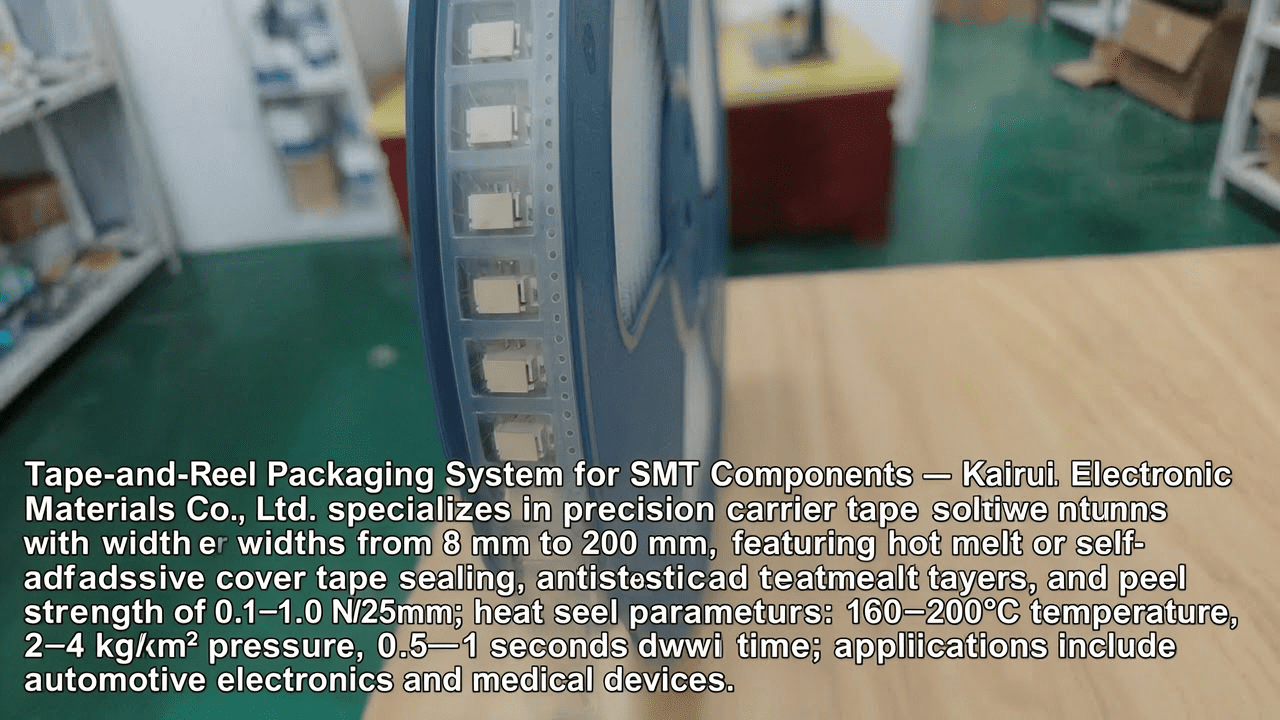
Our product lineup includes models such as KR-8 (8 mm width), KR-12 (12 mm), KR-24 (24 mm), and KR-56 (56 mm). Each model is optimized for specific component types, from small resistors and capacitors to larger connectors and LEDs. The dual-mode sealing capability (heat seal and self-adhesive) allows customers to switch between sealing methods without changing tooling, enhancing production flexibility.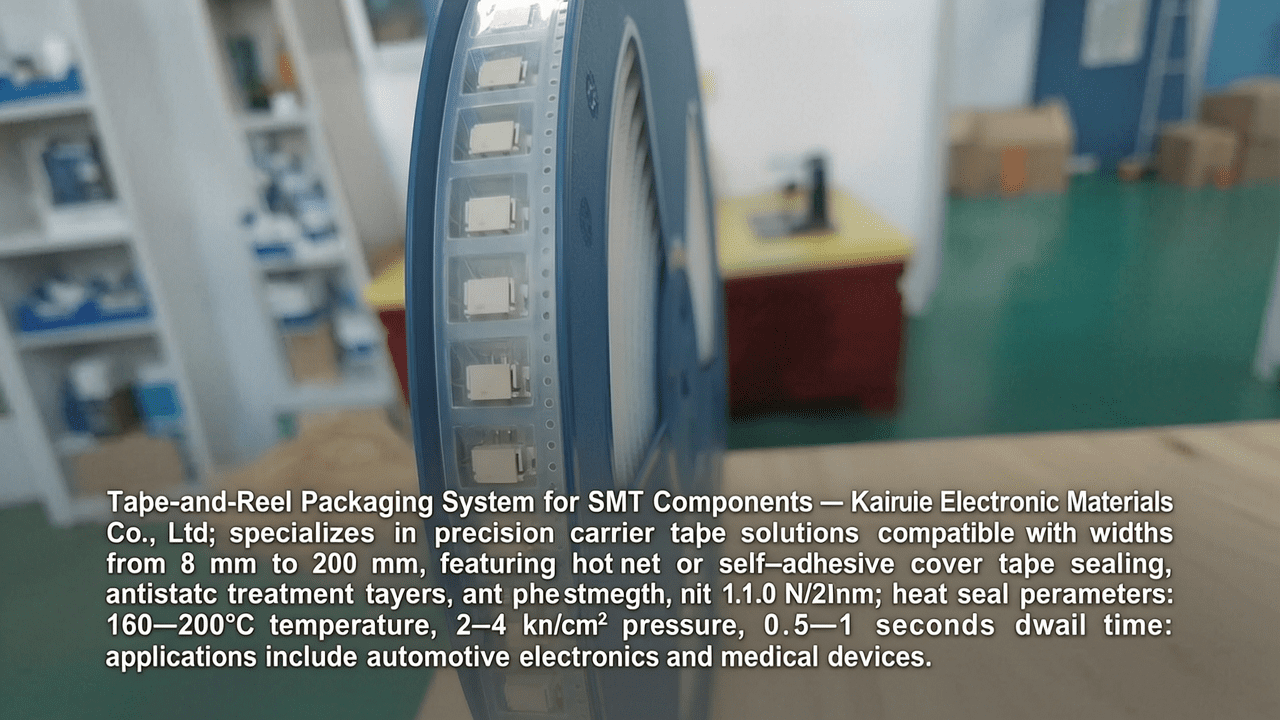
3. Core Process Parameter Control
3.1 Temperature, Pressure, and Time Recommendations
For heat seal cover tape, the recommended sealing temperature is 160–200°C, with contact pressure of 2–4 kg/cm² and dwell time of 0.5–1.5 seconds. For self-adhesive cover tape, no heat is required; pressure of 3–5 kg/cm² and dwell time of 0.3–1.0 seconds are sufficient. These parameters ensure a consistent peel strength between 0.1 and 1.0 N/25mm, as per EIA-481 standards.
3.2 Impact of Parameters on Quality
Excessive temperature can cause base layer deformation or adhesive oozing, leading to component contamination. Insufficient temperature results in weak seal and tape lift-off. Pressure that is too high may crush components, while low pressure leads to incomplete sealing. Dwell time must be optimized to balance throughput and bond strength. Process window optimization is achieved through Design of Experiments (DOE) to identify the ideal combination for each material set.
4. Common Issues & Troubleshooting
| Symptom | Root Cause | Solution |
|---|---|---|
| Cover tape lifts during handling | Insufficient sealing temperature or pressure | Increase temperature by 10°C or pressure by 0.5 kg/cm² |
| Components stick to cover tape | Excessive adhesive bleed or high peel strength | Reduce sealing temperature by 10°C or use self-adhesive mode |
| Carrier tape curling | Uneven cooling or high base layer stress | Adjust cooling rate or use antistatic treatment |
| Inconsistent pocket depth | Worn tooling or improper vacuum | Inspect embossing dies and vacuum system |
| ESD damage to components | Surface resistivity too high | Use antistatic carrier tape (≤10^9 Ω/sq) |
5. Quality Inspection Standards
5.1 Incoming Quality Control (IQC)
IQC includes visual inspection for contamination, scratches, or discoloration; dimensional measurement of tape width, pocket pitch, and depth using optical micrometers; and peel strength testing per EIA-481. Acceptance criteria: width tolerance ±0.1 mm, pitch tolerance ±0.05 mm, peel strength 0.1–1.0 N/25mm.
5.2 In-Process Quality Control (IPQC)
Sampling frequency is every 30 minutes or per reel, whichever is more frequent. Visual checks for seal integrity and component alignment are performed. Acceptance criteria: no missing components, no cover tape wrinkles, and peel strength within spec. If defects exceed 0.1%, the process is stopped and adjusted.
5.3 Reliability Testing
Aging test: 85°C/85% RH for 168 hours; high/low temperature cycling: -40°C to +85°C for 100 cycles; transportation simulation: vibration (10–500 Hz) and drop test (1 m). All tests must show no degradation in peel strength or dimensional stability.
6. Selection Guide
| Component Type | Recommended Tape Width | Sealing Mode | Model |
|---|---|---|---|
| Resistors, capacitors (0402–1206) | 8 mm | Self-adhesive | KR-8 |
| Small ICs, LEDs | 12–16 mm | Heat seal | KR-12 |
| Connectors, larger ICs | 24–32 mm | Heat seal | KR-24 |
| Custom components (sensors, modules) | Up to 88 mm | Dual mode | Custom |
For high-volume production, we recommend heat seal for consistent performance. For low-to-medium volumes or frequent product changes, self-adhesive reduces tooling costs. All solutions are compatible with EIA-481 standards and automated feeders.
7. Conclusion
Kairuie Electronic Materials Co., Ltd. delivers precision-engineered SMT packaging solutions that combine advanced process control, robust quality assurance, and flexible sealing options. Our carrier tapes and cover tapes are designed to meet the demanding requirements of modern electronics manufacturing, ensuring component integrity from reel to board. We invite industry peers to visit our website www.kairuie.com for more technical resources and to explore collaboration opportunities. Together, we can drive innovation in electronic packaging.