凯瑞尔电子材料
1. Introduction
In the rapidly evolving field of surface-mount technology (SMT), the packaging of miniaturized electronic components such as acoustic chip resonators demands extreme precision and cleanliness. Carrier tapes, the backbone of SMT packaging, must ensure secure component retention, precise feeding, and contamination-free handling. The 2718 acoustic chip resonator, with its ultra-narrow pitch and sensitivity to particulate contamination, presents unique challenges that require specialized carrier tape solutions. This article delves into the technical intricacies of ultra-narrow pitch clean carrier tapes, focusing on product structure, process control, troubleshooting, quality standards, and selection guidance. As a leader in carrier tape R&D and manufacturing for over 21 years, Kairuie Electronic Materials Co., Ltd. provides advanced solutions tailored to these demanding applications, with dimensional accuracy of ±0.05mm and zero MOQ for custom tooling.
2. Product Structure & Material Composition
2.1 Layer Structure
The ultra-narrow pitch clean carrier tape for 2718 resonators comprises three critical layers: the base layer (PET), the adhesive layer (heat-activated or pressure-sensitive), and a treatment layer (anti-static coating). The base layer, typically made from high-clarity PET with a thickness ranging from 0.3mm to 0.5mm, provides mechanical strength and dimensional stability. The adhesive layer is selected based on the cover tape type—heat-activated adhesive (HAA) for clean peeling or pressure-sensitive adhesive (PSA) for room-temperature application. A permanent anti-static treatment layer (surface resistivity < 10^12 Ω/sq) prevents electrostatic discharge (ESD) damage to sensitive resonators.
2.2 Key Material Parameters
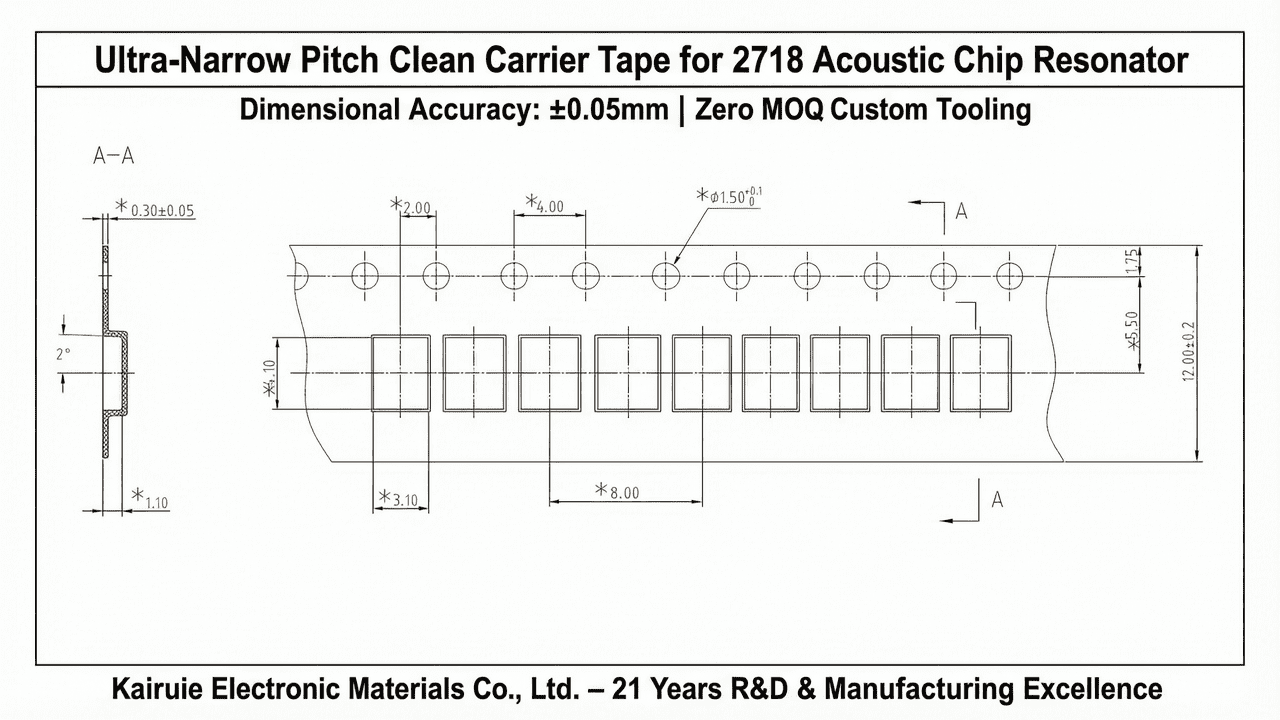
For the 2718 resonator, critical parameters include: pocket dimensions A0 (length), B0 (width), and K0 (depth) with tolerances of ±0.05mm; sprocket hole diameter D0 of 1.5mm ±0.05mm; and pocket pitch P0 of 4mm ±0.05mm. The carrier tape width W is 12mm ±0.05mm, with camber (bow) less than 1mm per 250mm length. Cover tape peel strength is tightly controlled between 0.3N and 0.8N to ensure consistent sealing without tearing. Material certification includes UL 94 V-0 flammability rating and RoHS compliance.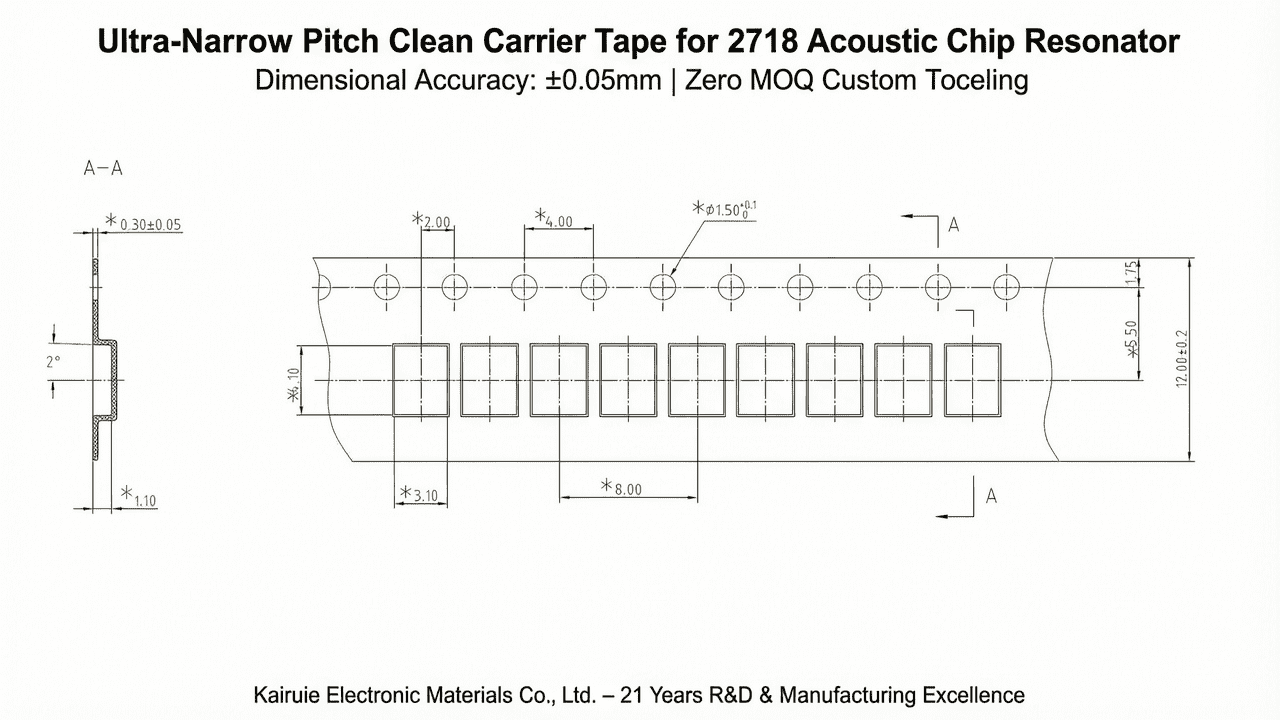
3. Core Process Parameter Control
3.1 Temperature, Pressure, and Time Recommendations
For heat-activated cover tape sealing, the recommended temperature range is 120°C to 160°C, with a pressure of 2.0–4.0 kgf/cm² and dwell time of 0.5–1.5 seconds. Lower temperatures (120–140°C) are preferred for thin PET (0.3mm) to avoid deformation, while thicker base tapes (0.5mm) can tolerate higher temperatures (150–160°C). Pressure must be uniform across the sealing head to prevent weak spots. Time settings should be optimized to achieve full adhesive activation without excessive heat transfer to components.
3.2 Impact of Parameters on Quality
Temperature deviation beyond ±10°C can cause incomplete sealing (low peel strength) or cover tape melting (high peel strength). Pressure imbalance leads to inconsistent peel strength across the tape width. Excessive dwell time may degrade the anti-static coating. A process window optimization study using Design of Experiments (DOE) helps identify the sweet spot: 140°C ±5°C, 3.0 kgf/cm² ±0.5, and 1.0s ±0.2s yields peel strength of 0.5N ±0.1N with minimal variation.
4. Common Issues & Troubleshooting
| Symptom | Root Cause | Solution |
|---|---|---|
| Cover tape lifts during feeding | Low peel strength due to insufficient temperature or pressure | Increase sealing temperature by 5–10°C or pressure by 0.5 kgf/cm² |
| Component rotation in pocket | Pocket depth K0 too large or component size mismatch | Verify K0 tolerance (±0.05mm); reduce depth by 0.05mm if needed |
| Excessive camber (bow) | Uneven tension during slitting or material stress | Adjust slitting tension to 2.0–3.0 N; anneal PET at 60°C for 1 hour |
| Peeling force > 0.8N | High temperature or long dwell causing over-bonding | Reduce temperature by 10°C or dwell time by 0.3s |
| ESD damage to resonator | Surface resistivity > 10^12 Ω/sq | Apply anti-static coating; verify resistivity < 10^12 Ω/sq |
5. Quality Inspection Standards
5.1 Incoming Quality Control (IQC)
All raw materials undergo visual inspection for surface defects, scratches, and contamination. Dimensional verification uses CCD measurement for all critical parameters (W, E, P0, etc.) with ±0.05mm tolerance. Peel strength is tested per EIA-481 standard using a 90° peel test at 300mm/min. Anti-static coating effectiveness is confirmed via surface resistivity measurement (< 10^12 Ω/sq).
5.2 In-Process Quality Control (IPQC)
During production, sampling frequency is set at one reel per hour for dimensional and peel strength checks. Acceptance criteria: all dimensions within ±0.05mm, peel strength 0.3–0.8N, and no visible defects. Camber is measured every 250mm length with a limit of < 1mm. Any deviation triggers immediate process adjustment and 100% inspection of the previous batch.
5.3 Reliability Testing
Reliability tests include: (1) Aging test at 85°C/85%RH for 168 hours—peel strength variation < 20%; (2) High/low temperature cycling from -40°C to +85°C for 100 cycles—no delamination or cracking; (3) Transportation simulation with vibration (10–500Hz, 1.5g) and drop test (1m height)—no component loss or tape damage. These tests ensure robust performance under real-world conditions.
6. Selection Guide
| Component Type | Recommended Product | Key Features |
|---|---|---|
| Acoustic resonator 2718 (narrow pitch) | Kairuie Ultra-Clean Carrier Tape (PET 0.4mm, HAA) | ±0.05mm precision, anti-static, low outgassing |
| Large IC (QFP, BGA) | Kairuie Embossed Carrier Tape (PET 0.5mm, PSA) | High strength, deep pockets, ESD protection |
| Passive components (0402, 0603) | Kairuie Punched Carrier Tape (Paper-based) | Cost-effective, high speed, standard tolerances |
| LEDs (side-view) | Kairuie Conductive Carrier Tape (Carbon-loaded PET) | Surface resistivity < 10^6 Ω/sq, UV-resistant |
7. Conclusion
Ultra-narrow pitch clean carrier tapes are indispensable for reliable SMT packaging of sensitive components like acoustic chip resonators. With 21 years of expertise, Kairuie Electronic Materials Co., Ltd. delivers carrier tapes that meet the highest standards of dimensional accuracy (±0.05mm), cleanliness, and process control. Our zero MOQ policy and free tooling and samples enable rapid prototyping and low-volume production. For more information, visit www.kairuie.com and join the conversation with industry peers to advance SMT packaging technology.