凯瑞尔电子材料
1. Introduction
In the realm of Surface Mount Technology (SMT) packaging, the mechanical integrity of carrier tape pockets is paramount to protecting sensitive electronic components during transportation, handling, and automated assembly. The 72mm wide PS (Polystyrene) carrier tape, featuring an ultra-high 8KG single-pocket pressure resistance, represents a significant advancement in ensuring component safety under various mechanical stress scenarios. This article explores the critical role of pocket pressure resistance in SMT packaging, the material and structural innovations that enable such performance, and the process controls necessary to maintain consistency. We will delve into the product structure, core process parameters, common troubleshooting, quality inspection standards, and selection guidelines to provide a comprehensive technical reference for industry professionals.
2. Product Structure & Material Composition
2.1 Layer Structure
The 72mm PS carrier tape is constructed from a single-layer polystyrene base material, chosen for its excellent dimensional stability, impact resistance, and compatibility with heat seal and pressure-sensitive cover tapes. Unlike multi-layer tapes, the PS carrier tape relies on the intrinsic properties of the polymer to achieve high pocket strength. The tape is typically available in anti-static grades, including single-sided and double-sided anti-static versions, with surface resistivity ranging from 10⁶ to 10¹² Ω/sq to prevent electrostatic discharge (ESD) damage.
2.2 Key Material Parameters
Table 1 summarizes the critical dimensional specifications for the 72mm PS carrier tape, as verified by CCD inspection. All dimensions are controlled to ±0.05mm, ensuring precise pocket geometry for reliable component placement.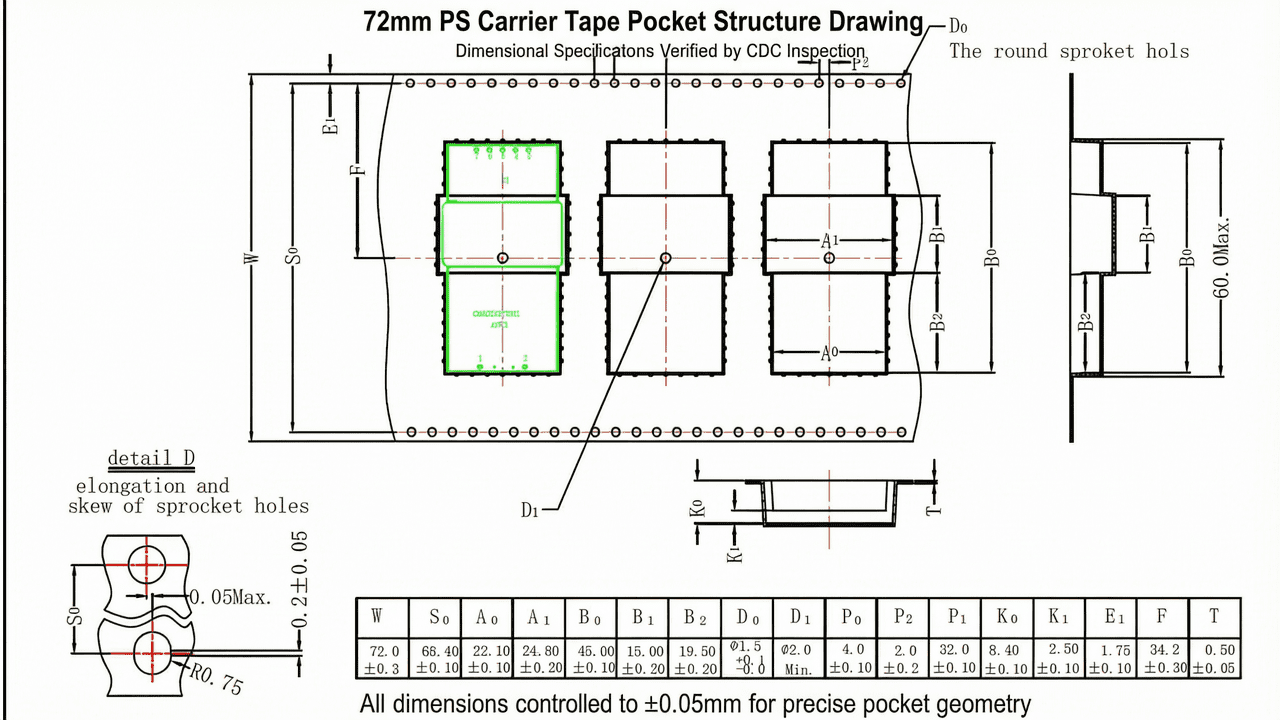
| Parameter | Symbol | Tolerance |
|---|---|---|
| Carrier tape width | W | ±0.05 mm |
| Sprocket hole pitch | E | ±0.05 mm |
| Pocket pitch | P0 | ±0.05 mm |
| Center distance (adjacent pockets) | P2 | ±0.05 mm |
| Sprocket hole to pocket edge | F | ±0.05 mm |
| Sprocket hole diameter | D0 | ±0.05 mm |
| Top hole diameter | D1 | ±0.05 mm |
| Pocket length | A0 | ±0.05 mm |
| Pocket width | B0 | ±0.05 mm |
| Pocket depth | K0 | ±0.05 mm |
| Cumulative pitch (10 pitches) | P | ±0.05 mm |
The 8KG single-pocket pressure resistance is achieved through optimized mold design and material selection, ensuring that pockets can withstand vertical forces during stacking, vacuum pickup, and automated handling without deformation.
3. Core Process Parameter Control
3.1 Temperature, Pressure, and Time
For the 72mm PS carrier tape, the sealing process is critical to maintaining pocket integrity. When using heat seal cover tape, the recommended temperature range is 180–220°C, with a pressure of 2–4 kg/cm² and a dwell time of 0.5–1.5 seconds. For pressure-sensitive adhesive (PSA) cover tape, sealing is performed at ambient temperature (20–25°C) with a pressure of 3–5 kg/cm² and a dwell time of 0.3–1.0 second. These parameters ensure a strong bond without compromising the pocket’s mechanical strength.
3.2 Impact on Product Quality
Excessive temperature or pressure can cause pocket deformation, reducing the 8KG pressure resistance. Insufficient sealing leads to cover tape peeling, exposing components to contamination. Process optimization involves balancing these parameters to achieve a peel strength of 0.1–1.0 N (for heat seal) or 0.05–0.5 N (for PSA), as per EIA-481 standards.
3.3 Process Window Optimization
To maintain the 8KG pocket strength, it is recommended to use a lower temperature and higher pressure for heat seal, or moderate pressure for PSA. Regular calibration of sealing heads and temperature sensors is essential. The automated system should include real-time monitoring of sealing force and temperature to ensure consistency.
4. Common Issues & Troubleshooting
| Symptom | Root Cause | Solution |
|---|---|---|
| Pocket deformation during sealing | Excessive temperature or pressure | Reduce sealing temperature by 10–20°C or lower pressure by 0.5 kg/cm² |
| Cover tape peeling after sealing | Insufficient sealing temperature or pressure | Increase temperature by 10–15°C or pressure by 0.5–1.0 kg/cm² |
| Component shifting in pocket | Pocket dimensions out of tolerance | Verify CCD inspection data; adjust mold if needed |
| Static discharge during unwinding | Inadequate anti-static treatment | Use double-sided anti-static tape; ensure grounding |
| Inconsistent peel strength | Variation in cover tape adhesive quality | Replace cover tape lot; verify adhesive specification |
5. Quality Inspection Standards
5.1 Incoming Quality Control (IQC)
Upon receipt, the 72mm PS carrier tape undergoes visual inspection for surface defects, scratches, and contamination. Dimensional verification using CCD ensures all parameters meet the ±0.05mm tolerance. Peel strength testing is performed on sample rolls to confirm adhesion within specified ranges.
5.2 In-Process Quality Control (IPQC)
During production, sampling is conducted every 30 minutes for dimensional checks and visual inspection. Acceptance criteria require 100% of samples to meet dimensional tolerances and zero defects in pocket integrity. Any deviation triggers immediate process adjustment.
5.3 Reliability Testing
Aging tests at 85°C/85%RH for 168 hours assess long-term stability. High/low temperature cycling (-40°C to +85°C, 10 cycles) evaluates material resilience. Transportation simulation (ASTM D4169) ensures the 8KG pocket strength protects components during shipping.
6. Selection Guide
| Component Type | Recommended Product | Key Features |
|---|---|---|
| Large ICs (QFP, BGA) | 72mm PS carrier tape, double-sided anti-static | 8KG pocket strength, precise pocket dimensions |
| Passive components (resistors, capacitors) | 8–24mm PS carrier tape, single-sided anti-static | Cost-effective, standard pocket pressure |
| Sensitive MEMS devices | 72mm PS carrier tape with conductive cover tape | Faraday cage protection, ESD safe |
| LEDs and optoelectronics | 72mm PS carrier tape, transparent anti-static | Optical clarity, low triboelectric charging |
7. Conclusion
The 72mm PS carrier tape with 8KG single-pocket pressure resistance sets a new benchmark for mechanical protection in SMT packaging. By combining precise dimensional control, robust material properties, and optimized process parameters, it ensures component integrity under the most demanding conditions. Kairuie Electronic Materials Co., Ltd. is committed to advancing this technology, offering customized solutions for diverse applications. For more information, visit www.kairuie.com. We welcome industry peers to exchange ideas and collaborate on future innovations.