凯瑞尔电子材料
1. Introduction
SMT (Surface Mount Technology) packaging is a critical process in the electronics manufacturing supply chain, ensuring that components are securely and accurately presented for pick-and-place assembly. Among the various packaging equipment, the vibratory bowl feed fully automatic CCD taping machine stands out as a high-performance solution for medium- to high-volume production, where precision, speed, and reliability are paramount. This article delves into the technical aspects of this advanced machine, covering its structure, process parameters, common issues, quality standards, and selection guidance. By understanding these elements, manufacturers can optimize their packaging lines to achieve superior yield and efficiency.
2. Product Structure & Material Composition
2.1 Machine Architecture and Key Components
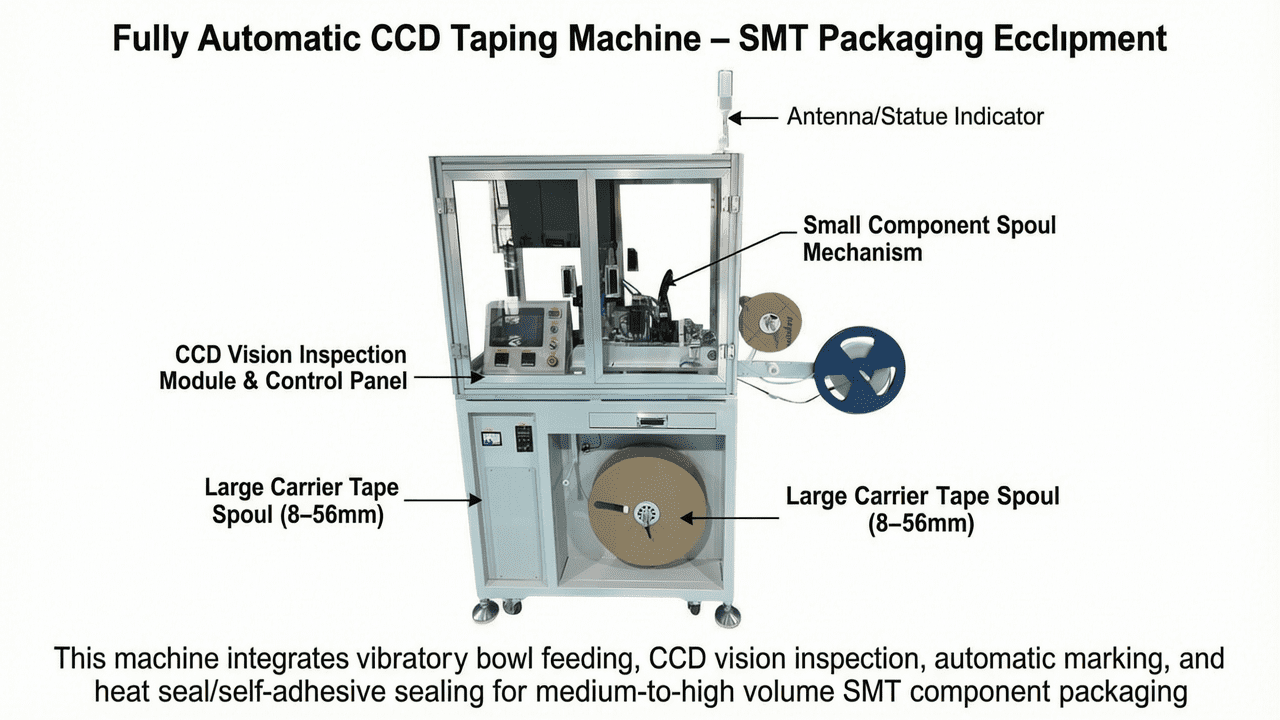
The fully automatic CCD taping machine integrates several subsystems: a vibratory bowl feeder for component orientation and feeding, a CCD vision inspection module for real-time quality check, an automatic marking unit for defective component rejection, and a sealing and rewinding mechanism. The machine supports both heat seal and self-adhesive sealing modes, switchable according to packaging requirements. It is compatible with carrier tape widths ranging from 8 mm to 56 mm, with customization up to 88 mm for larger components.
2.2 Material Parameters
The packaging materials used include carrier tape (typically PET with thickness 0.3–0.6 mm), cover tape (heat seal or self-adhesive type), and embossed pockets. Key parameters such as surface resistivity (10^5–10^9 Ω/sq for anti-static versions), peel strength (0.2–0.8 N for heat seal, 0.1–0.5 N for self-adhesive), and dimensional accuracy (±0.05 mm for pocket pitch) are critical for consistent performance. The machine’s CCD camera resolution is typically 5–10 megapixels, enabling detection of defects as small as 0.1 mm.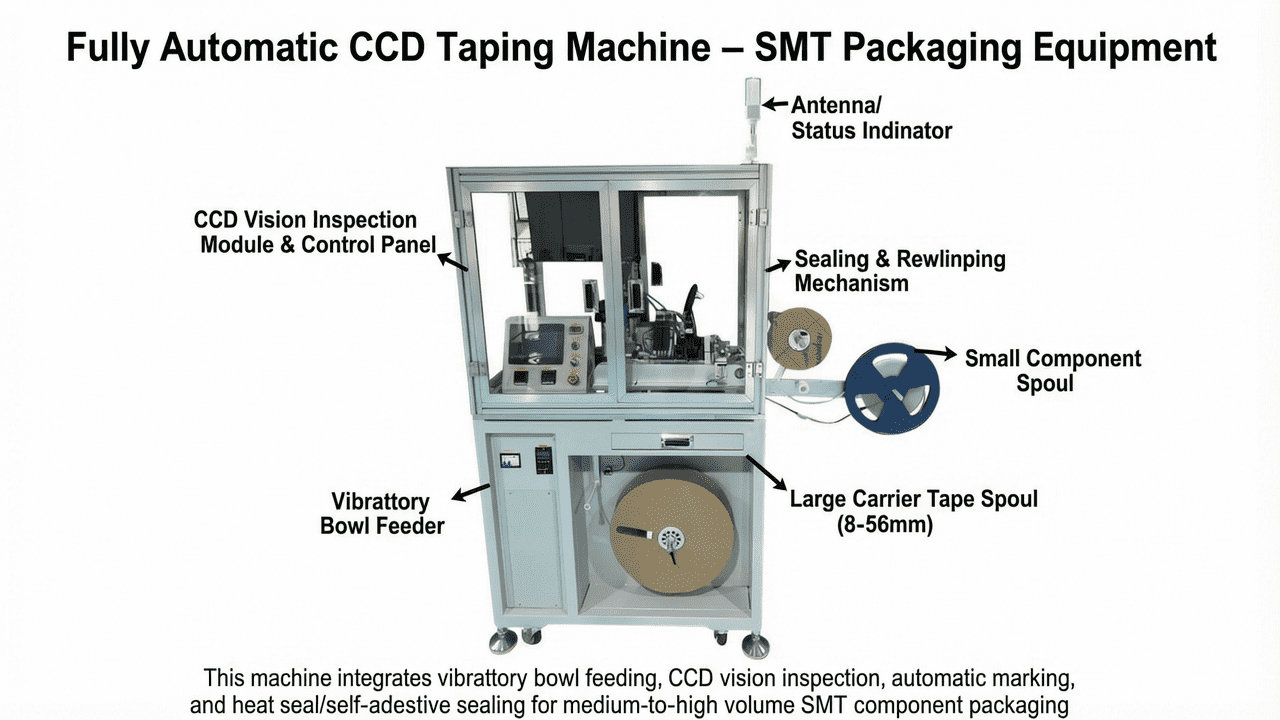
3. Core Process Parameter Control
3.1 Temperature, Pressure, and Time Settings
For heat seal mode, the sealing temperature should be maintained between 180°C and 220°C, with a tolerance of ±5°C. The sealing pressure is recommended at 2–4 kg/cm², and the dwell time per seal is 0.5–1.5 seconds. For self-adhesive mode, no heat is required; instead, the pressure should be 1–3 kg/cm² with a dwell time of 0.3–1.0 second. These parameters directly affect peel strength and seal integrity. If the temperature is too low, the bond may be weak; too high, and the tape may deform or stick excessively.
3.2 Process Window Optimization
Optimization involves balancing speed and quality. For a typical 8 mm tape width, the machine can achieve a cycle time of 0.8–1.2 seconds per component, including feeding, inspection, sealing, and indexing. To avoid misalignment, the indexing accuracy must be within ±0.1 mm. It is recommended to perform a DOE (Design of Experiments) to determine the optimal settings for each component type, especially for sensitive components like ICs and connectors.
4. Common Issues & Troubleshooting
| Symptom | Root Cause | Solution |
|---|---|---|
| Peel strength below spec | Sealing temperature too low or time too short | Increase temperature by 5–10°C or extend dwell time by 0.2 s |
| Component misalignment in pocket | Vibratory bowl feeder frequency incorrect or tape indexing error | Adjust bowl frequency (typically 50–100 Hz) and recalibrate indexing sensor |
| Excessive tape breakage | Carrier tape material too brittle or tension too high | Reduce reel tension to 0.5–1.0 N and verify tape material specification |
| CCD false rejects | Lighting inconsistency or threshold setting too strict | Calibrate lighting (use diffused LED) and adjust defect detection threshold |
| Seal wrinkles or bubbles | Sealing pressure uneven or cover tape wrinkled | Check pressure roller alignment and replace cover tape if damaged |
5. Quality Inspection Standards
5.1 Incoming Quality Control (IQC)
Upon receipt of carrier tape and cover tape, visual inspection is performed for scratches, contamination, and dimensional consistency. Key dimensions measured include pocket depth, width, and pitch, with acceptance criteria of ±0.05 mm. Peel strength is tested using a 90° peel test at 300 mm/min, with acceptable range per EIA-481 standard (0.2–0.8 N for heat seal).
5.2 In-Process Quality Control (IPQC)
During production, samples are taken every hour (or every 1000 components) for visual inspection and peel strength test. Acceptance criteria: no missing components, no reversed polarity, and peel strength within spec. The CCD system continuously monitors component presence and orientation, rejecting defective units automatically.
5.3 Reliability Testing
Reliability tests include aging test (85°C/85% RH for 168 hours), high/low temperature cycling (-40°C to +125°C for 100 cycles), and transportation simulation (vibration test per ISTA 2A). After testing, peel strength must remain within 80% of initial value, and no component displacement is allowed.
6. Selection Guide
| Component Type | Recommended Machine Configuration | Key Considerations |
|---|---|---|
| Passive components (resistors, capacitors) | Semi-automatic manual or CCD semi-automatic | Low cost, low volume; manual placement sufficient |
| Small ICs (SOT, SOP) | CCD semi-automatic | Medium volume; CCD inspection ensures polarity and alignment |
| Large ICs (QFP, BGA) | Fully automatic CCD with vibratory bowl feeder | High volume, high precision; automatic reject marking required |
| Connectors, odd-form components | Fully automatic CCD (customizable width up to 88 mm) | Requires flexible bowl feeder and wider tape support |
7. Conclusion
The vibratory bowl feed fully automatic CCD taping machine represents a significant advancement in SMT packaging technology, offering high-speed, high-precision, and reliable operation for demanding production environments. Its integration of vision inspection and automatic rejection ensures near-zero defect rates, while the dual-mode sealing provides flexibility for different material types. For manufacturers seeking to enhance their packaging line performance, Kairuie Electronic Materials Co., Ltd. provides comprehensive solutions and technical support. Visit our website www.kairuie.com for more information on product specifications and customization options. We welcome industry peers to exchange ideas and collaborate on advancing SMT packaging technology.