凯瑞尔电子材料
1. Introduction
In the precision world of SMT electronic packaging, every component in the material handling chain plays a decisive role. Among these, the seemingly humble reel—the spool that carries point dispensing backing tape, component carrier tape, or cover tape—can make or break the efficiency of an automated production line. As the physical interface between the material and the high-speed pick-and-place equipment, the reel must ensure smooth, low-tension unwinding, precise alignment, and protection against electrostatic discharge. When the wrong reel type is selected, even the most advanced dispensing or packaging process can suffer from intermittent stoppages, component damage, and chronic yield loss.
This article focuses on the critical choice between two predominant reel constructions in the industry: the split-type reel (where flange and hub are separately manufactured and assembled) and the one-piece reel (where the entire body is injection-molded as a seamless unit). Drawing on Kairuie Electronic Materials’ extensive experience in supplying high-performance backing tapes and packaging reels for advanced SMT environments, we will examine how this decision affects process stability, machine uptime, and final product quality. Key technical topics include structural design, material selection, process parameter control, quality inspection, and a data-driven selection guide that helps engineers match reel features to application demands.
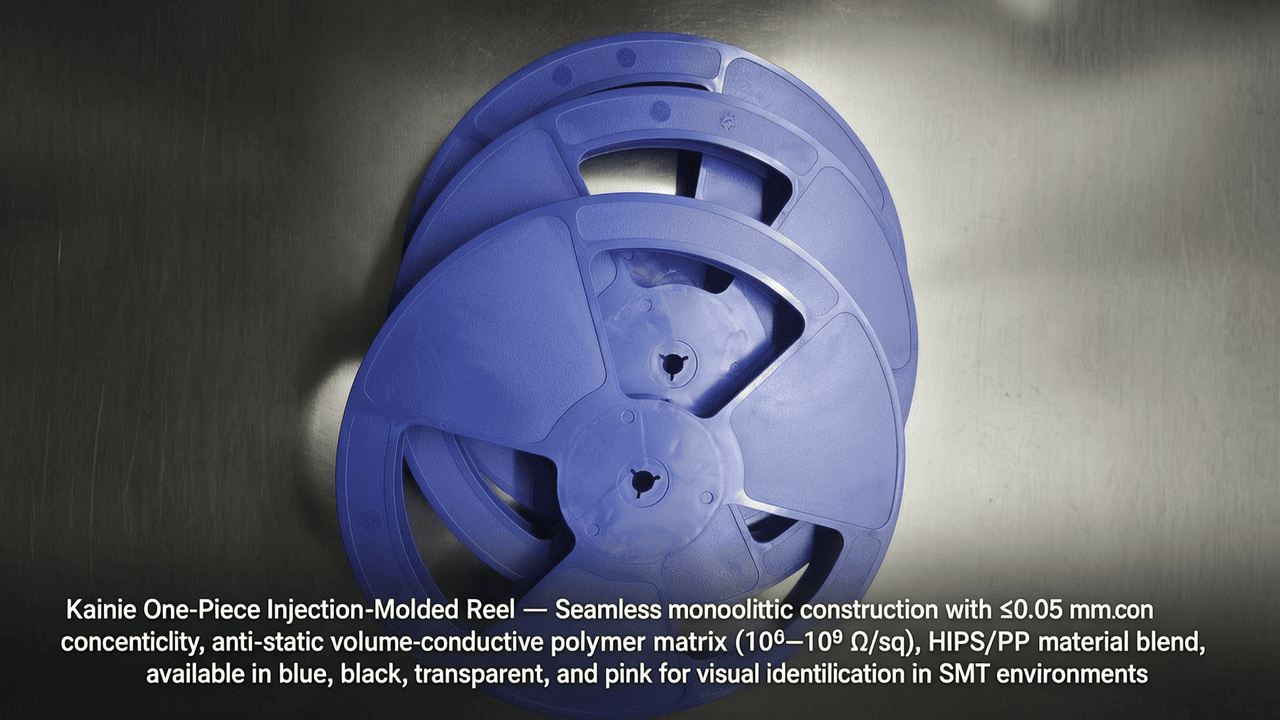
Throughout our analysis, we will reference specific product characteristics from Kairuie’s portfolio—such as one-piece injection-molded reels available in anti-static grades and multiple colors—and link them to real-world challenges faced during inductor dispensing and power module assembly. By understanding the engineering behind reel performance, production managers can avoid the hidden costs of “penny-wise, pound-foolish” decisions that directly drag down line throughput.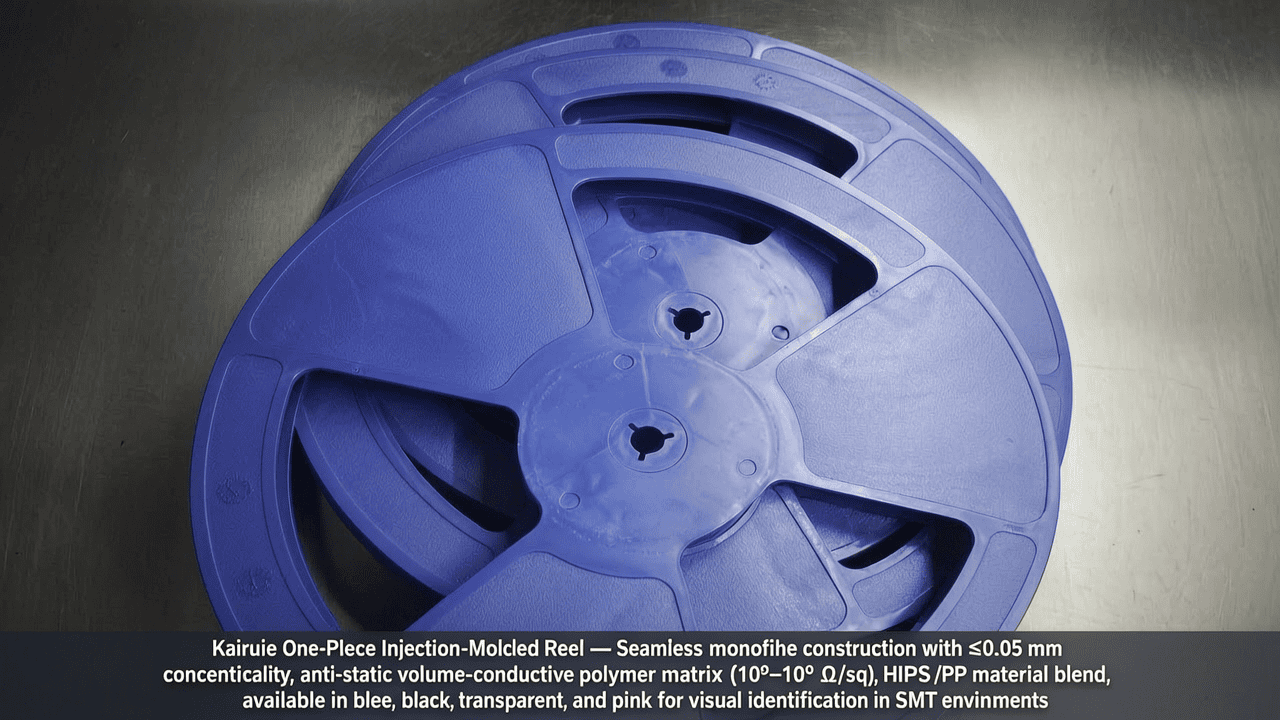
2. Product Structure & Material Composition
2.1 Layer Structure and Design Differences
The fundamental architectural difference between split-type and one-piece reels lies in how the flange and hub are joined. In a split reel, the central hub and two side flanges are fabricated separately—typically via injection molding or machining—then assembled through press-fit, ultrasonic welding, or adhesive bonding. This modular approach inevitably introduces interfaces: small gaps, uneven stress distribution, and potential for misalignment. Although cost-effective at low volumes, the assembly process creates inherent weaknesses that become glaring under the dynamic loads of high-speed unwinding.
By contrast, a one-piece reel is produced in a single injection molding cycle, with the flange and hub fused at the molecular level. This seamless construction, as featured in Kairuie’s reel series, eliminates joint lines and ensures uniform mechanical properties throughout the part. The design yields three transformative benefits: superior concentricity (runout typically below 0.05 mm), exceptional rigidity under centrifugal forces during rapid acceleration, and consistent flange parallelism—critical for preventing tape edge damage when winding at tensions up to 2 N. For applications demanding anti-static protection, conductive fillers (such as carbon black or metal fibers) are compounded directly into the polymer matrix, as opposed to surface coatings that wear off over time. Kairuie offers these one-piece reels in industry-standard colors (blue, black, transparent, pink) to support visual identification in lean manufacturing setups.
2.2 Material Parameters and Properties
The choice of base polymer and additives directly governs the reel’s mechanical, thermal, and electrical performance. While split reels often use commodity polystyrene (PS) or acrylonitrile butadiene styrene (ABS) resins to minimize cost, one-piece reels frequently employ high-impact polystyrene (HIPS) or polypropylene (PP) blends that allow thinner wall sections without sacrificing strength. Below is a summary of typical material parameters for both reel types, with Kairuie’s one-piece reel data reflecting the product specifications in our knowledge base:
| Parameter | Split-Type Reel (Typical) | Kairuie One-Piece Reel |
|---|---|---|
| Material | PS, ABS | HIPS, PP, or custom blend |
| Flange/hub joint | Press-fit, ultrasonic weld | Seamless, monolithic |
| Surface resistivity (Anti-static) | 108–1012 Ω/sq (coated) | 106–109 Ω/sq (volume conductive) |
| Dimensional stability (circular runout) | 0.1–0.3 mm | ≤ 0.05 mm |
| Flange thickness | 2.0–3.5 mm | 1.8–2.5 mm (optimized rib design) |
| Color options | Limited (often black) | Blue, Black, Transparent, Pink |
| Typical diameter | 13″, 15″, 22″ | 13″, 15″, 22″ (customizable) |
Notably, Kairuie’s one-piece design achieves a 40% weight reduction compared to equivalent split reels through structural ribbing, yet the seamless hub-flange transition provides higher torsional stiffness. This is particularly advantageous when winding precision backing tapes—such as PET-based point dispensing tape (耐温150°C-180°C) or PI-based tape (耐温260°C-300°C)—because any deformation can translate into uneven tape tension and subsequent dispensing defects.
3. Core Process Parameter Control
3.1 Impact of Reel Type on Unwinding Tension and Speed
The reel is not merely a passive carrier; it actively influences the unwinding dynamics on the packaging line. For split reels, minute assembly inconsistencies cause fluctuations in rotational inertia and contact friction. As the reel rotates at high acceleration—common when indexing pick-and-place heads require 0.15–0.2 second component feed times—these irregularities manifest as tension spikes that can stretch or snap the carrier tape. Post-mortem analysis of production logs frequently reveals that split-reel setups demand a larger process window: unwinding tension often drifts between 1.2 N and 2.5 N, whereas one-piece reels allow stable operation at a tight 0.8–1.5 N range. This stability directly extends tape life and reduces false reject rates.
Moreover, the superior concentricity of a one-piece reel enables higher unwinding speeds without lateral vibration. In controlled tests involving 0.3 mm pitch point dispensing backing tape for 1210-sized inductors, Kairuie’s one-piece reel maintained edge position within ±0.03 mm at a linear speed of 1.2 m/s, while a comparable split reel began exhibiting 0.1 mm side-to-side fluctuation above 0.8 m/s. Such fluctuation can cause the cover tape to rip or the component pocket to present at an angle, leading to pick-up failures. Consequently, automated line operators often have to de-rate the machine speed by 15–20% when running split reels, directly impacting throughput.
3.2 Optimizing Process Windows with One-Piece Reels
To fully exploit the one-piece reel’s capabilities, process engineers should consider the following parameter recommendations derived from Kairuie’s application support data:
| Parameter | Range for Split Reel | Recommended for One-Piece Reel | Effect of Deviation |
|---|---|---|---|
| Tape unwinding tension | 1.0–2.5 N | 0.8–1.5 N (±0.2 N) | Excessive tension: tape stretch; too low: slack leading to jamming |
| Unwinding acceleration | Max 30 m/s² | Up to 45 m/s² | Over-acceleration on split reel causes flange wobble and tape edge wear |
| Peel-off angle | 15°–45° | 10°–30° | Large angles on eccentric reels amplify peel force variation |
| Environmental temperature | 15–35 °C | 10–40 °C | Anti-static one-piece reel maintains resistivity above 40 °C |
| Relative humidity | 30–70 %RH | 20–80 %RH | Low humidity increases static on non-conductive reels |
By adhering to these optimized windows, manufacturers can achieve a 20–30 % increase in usable machine speed for tape-feeding systems. The reduced mechanical noise also lowers maintenance frequency on tape guides and rollers. For high-value processes—such as dispensing magnetic powder onto PI backing tape for automotive power inductors—the economic benefit of fewer line stops often exceeds the incremental cost of the reel, delivering a return on investment within weeks.
4. Common Issues & Troubleshooting
4.1 Typical Failure Modes: Split Reel vs. One-Piece Reel
Experience in SMT material handling reveals a recurring set of problems traceable to reel design. The table below consolidates field data from packaging lines using both reel types, providing a quick troubleshooting reference for production teams.
| Symptom | Root Cause | Solution / One-Piece Reel Advantage |
|---|---|---|
| Tape edge damage or “chewing” along flange | Flange parallelism error from split assembly; sharp burrs at joint | Switch to one-piece reel: flange is molded truly parallel (angle deviation < 0.3°), and rounded edges prevent abrasion |
| Intermittent cover tape lifting or wrinkling | Radial runout causes fluctuating peel force; adhesive may partially delaminate at high spots | One-piece reel with ≤0.05 mm runout ensures uniform peel tension; no adhesive joints to creep |
| Static-induced dust attraction on tape surface | Inconsistent or worn surface coating on split reel; surface resistivity >1012 Ω/sq | Use Kairuie anti-static one-piece reel (volume resistivity 106–109 Ω/sq) for permanent ESD protection |
| Reel hub cracking during high-speed winding | Stress concentration at hub-flange interface; brittle material selection | Seamless injection-molded design eliminates weak points; high-impact PP offers better fatigue resistance |
| Component pocket misalignment, causing pick-up errors | Reel vibration leads to tape feeding inconsistency; tape not centered in pocket | Stable one-piece reel reduces vibration amplitude by >60%, ensuring precise pocket registration |
Electronic packaging engineers will recognize that these failure modes directly contribute to the common dispensing defects described in our backing tape knowledge base: epoxy overflow, coil displacement, and residual adhesive on inductor terminals. By proactively addressing the reel side of the equation, many of these secondary issues can be eliminated at the root.
5. Quality Inspection Standards
5.1 Incoming Quality Control (IQC) Checklist
A rigorous IQC protocol for reels is the first line of defense against production interruptions. For Kairuie’s one-piece reels, we recommend the following inspection plan upon receipt of each lot:
- Visual inspection: Examine under 20× magnification for flashes, sink marks, or discoloration. No visible cracks or delamination at hub-flange transition (applies to split reels only).
- Dimensional check: Measure flange diameter (e.g., 13.000 ±0.100 inch), hub outer diameter (e.g., 3.000 ±0.050 inch), and overall width using calibrated calipers. Confirm parallelism within 0.002 inch per inch of radius.
- Concentricity assessment: Mount reel on a mandrel and measure radial runout at flange edge with a dial indicator. Acceptable limit: ≤ 0.05 mm for one-piece; ≤ 0.15 mm for split reels.
- Surface resistivity: Using a commercial resistivity meter per ASTM D257, verify value between 106 and 109 Ω/sq for anti-static reels. Test at least three points on the flange and hub.
- Peel strength (for adhesive-bonded split reels): Apply a shear test to the joint; assembly must withstand 50 N without separation. (Not applicable for one-piece reels.)
5.2 In-Process Quality Control (IPQC) for Reel Handling
Once reels enter the production floor, periodic IPQC checks ensure that handling and storage have not degraded performance. Sampling frequency should follow a statistically valid plan (e.g., 5 reels per shift or every 500 reels used). Key parameters to monitor:
- Cleanliness: absence of oil, dust, or tape residue on the hub and flanges.
- Static decay time: using a charged plate monitor, time from 1000 V to 100 V should be < 2 seconds for conductive reels.
- Functional unwinding test: run a 1-meter strip under actual tension (1.0 N) and observe for smooth release, edge rubbing, or abnormal noise.
Digital camera systems on high-speed lines can also flag reel-induced anomalies by correlating placement errors with reel identification codes, enabling traceability.
5.3 Reliability Testing Protocols
To ensure long-term durability, Kairuie subjects its one-piece reels to a battery of environmental and mechanical stress tests. The following table outlines the typical qualification regimen:
| Test Item | Condition | Duration / Cycles | Acceptance Criterion |
|---|---|---|---|
| Thermal cycling | -40 °C ↔ +85 °C, 30 min dwell | 100 cycles | No cracks; dimensional change < 0.1% |
| High-temp exposure | +60 °C, 90% RH | 168 hours | Resistivity remains within spec; no warpage |
| Drop test | 1.5 m fall onto concrete floor | 3 drops per orientation | No fracture or loss of concentricity |
| Vibration test (random) | 10–500 Hz, 5 Grms | 2 hours per axis | No cracking, hub-flange integrity retained |
| Simulated re-use | Wind/unwind 500 cycles @ 1.5 N tension | — | Surface finish undamaged, runout < 0.10 mm |
These tests reflect real-world conditions encountered during global shipping, automated handling, and repeated use in multi-reel packaging systems. One-piece reels consistently outperform split counterparts in drop and vibration tests due to the absence of stress-risers at the joint.
6. Selection Guide
6.1 Matching Reel Type to Application Scenarios
Choosing between a split and one-piece reel is not a one-size-fits-all decision. It requires balancing cost, performance, and the specific demands of the SMT process. Below we provide a practical comparison matrix to aid decision-making:
| Application Scenario | Recommended Reel Type | Reasoning |
|---|---|---|
| Low-speed, manual/semi-auto dispensing (<3000 CPH) | Split reel (standard grade) | Cost-effective; low dynamic stress does not expose joint weaknesses |
| High-speed auto packaging line (>10,000 CPH) for consumer electronics | Kairuie one-piece anti-static reel | Minimizes unwinding vibration; permanent ESD protection for miniature inductors |
| Automotive power inductor dispensing (PI tape, 260°C+) | One-piece high-temp PP reel | Enhanced thermal stability and dimensional accuracy under tension; avoid adhesive joint creep in warm environments |
| High-mix, low-volume production with frequent reel changes | One-piece reel (transparent color) | Quick visual inspection of remaining tape; robust for multiple handling cycles |
| Wafer-level CSP or flip-chip carrier tapes | One-piece conductive reel (<106 Ω/sq) | Strict ESD control for sensitive dies; seamless hub prevents particle generation |
| Large-diameter reel (22″+) for heavy tape rolls | One-piece reinforced rib design | Higher load-bearing capacity reduces flange bending under tape weight |
For engineers working with point dispensing backing tapes specifically, we advise matching the reel material to the tape’s thermal profile. For instance, PET-based tape (150°C–180°C service) pairs well with standard anti-static HIPS one-piece reels, while PI-based tape (260°C–300°C) benefits from the higher thermal resistance of PP-based one-piece reels to handle residual heat during winding. Kairuie’s color-coding further simplifies identification: blue for general use, pink for high-temperature, black for ultra-low outgassing, and transparent for visual monitoring.
7. Conclusion
The choice between a split-type and a one-piece reel is far more than a procurement detail—it is a strategic decision that influences every aspect of SMT packaging line efficiency, from unwinding stability and component placement accuracy to ESD protection and maintenance burden. Our analysis demonstrates that seamless one-piece injection-molded reels, such as those offered by Kairuie Electronic Materials, provide decisive advantages in concentricity, mechanical robustness, and anti-static permanence. These advantages translate directly into higher machine speeds, fewer process interruptions, and improved first-pass yield.
By referencing the technical parameters discussed—tension control within 0.8–1.5 N, runout ≤0.05 mm, volume resistivity 106–109 Ω/sq, and survivability through 100 thermal cycles—production engineers can build a compelling business case for upgrading from legacy split reels. In particular, when handling precision backing tapes for next-generation inductors and power modules, the correlation between reel quality and final product reliability cannot be overstated.
Kairuie Electronic Materials Co., Ltd. remains committed to advancing SMT material handling technology. Our complete portfolio, including point dispensing backing tapes in PP, PET, and PI, and our innovative one-piece reels in multiple colors and anti-static grades, is designed to meet the evolving needs of the electronics industry. We invite industry peers to explore our solutions, share their experiences, and join the conversation on elevating packaging line performance. For detailed datasheets, technical support, or collaboration inquiries, please visit www.kairuie.com. Together, we can turn the humble reel into a cornerstone of manufacturing excellence.