凯瑞尔电子材料
1. Introduction
In the rapidly evolving landscape of Surface Mount Technology (SMT), the packaging of electronic components is not merely a final step; it is a critical determinant of supply chain efficiency and assembly quality. As components become smaller and more sensitive—transitioning from 0402 to 01005 chip sizes—the demand for precision in Carrier Tape Packaging Systems has never been higher. For manufacturers like Kairuie Electronic Materials Co., Ltd., understanding the symbiotic relationship between the packaging machinery and the packaging materials is paramount.
This technical article addresses the comprehensive question: How do you customize a carrier tape packaging machine? Moving beyond basic operation, we analyze the entire workflow from the input of raw components via vibratory bowl feeders to the final traceability step of inkjet coding. By examining the interplay between mechanical engineering parameters and material properties—specifically Polystyrene (PS) and Polyethylene Terephthalate (PET) based carrier systems—we aim to provide engineers with a blueprint for optimizing their SMT packaging lines. Whether you are dealing with integrated circuits (ICs), connectors, or discrete components, the customization of your packaging line dictates the integrity of the final reel.
2. Product Structure & Material Composition
To effectively customize a packaging machine, one must first understand the physical properties of the media being processed. At Kairuie, our carrier tape and cover tape solutions are engineered with specific structural layers designed to withstand the rigors of high-speed automated packaging.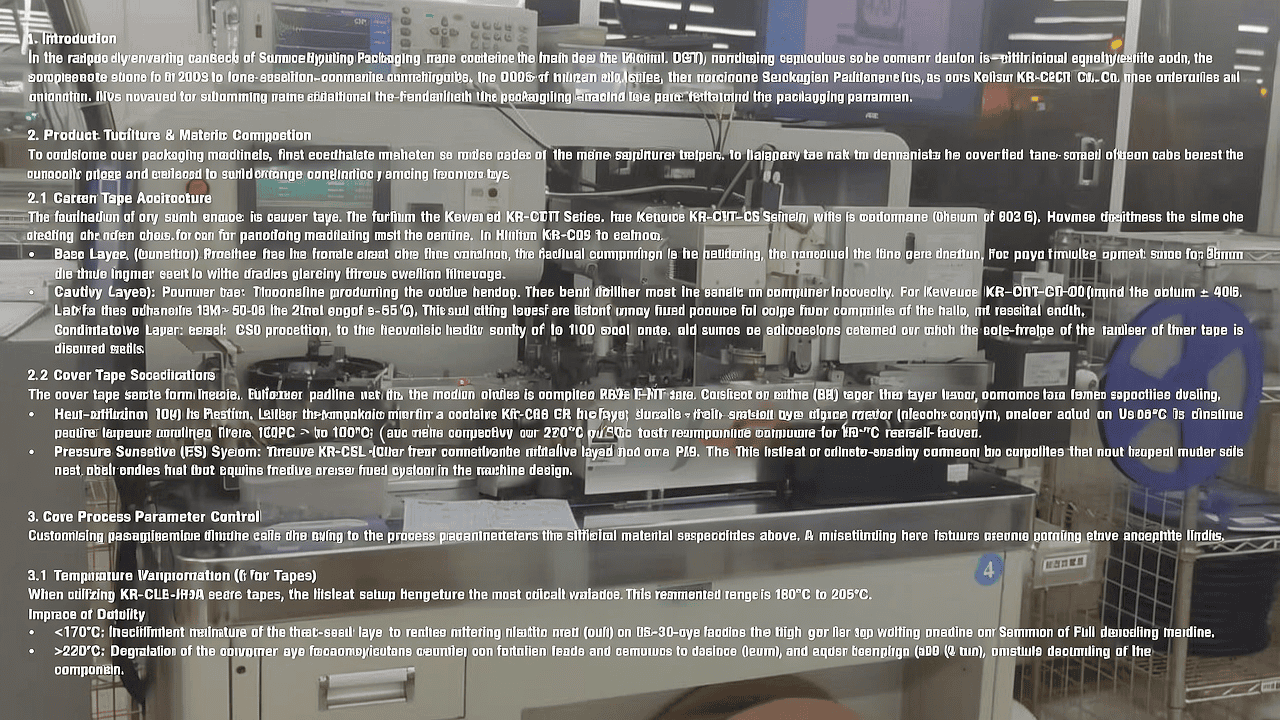
2.1 Carrier Tape Architecture
The foundation of any SMT package is the carrier tape. Our flagship product, the Kairuie KR-CT-PS Series, utilizes high-impact Polystyrene (PS) for its dimensional stability and cost-effectiveness. However, for applications requiring higher thermal resistance or mechanical strength, we recommend the Kairuie KR-CT-PET Series.
The structure typically comprises three distinct layers:
- Base Layer (Substrate): Provides the mechanical skeleton. For the KR-CT-PS-08W (8mm width, 2mm pitch), the base thickness is maintained at 0.35mm ± 0.03mm. This thickness is crucial for the sprocket holes to engage correctly with the packaging machine’s drive gears without skipping.
- Cavity (Pocket): Formed via precision thermoforming or cold stamping. The pocket geometry must match the component body exactly. For example, our KR-CT-PET-12S (12mm, 4mm pitch) features pockets with a draft angle of 40° ± 5° to facilitate smooth component exit during Pick-and-Place operations.
- Conductive Layer: Essential for ESD protection. Kairuie tapes generally feature a surface resistivity of 10^4 to 10^9 ohms/sq, ensuring that static charges generated during the high-speed friction of the vibratory feeder are dissipated safely.
2.2 Cover Tape Specifications
The cover tape seals the system. In a customized packaging line, the choice between Heat-Activated (HA) and Pressure-Sensitive (PS) cover tapes dictates the machine’s heating and pressure module configuration.
- Heat-Activated (HA) System: Utilizes a composite film like the Kairuie KR-CPL-HA-120. This consists of a 50µm PET base layer, a 15µm heat-seal layer (often acid copolymer), and an anti-static topcoat. It requires precise temperature control (typically 160°C – 210°C) to bond with the PS carrier tape flanges.
- Pressure-Sensitive (PS) System: The Kairuie KR-CPL-PS-100 uses an acrylic adhesive layer coated onto a PET backing. This is ideal for moisture-sensitive components that cannot tolerate heat-seal temperatures but requires a robust pressure roller system in the machine design.
3. Core Process Parameter Control
Customizing a packaging machine involves fine-tuning the process parameters to match the specific material specifications mentioned above. A misalignment here leads to scrap rates soaring above acceptable limits.
3.1 Temperature Management (For HA Tapes)
When utilizing KR-CPL-HA series tapes, the heat-seal head temperature is the most critical variable. The recommended range is 180°C to 205°C.
Impact on Quality:
- <170°C: Insufficient melting of the heat-seal layer results in low peel strength (< 5N), causing the tape to pop open during high-speed unwinding on a Samsung or Fuji placement machine.
- >220°C: Degradation of the polymer layer creates “carbonization” residue on the sealer head and causes excessive peel strength (> 20N), potentially damaging the component during de-taping.
3.2 Pressure and Dwell Time
Pressure is measured in bar or psi along the sealing platen. For standard 8mm tape, a linear pressure of 20-30 N/cm is optimal. The dwell time (contact time) should be set between 30ms and 80ms, depending on the line speed (measured in cycles per minute, CPM).
Optimization Tip: If running a high-speed line (>1000 CPM), we recommend increasing the temperature slightly (+10°C) and reducing dwell time to prevent heat transfer to the component body inside the pocket, which could damage passive components.
3.3 Tension Control
Unwinding and rewinding tension must be synchronized. For the KR-CT-PS series, the elongation rate is low, so tension fluctuations cause immediate tracking errors. We advise setting rewind torque to maintain a constant web tension of 0.8N to 1.2N for 12mm tapes.
4. Common Issues & Troubleshooting
Even with perfect customization, operational variances occur. Below is a troubleshooting guide derived from field data involving Kairuie materials.