凯瑞尔电子材料
1. Introduction
In the rapidly evolving landscape of Surface Mount Technology (SMT), the margin for error has vanished. As electronic components shrink towards microscopic dimensions—such as 01005 chip resistors and fine-pitch QFN packages—the packaging materials tasked with protecting and transporting them face unprecedented engineering challenges. At the heart of this supply chain lies the Carrier Tape, often overlooked yet critically responsible for component integrity from the production line to the placement nozzle.
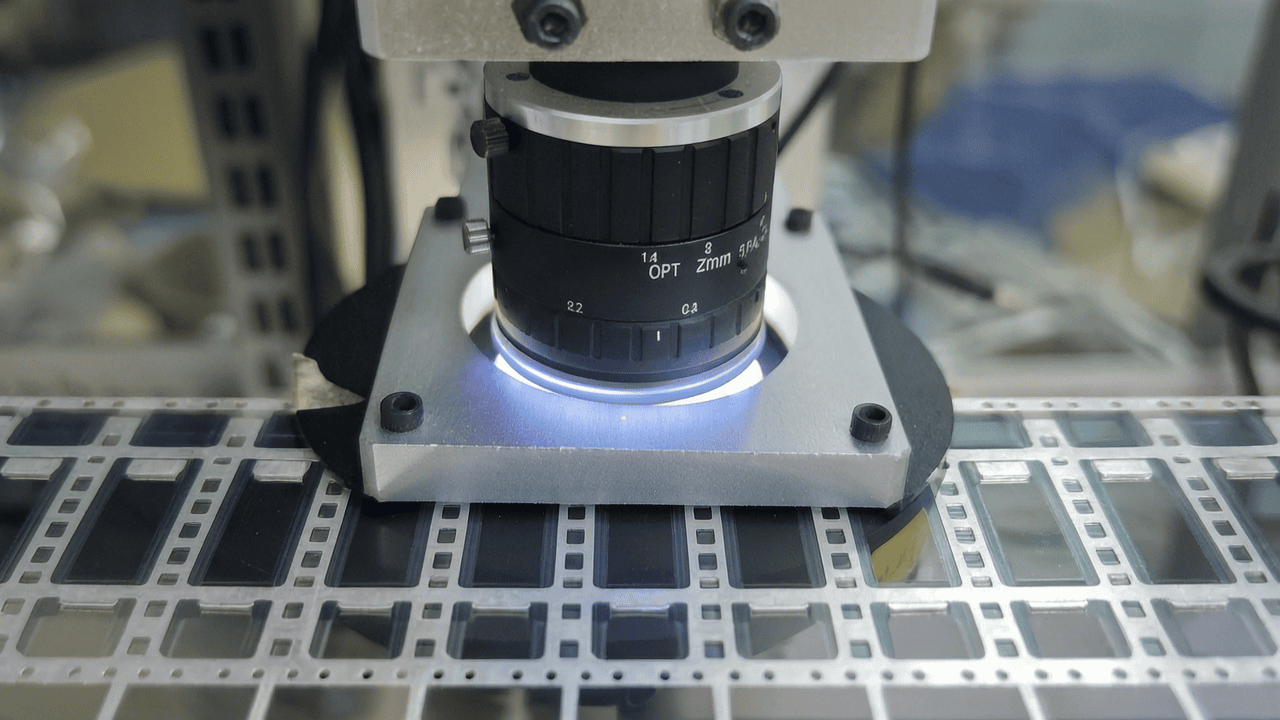
For manufacturers like Kairuie Electronic Materials Co., Ltd., the definition of quality has shifted from simple functionality to extreme precision. A deviation of even 0.1mm in pocket positioning can result in pickup errors, causing costly downtime on high-speed Samsung or Fuji placement machines. To combat this, the industry is turning to intelligent manufacturing processes centered on 100% CCD (Charge-Coupled Device) Visual Full Inspection.
This article delves into the technical core of modern SMT packaging, analyzing how Kairuie leverages high-resolution optical inspection to maintain a strict baseline of ±0.05mm dimensional tolerance. We will explore the structural composition of advanced carrier tapes, the thermodynamic nuances of the forming process, and the rigorous quality protocols that ensure every meter of tape delivered meets the highest global standards.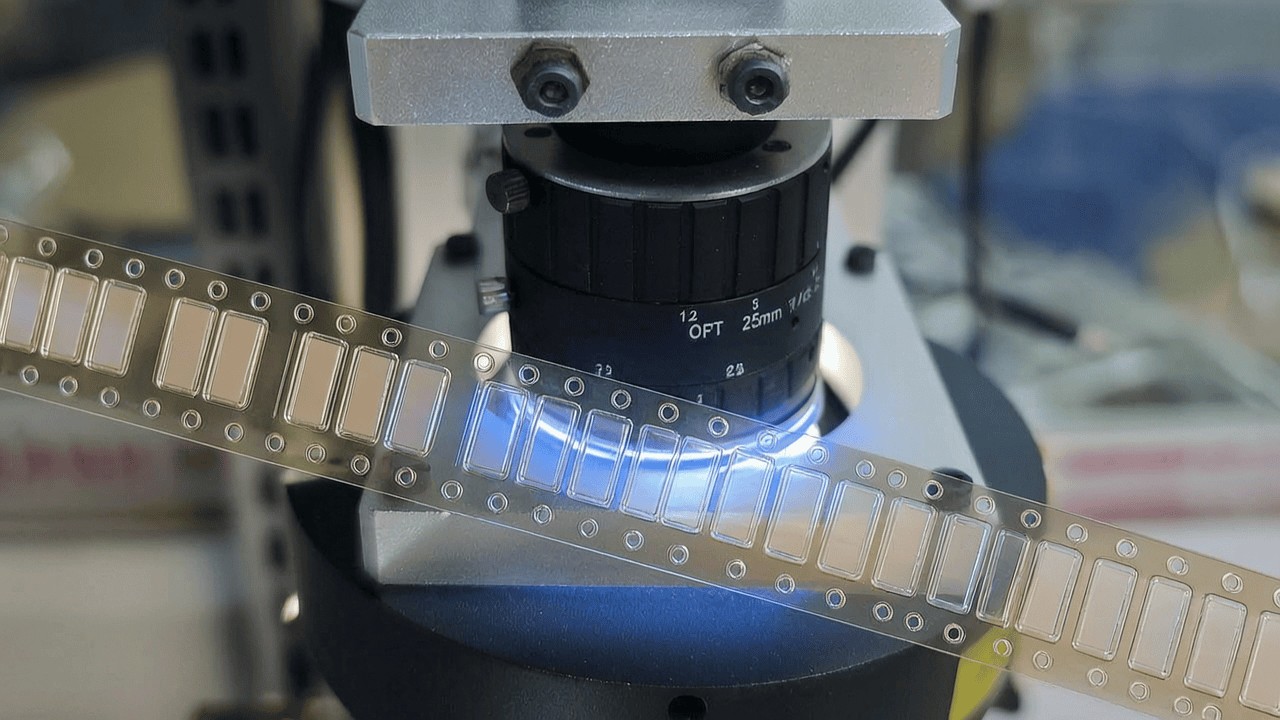
2. Product Structure & Material Composition
The ability to hold a ±0.05mm tolerance is not merely a function of the inspection equipment; it begins fundamentally with the material properties and structural design of the carrier tape itself. Kairuie’s product portfolio is engineered to balance mechanical rigidity with thermoformability, ensuring that once formed, the pockets do not relax or deform beyond acceptable limits.
2.1 Layer Architecture and Material Science
Kairuie’s flagship carrier tapes, such as the KR-PS-EC (Conductive Polystyrene) series and the KR-PET-HS (High-Stiffness Polyester) series, utilize a multi-layer extrusion or coating technology designed for stability.
- Base Layer (Substrate): The foundation of the tape. For PS tapes (e.g., Model KR-PS-0804), we use high-purity polystyrene with a thickness typically ranging from 0.18mm to 0.40mm. This material offers excellent thermoforming characteristics, allowing for sharp pocket corners essential for small components. For applications requiring higher temperature resistance (such as lead-free reflow environments), our PET-based tapes (Model KR-PET-1208) provide a melting point exceeding 240°C.
- Functional Treatment Layer: To prevent Electrostatic Discharge (ESD) damage to sensitive ICs, the surface is treated. Kairuie offers two primary variants: Anti-Static (AS) with surface resistivity of $10^{9}$ to $10^{11} \Omega/sq$, and Electro-Conductive (EC) with surface resistivity of $10^{3}$ to $10^{5} \Omega/sq$. The uniformity of this layer is critical; any variation can interfere with the CCD camera’s contrast recognition during inspection.
2.2 Key Dimensional Parameters
To achieve compatibility with universal pick-and-place feeders, adherence to standards like EIA-481 is non-negotiable. Our CCD inspection system verifies the following critical parameters on every single pocket:
| Parameter | Specification | Tolerance (Kairuie Standard) |
|---|---|---|
| Pitch (P) | 2mm, 4mm, 8mm, 12mm, 16mm, 24mm, 32mm, 44mm | ±0.03mm ~ ±0.05mm |
| Pocket Width (W) | Variable by model | ±0.05mm |
| Pocket Depth (D) | Variable by model | ±0.05mm |
| Tape Width | 8mm, 12mm, 16mm, 24mm, 32mm, 44mm | ±0.2mm |
| Sprocket Hole Position | Standard | ±0.05mm |
By controlling the shrinkage rate of the base film to less than 0.2% after thermal exposure, Kairuie ensures that the dimensions captured by the CCD camera at the end of the line remain stable when the customer loads the reel onto their SMT machine.
3. Core Process Parameter Control
The ±0.05mm baseline is forged in the fire of the thermoforming process. Even the most sophisticated camera cannot fix a defect created by poor process control; it can only reject it. Therefore, optimizing the forming window is paramount to maximizing yield while maintaining the “Zero Defect” goal enabled by full inspection.
3.1 Temperature Control: The Thermal Profile
Thermoforming involves heating the plastic sheet until pliable and then using vacuum or air pressure to form it over a mold. For our KR-PS-EC series, the pre-heating zone temperature is strictly controlled between 140°C and 160°C.
If the temperature exceeds 160°C, the material degrades, leading to thinning at the pocket corners (a defect known as “webbing” or excessive stretching), which causes the pocket width to fall below the -0.05mm limit. Conversely, temperatures below 140°C result in “short shots,