凯瑞尔电子材料
1. Introduction
In the realm of Surface Mount Technology (SMT), carrier tapes serve as the backbone for component packaging, ensuring safe transport and precise placement during assembly. With the miniaturization of electronic components and the increasing demand for high-density interconnects, the dimensional accuracy of carrier tapes has become a critical factor. A tolerance of ±0.05mm is now a common requirement for advanced packaging, demanding meticulous design and process control. This article delves into the technical aspects of developing carrier tapes that meet such stringent specifications, covering material composition, process parameters, quality inspection, and selection guidance. We will explore how Kairuie Electronic Materials Co., Ltd. leverages proprietary vision-based carrier tape equipment to achieve and maintain this precision, ensuring reliability and performance in demanding applications.
2. Product Structure & Material Composition
2.1 Layer Structure
Kairuie’s carrier tapes are engineered with a multi-layer structure designed for optimal performance. The base layer is typically made from high-quality polyethylene terephthalate (PET) or polycarbonate (PC), providing mechanical strength and dimensional stability. The adhesive layer, often a pressure-sensitive acrylic or silicone-based adhesive, ensures secure component retention. A top cover tape seals the pockets to protect components from contamination and static discharge. Some advanced products incorporate an anti-static treatment layer to control surface resistivity.
2.2 Key Material Parameters
Kairuie’s carrier tapes are available in various models, each tailored to specific applications. For instance, the KR-3000 series features a PET thickness of 0.30mm ±0.02mm, with a peel strength of 0.2-0.5 N/mm and surface resistivity of 10^6-10^9 ohms/sq. The adhesive type is silicone-based for high-temperature resistance up to 150°C. Another model, KR-4500, offers a thicker PET base of 0.45mm for larger components, with similar electrical properties. These parameters are critical for maintaining pocket dimensions and ensuring reliable component handling.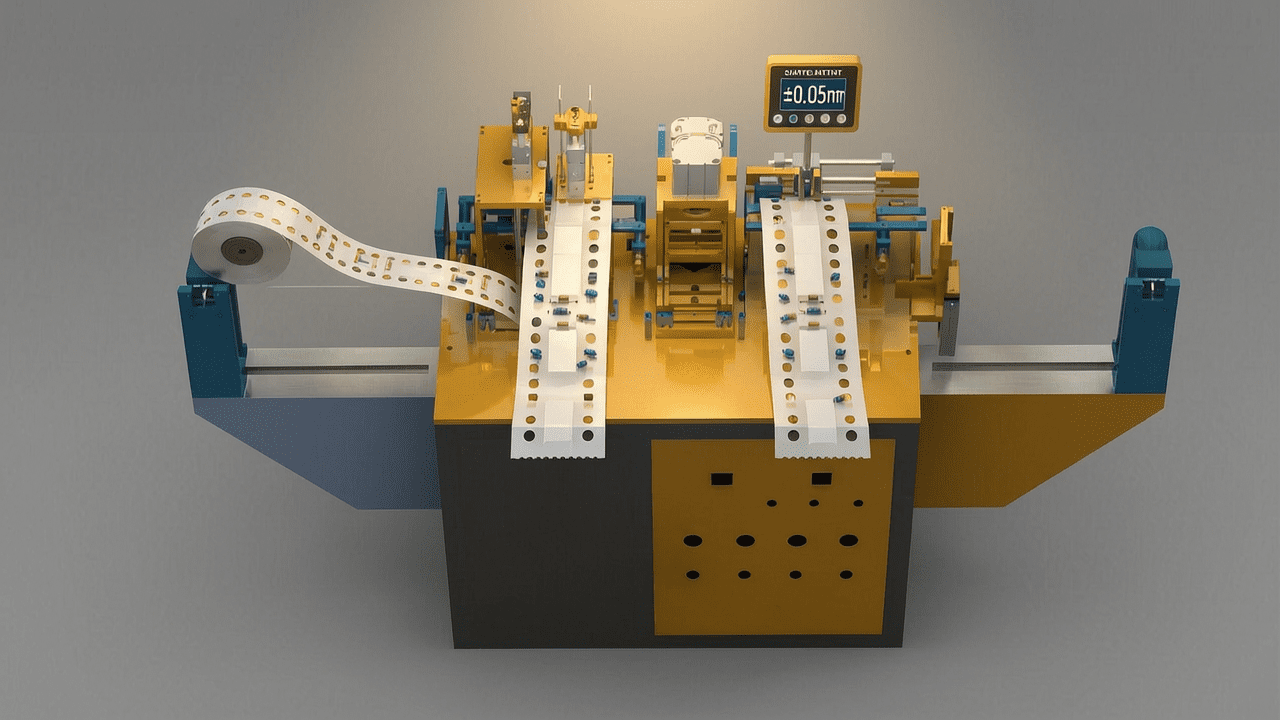
2.3 Precision Design for ±0.05mm Tolerance
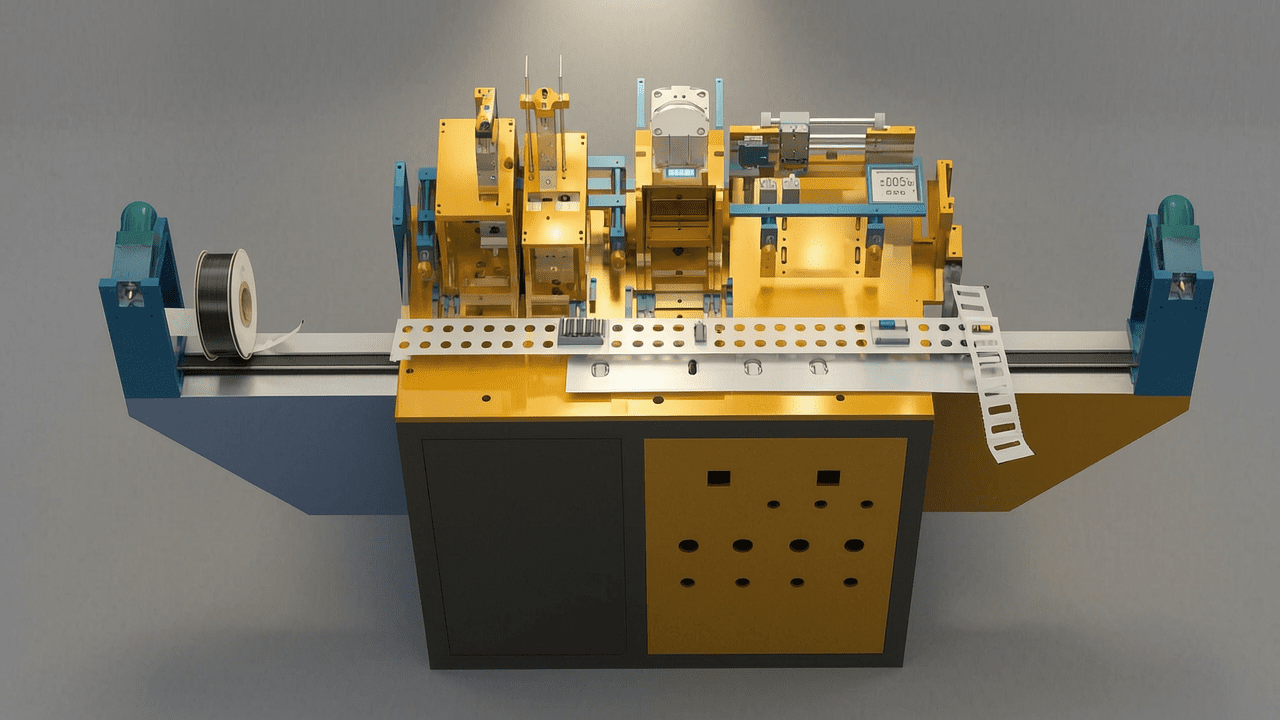
To achieve ±0.05mm tolerance, Kairuie employs vision-based carrier tape equipment that integrates high-resolution cameras and real-time feedback systems. The equipment inspects pocket dimensions, sprocket hole positions, and overall tape width during production. Any deviation triggers automatic adjustments, ensuring consistent accuracy. This design eliminates human error and compensates for material variability, such as PET shrinkage or adhesive thickness fluctuations.
3. Core Process Parameter Control
3.1 Temperature, Pressure, and Time
The lamination process is critical for achieving precise pocket formation. For Kairuie’s KR-3000 series, the recommended temperature range is 120-140°C, with a pressure of 0.3-0.5 MPa and a dwell time of 1-2 seconds. These parameters ensure proper adhesive flow without deforming the PET base. For the KR-4500 series, slightly higher temperatures (130-150°C) are recommended to accommodate the thicker material.
3.2 Impact on Quality
Temperature directly affects adhesive viscosity and bond strength. Too low a temperature results in weak adhesion, leading to component dislodgment. Excessive temperature can cause PET shrinkage, altering pocket dimensions. Pressure must be uniform to avoid uneven pocket depths. Time controls the extent of adhesive curing; insufficient time yields incomplete bonding, while excessive time may degrade the adhesive. Kairuie’s vision system monitors these parameters in real-time, adjusting them dynamically to maintain tolerance.
3.3 Process Window Optimization
To optimize the process window, Kairuie recommends starting at the midpoint of the temperature range (130°C) and adjusting based on peel strength tests. A peel strength of 0.3 N/mm is ideal for most components. If pockets are too deep, reduce pressure or temperature; if too shallow, increase them. The vision system provides immediate feedback, allowing rapid iteration. Statistical process control (SPC) charts are used to track variations and predict drift.
4. Common Issues & Troubleshooting
| Symptom | Root Cause | Solution |
|---|---|---|
| Pocket dimensions out of tolerance (±0.05mm) | PET shrinkage due to excessive temperature or inconsistent cooling | Reduce lamination temperature by 5-10°C; ensure uniform cooling rate; verify PET batch consistency |
| Components not retained securely | Insufficient peel strength due to low temperature or pressure | Increase temperature by 5°C or pressure by 0.1 MPa; check adhesive shelf life |
| Cover tape lifts during handling | Adhesive contamination or improper sealing | Clean sealing rollers; increase sealing pressure; verify cover tape compatibility |
| Static discharge damage to components | Surface resistivity above 10^9 ohms/sq | Apply anti-static treatment; increase humidity in production area; use conductive cover tape |
| Sprocket hole misalignment | Tooling wear or improper indexing | Inspect and replace tooling; recalibrate vision system; adjust feed rate |
5. Quality Inspection Standards
5.1 Incoming Quality Control (IQC)
IQC involves visual inspection of raw materials for defects such as scratches, contamination, or dimensional anomalies. PET thickness is measured using a micrometer at five points per roll, ensuring ±0.02mm tolerance. Peel strength is tested with a 90-degree peel test at 300 mm/min, accepting values between 0.2-0.5 N/mm. Sprocket hole pitch is verified with an optical comparator to within ±0.05mm.
5.2 In-Process Quality Control (IPQC)
During production, samples are taken every 30 minutes for dimensional checks. Pocket width, length, and depth are measured using a vision system with 0.01mm resolution. Acceptance criteria include: pocket dimensions within ±0.05mm of nominal, sprocket hole position within ±0.1mm, and peel strength within specified range. Any deviation triggers an immediate process adjustment.
5.3 Reliability Testing
Reliability tests simulate real-world conditions. Aging tests at 85°C/85%RH for 168 hours assess adhesive stability. High/low temperature cycles (-40°C to +125°C, 100 cycles) test material fatigue. Transportation simulation involves vibration (10-500 Hz, 1.5g) and drop tests (1m height). After testing, pocket dimensions must remain within ±0.05mm, and peel strength must not degrade more than 20%.
6. Selection Guide
| Component Type | Recommended Product | Key Features |
|---|---|---|
| Small passive components (0402, 0603) | KR-2000 series | 0.20mm PET thickness, anti-static, ±0.05mm tolerance |
| Medium ICs (SOIC, QFP) | KR-3000 series | 0.30mm PET, high-temperature adhesive (150°C), ±0.05mm |
| Large connectors, shielding | KR-4500 series | 0.45mm PET, reinforced adhesive, ±0.05mm |
| High-reliability automotive | KR-5000 series | PC base, silicone adhesive, 0.50mm thick, ±0.05mm |
For applications requiring ultra-precision, such as MEMS or optical sensors, Kairuie offers custom solutions with tolerance down to ±0.03mm, leveraging advanced vision control.
7. Conclusion
Carrier tapes with ±0.05mm tolerance are essential for modern SMT packaging, enabling reliable component placement and reducing assembly defects. Kairuie Electronic Materials Co., Ltd. has developed proprietary vision-based carrier tape equipment that achieves this precision through real-time monitoring and adaptive control. By understanding material composition, optimizing process parameters, and adhering to rigorous quality standards, manufacturers can ensure consistent performance. Kairuie’s commitment to innovation and quality is reflected in its comprehensive product range, from standard tapes to custom solutions. For more information, visit www.kairuie.com. We invite industry peers to exchange ideas and collaborate on advancing packaging technology.