凯瑞尔电子材料
1. Introduction
In the realm of Surface Mount Technology (SMT) packaging, the cover tape plays a critical role in protecting electronic components during storage, transport, and feeding into pick-and-place machines. Among various cover tape types, heat-sealable cover tapes offer superior sealing integrity and are widely used for high-reliability applications. This article focuses on a 500-meter heat-sealable permanent antistatic cover tape, delving into its product structure, process parameters, common issues, quality standards, and selection guidelines. By understanding these technical aspects, engineers can optimize their SMT packaging processes to ensure component protection and assembly efficiency.
2. Product Structure & Material Composition
2.1 Layer Structure
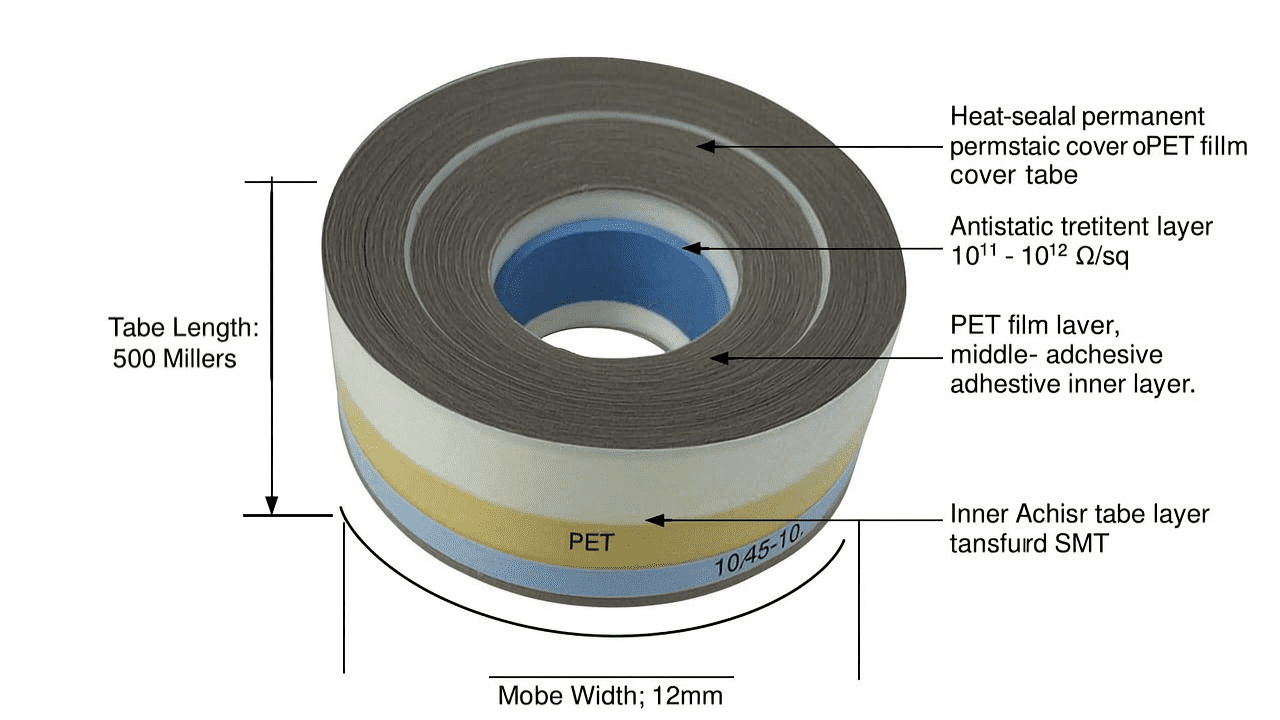
The heat-sealable cover tape typically consists of three layers: a base layer, an adhesive layer, and a treatment layer. The base layer is usually made of polyethylene terephthalate (PET) film, providing mechanical strength and dimensional stability. The adhesive layer is a heat-activated adhesive that bonds to the carrier tape upon application of heat and pressure. The treatment layer, often an antistatic coating, ensures the tape’s surface resistivity falls within the antistatic range (10^11 to 10^12 Ω/sq) to prevent triboelectric charging and electrostatic discharge (ESD) damage to sensitive components.
2.2 Key Material Parameters
| Parameter | Value | Unit |
|---|---|---|
| PET Thickness | 0.045 – 0.050 | mm |
| Total Tape Thickness | 0.060 – 0.070 | mm |
| Adhesive Type | Heat-activated (HAA) | – |
| Surface Resistivity | 10^11 – 10^12 | Ω/sq |
| Peel Strength (at 23°C) | 0.3 – 0.8 | N/10mm |
| Elongation at Break | ≥ 100 | % |
| Tensile Strength | ≥ 100 | MPa |
The specific product model, e.g., KRS-HA500, features a permanent antistatic property that does not rely on humidity, ensuring consistent ESD protection across varying environmental conditions. The adhesive is formulated to provide stable peel strength over time, preventing component loss or feeding issues.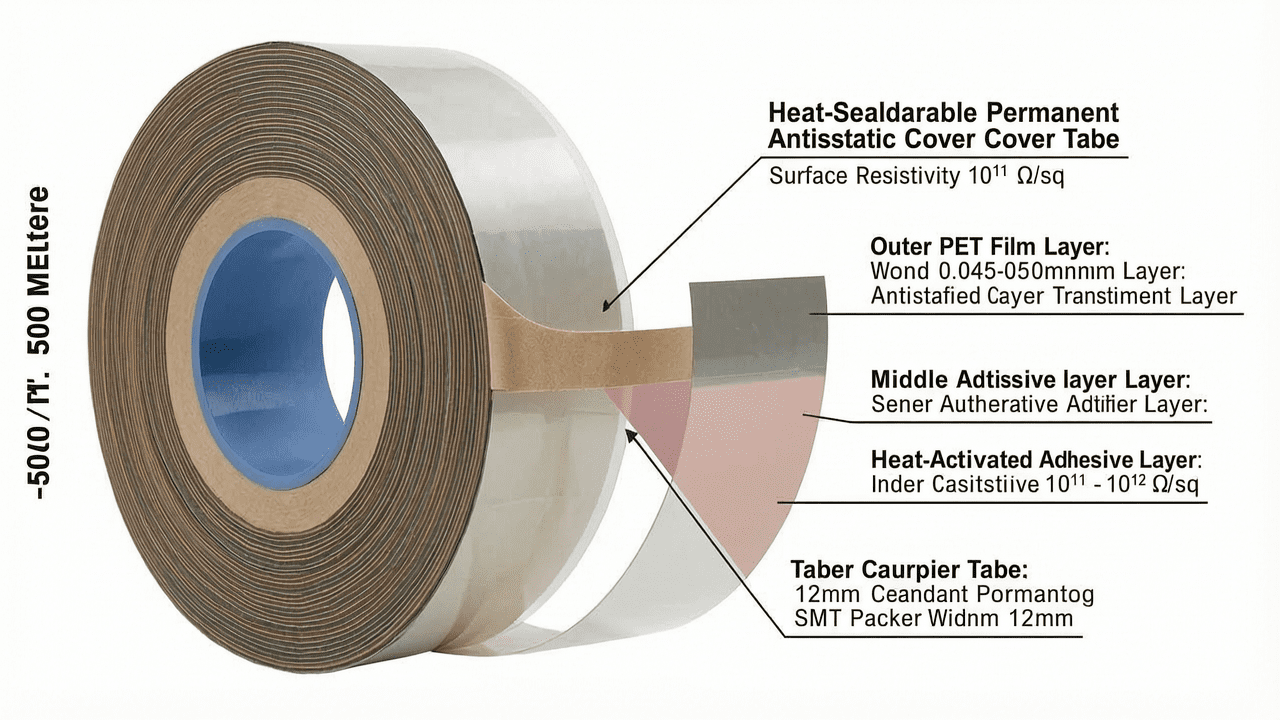
3. Core Process Parameter Control
3.1 Temperature, Pressure, and Time Recommendations
For optimal heat sealing, the following parameter ranges are recommended:
| Parameter | Recommended Range | Unit |
|---|---|---|
| Sealing Temperature | 140 – 180 | °C |
| Sealing Pressure | 0.2 – 0.5 | MPa |
| Dwell Time | 0.5 – 1.5 | seconds |
3.2 Impact on Product Quality
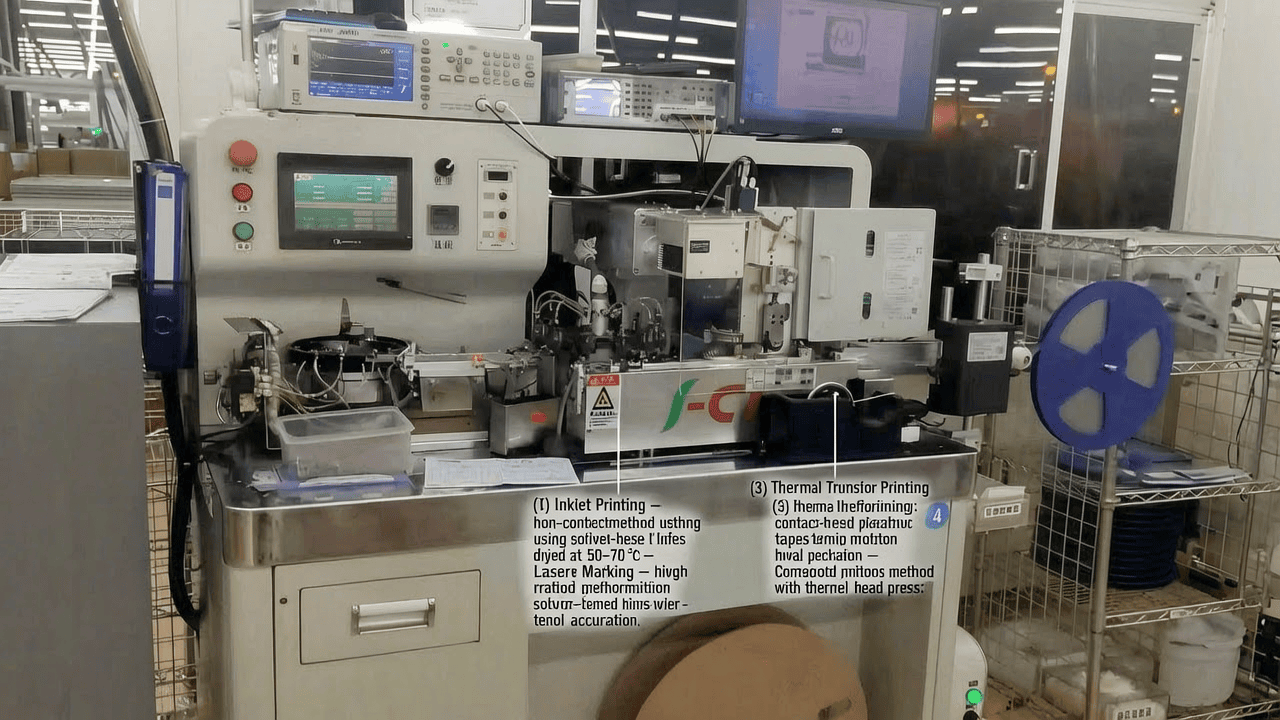
Temperature: Too low results in weak adhesion; too high may cause adhesive degradation or carrier tape deformation. Pressure: Insufficient pressure leads to incomplete bonding; excessive pressure can damage components or cause tape wrinkling. Dwell time: Short time yields weak seals; long time may cause adhesive squeeze-out or thermal damage.
3.3 Process Window Optimization
To achieve a robust seal, start with mid-range values (160°C, 0.35 MPa, 1.0 s) and adjust based on peel strength testing. Use a factorial design of experiments (DOE) to identify the optimal combination for specific carrier tape materials (e.g., polystyrene, polycarbonate). Monitor peel strength regularly to ensure it remains within 0.3-0.8 N/10mm.
4. Common Issues & Troubleshooting
| Symptom | Root Cause | Solution |
|---|---|---|
| Weak peel strength | Low temperature or pressure; short dwell time | Increase temperature to 170°C, pressure to 0.4 MPa, and dwell time to 1.2 s |
| Adhesive residue on carrier tape | Excessive temperature or adhesive degradation | Reduce temperature to 150°C; check adhesive shelf life |
| Tape wrinkling during sealing | High pressure or misalignment | Reduce pressure to 0.25 MPa; ensure proper tape tension and alignment |
| Component shift after sealing | Excessive vibration or improper sealing | Verify sealing parameters; ensure carrier tape pockets are snug |
| Static discharge during peeling | Insufficient antistatic property | Verify surface resistivity; use tape with lower resistivity (<10^11 Ω/sq) |
5. Quality Inspection Standards
5.1 Incoming Quality Control (IQC)
Visual inspection: Check for scratches, contamination, or adhesive streaks. Dimensional measurement: Verify width (8mm, 12mm, etc.) and thickness within tolerances (±0.05mm). Peel strength test: Measure at 23°C, 50% RH using a 180° peel test at 300 mm/min; acceptable range: 0.3-0.8 N/10mm.
5.2 In-Process Quality Control (IPQC)
Sampling frequency: Every 1000 meters or per reel change. Acceptance criteria: Peel strength within specification, no visual defects. Record and track trends for process capability (Cpk > 1.33).
5.3 Reliability Testing
Aging test: 85°C/85% RH for 168 hours; peel strength change < 20%. High/low temperature test: -40°C to 85°C cycling for 100 cycles; no cracking or delamination. Transportation simulation: Vibration test per ISTA 2A; no tape lift-off or component damage.
6. Selection Guide
6.1 Recommendations by Component Type
| Component Type | Recommended Cover Tape | Key Feature |
|---|---|---|
| Passive components (resistors, capacitors) | KRS-HA500 (antistatic) | Cost-effective, permanent antistatic |
| IC components (small outline, QFP) | KRS-HA500 (antistatic) | Low peel strength variation, no residue |
| LEDs and optoelectronics | KRS-HA500 (antistatic) | Transparent base for optical inspection |
| Moisture-sensitive devices (MSD) | KRS-HA500 with moisture barrier | Low moisture vapor transmission rate |
6.2 Application Scenario Comparison
| Scenario | Requirement | Recommended Model | Remarks |
|---|---|---|---|
| High-speed placement | Consistent peel force | KRS-HA500 | Peel strength 0.4-0.6 N/10mm |
| Harsh environment (high temp/humidity) | Reliable sealing | KRS-HA500 | Passes 85/85 aging test |
| ESD-sensitive components | Low surface resistivity | KRS-HA500 | Surface resistivity < 10^11 Ω/sq |
7. Conclusion
The heat-sealable permanent antistatic cover tape, exemplified by the KRS-HA500 model, offers a reliable and cost-effective solution for SMT packaging. Its robust structure, precise process control, and stringent quality standards ensure component protection and assembly efficiency. Kairuie Electronic Materials Co., Ltd. is committed to providing high-quality packaging materials that meet the evolving needs of the electronics industry. For more information, visit www.kairuie.com. We welcome industry peers to exchange ideas and collaborate on advancing SMT packaging technology.