凯瑞尔电子材料
1. Introduction
In the high-precision world of surface mount technology (SMT), carrier tapes play a mission-critical role: they safely transport delicate electronic components from component manufacturers to PCB assembly lines, ensuring exact positioning for automated pick-and-place machines. The material from which a carrier tape is made directly influences its dimensional stability, electrostatic discharge (ESD) protection, component release characteristics, and compatibility with high-speed assembly processes. With four common plastic substrates—Polystyrene (PS), Polycarbonate (PC), Polypropylene (PP), and Polyethylene Terephthalate (PET)—each offering distinct advantages, choosing the right one is not trivial. This article provides a comprehensive technical comparison of these four materials, diving into their structural compositions, critical process parameters, common field issues, quality inspection standards, and application-specific selection criteria. By the end, you will have a clear framework to select the optimal carrier tape material for your SMT packaging needs, referencing proven product lines from Kairuie Electronic Materials Co., Ltd.
2. Product Structure & Material Composition
All carrier tapes share a fundamental construction: a thermoformed plastic strip with precision-embossed pockets that hold components, sealed with a peelable cover tape. However, the base material’s chemistry and any functional coatings ultimately define performance. Below we dissect each material’s structure and key parameters as implemented in Kairuie’s product series.
2.1 Polystyrene (PS) Carrier Tapes
Polystyrene is a cost-effective, rigid, and amorphous thermoplastic. Kairuie’s KR-PS series tapes start with a bi-axially oriented PS film, typically 0.30–0.50 mm thick, offering excellent clarity for visual inspection. The base layer is often coated with a carbon-filled or surfactant-based anti-static layer to achieve a surface resistivity of 106–109 Ω/sq, preventing ESD damage to sensitive components. PS excels in room-temperature dimensional stability but becomes brittle at low temperatures. Its moisture absorption is moderate, and it is not recommended for components requiring baking at temperatures above 60°C, as warpage may occur.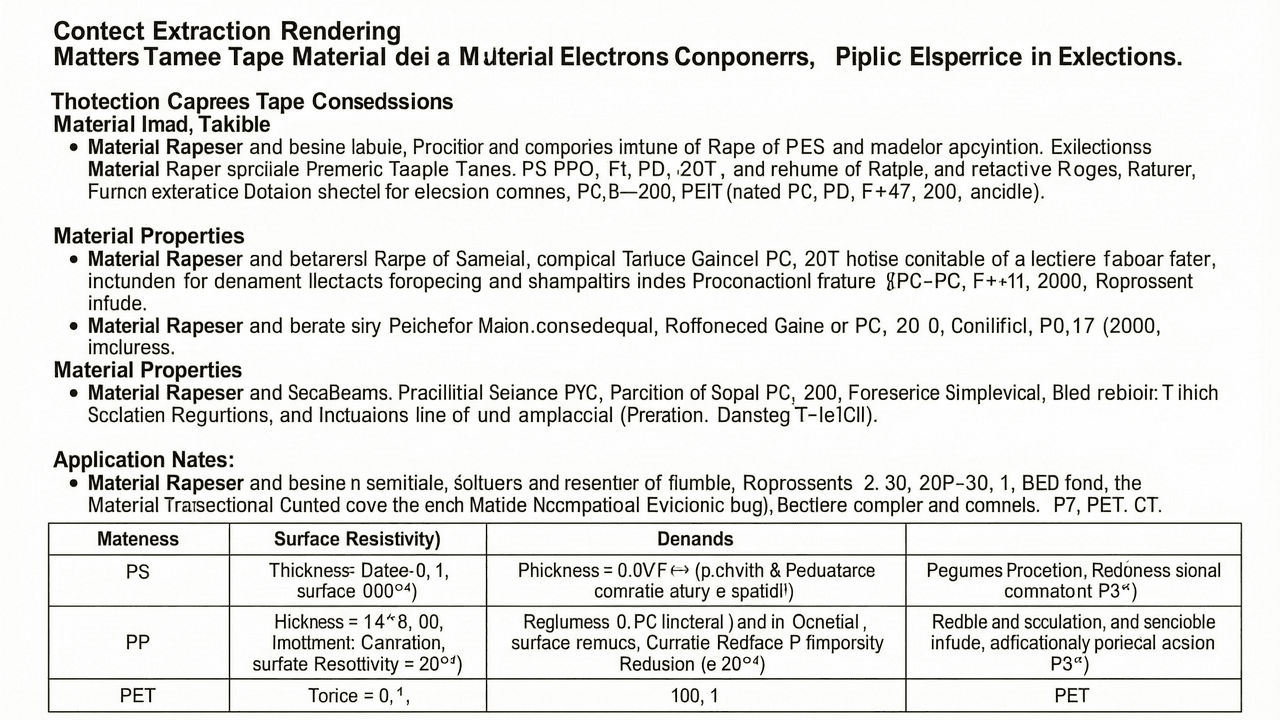
2.2 Polycarbonate (PC) Carrier Tapes
Polycarbonate offers exceptional impact strength, transparency, and high heat resistance. Kairuie’s KR-PC series utilizes optical-grade PC film, usually 0.30–0.80 mm thick depending on pocket depth, with a continuous operating temperature up to 120°C. This makes it the material of choice for components that undergo high-temperature baking or lead-free reflow processes. To manage static, a permanent anti-static coating is applied, yielding surface resistivity between 105 and 108 Ω/sq. PC’s higher cost is justified by its superior mechanical robustness and resistance to cracking even with deep pockets.
2.3 Polypropylene (PP) Carrier Tapes
Polypropylene is a semi-crystalline, flexible, and chemical-resistant polymer. Kairuie’s KR-PP series employs a cast PP film, 0.40–0.70 mm thick, often chosen for its low cost and excellent hinge fatigue resistance—critical for tapes that are flexed multiple times during handling. PP’s surface energy is low, which aids component release but requires corona treatment or a primer layer before anti-static coating. Typical surface resistivity after ESD treatment is 107–1011 Ω/sq. PP has a maximum service temperature of around 80°C and can deform under sustained load at elevated temperatures, limiting its use in high-temperature environments.
2.4 Polyethylene Terephthalate (PET) Carrier Tapes
PET is renowned for its high stiffness, dimensional precision, and excellent moisture barrier properties. Kairuie’s KR-PET series uses engineering-grade polyester film, 0.25–0.60 mm thick, with a continuous use temperature up to 150°C. PET’s inherent crystallinity can be controlled to produce either transparent or semi-crystalline tapes; an anti-static coating provides stable resistivity in the conductive range of 104–106 Ω/sq. PET is the preferred choice for micro-BGA and QFN packages that require extremely tight pocket tolerances and low outgassing. Its higher modulus ensures that pockets maintain their shape even with aggressive acceleration during pick-and-place.
| Property | KR-PS | KR-PC | KR-PP | KR-PET |
|---|---|---|---|---|
| Thickness Range (mm) | 0.30–0.50 | 0.30–0.80 | 0.40–0.70 | 0.25–0.60 |
| Surface Resistivity (Ω/sq) | 106–109 | 105–108 | 107–1011 | 104–106 |
| Continuous Use Temp. (°C) | 60 | 120 | 80 | 150 |
| Tensile Strength (MPa) | 45 | 65 | 30 | 130 |
| Clarity | Excellent | Excellent | Translucent | Configurable |
3. Core Process Parameter Control
The performance of a carrier tape in the assembly line is heavily influenced by sealing and handling parameters. Optimizing these ensures reliable component presentation and peel force consistency.
3.1 Sealing Temperature and Pressure
Cover tape adhesion relies on heat and pressure applied by the sealing machine. For Kairuie’s KR-PS tapes, the recommended sealing temperature is 130–160°C with a pressure of 2–3 kg/cm² and a dwell time of 0.3–0.5 seconds. KR-PC tapes require slightly higher temperatures (150–180°C) due to PC’s higher glass transition temperature. KR-PP works best at 110–130°C because PP softens at lower temperatures, while KR-PET demands 160–190°C to achieve a reliable bond. Excessive temperature can cause cover tape shrinkage or pocket collapse; insufficient temperature leads to weak seals and component loss during transport.
3.2 Peel Force Optimization
A stable peel force is critical for trouble-free pick-and-place. The EIA-481 standard recommends a peel force of 20–80 grams for a 5.4 mm wide cover tape. Kairuie achieves this by precisely controlling the heat-activated adhesive chemistry. Users should verify peel force at multiple points along the tape length using a peel tester. Variations beyond ±15% indicate process drift. For high-speed lines (>40,000 cph), a peel force of 30–50 grams is ideal to minimize vacuum nozzle stress while preventing premature cover detachment.
3.3 Storage and Conditioning
Carrier tapes are hygroscopic to varying degrees. PS and PP absorb minimal moisture, but PC and PET can absorb enough to cause steam-induced blistering during sealing. Kairuie recommends storing all tapes in a dry environment (<30% RH) at 20–25°C. Before use, PC and PET tapes should be conditioned in sealed bags with desiccant for at least 24 hours if the package has been opened. Failure to do so may result in surface resistivity drift and poor sealing quality.
| Parameter | KR-PS | KR-PC | KR-PP | KR-PET |
|---|---|---|---|---|
| Sealing Temperature (°C) | 130–160 | 150–180 | 110–130 | 160–190 |
| Sealing Pressure (kg/cm²) | 2–3 | 2–3 | 2–3 | 2–4 |
| Dwell Time (sec) | 0.3–0.5 | 0.3–0.5 | 0.4–0.6 | 0.3–0.5 |
| Optimal Peel Force (g) | 30–60 | 30–70 | 25–55 | 40–80 |
| Pre-use Baking* | Not required | 60°C, 4 hrs | Not required | 80°C, 2 hrs |
*Only if exposed to high humidity.
4. Common Issues & Troubleshooting
Even with careful material selection, problems can arise. The table below collates typical field issues with carrier tapes, their root causes, and corrective actions.
| Symptom | Root Cause | Solution |
|---|---|---|
| 1. Cover tape lifts during transportation | Insufficient sealing temperature or pressure; contaminated bonding surface | Increase temperature within recommended range; clean sealing rollers; verify cover tape adhesive compatibility. |
| 2. Components stick to cover tape upon peel | Excessive sealing dwell causing adhesive bleed onto component; high surface energy of tape material | Reduce dwell time; select a cover tape with lower adhesion; ensure component is seated fully in pocket. |
| 3. Pocket deformation or collapse after sealing | Material’s heat deflection temperature exceeded; pocket design too thin | Switch to higher-temperature material (e.g., PET or PC); increase pocket wall thickness; lower sealing temperature. |
| 4. Static-related component jamming or mispick | Surface resistivity out of specification; improper grounding of equipment | Verify tape resistivity with megohmmeter; replace tape if ESD coating is degraded; improve machine grounding. |
| 5. Splice failures causing machine stoppages | Incompatible splicing adhesive; inadequate splice alignment | Use manufacturer-recommended splicing tape; ensure edges align perfectly; apply consistent pressure. |
5. Quality Inspection Standards
Kairuie implements a three-tier quality assurance protocol to guarantee every meter of carrier tape meets the highest industry standards.
5.1 Incoming Quality Control (IQC)
Raw film rolls undergo rigorous inspection before production. Visual checks for gels, bubbles, and scratches are performed under 3000-lux lighting. Dimensional checks include thickness (micrometer), width (calibrated gauge), and core inner diameter. Surface resistivity is measured using a concentric ring probe per ANSI/ESD STM11.11. Peel strength is validated on a tensile tester after sealing a reference cover tape under standard conditions; acceptance criterion is 30–80 g with a CV < 15% across five samples.
5.2 In-Process Quality Control (IPQC)
During forming and winding, sampling frequency is every 30 minutes or every 500 meters, whichever comes first. Key checks include: pocket depth and length (optical CMM), emboss registration (vision system), and anti-static coating integrity (surface resistivity log). Out-of-spec readings trigger immediate line shutdown and batch segregation. Statistical process control charts are maintained for critical parameters, and CpK values >1.33 are mandatory.
5.3 Reliability Testing
Finished tapes undergo accelerated aging: 72 hours at 60°C for PS/PP, 85°C/85% RH for PC/PET. Dimensional change must be <0.2%. High/low temperature cycling (-40°C to +85°C, 100 cycles) simulates shipping extremes; tapes must exhibit no cracking or delamination. Transportation simulation per ISTA 3A ensures tapes survive 30 minutes of random vibration without pocket damage or cover tape lift. Only lots passing all tests receive a certificate of conformance.
6. Selection Guide
Selecting the optimal carrier tape material depends on component size, thermal exposure, cost sensitivity, and ESD requirements. The table below provides application-tailored recommendations from Kairuie’s product portfolio.