凯瑞尔电子材料
1. Introduction
In the world of Surface Mount Technology (SMT), the reliability of component packaging is just as critical as the pick-and-place process itself. Carrier tape, cover tape, and plastic reels form the backbone of automated component handling, ensuring that each tiny resistor, capacitor, or IC arrives at the placement head in perfect condition. A mismatch among these three elements can lead to tape jamming, component damage, or sealing failures, directly impacting manufacturing yield and production efficiency. This article dives deep into the technical aspects of matching carrier tape, cover tape, and plastic reels, drawing on Kairuie Electronic Materials’ extensive product portfolio. We will explore material compositions, critical process parameters, common failure modes with troubleshooting guidance, and robust selection criteria to help you build a flawless packaging system.
2. Product Structure & Material Composition
2.1 Layer-by-Layer Breakdown
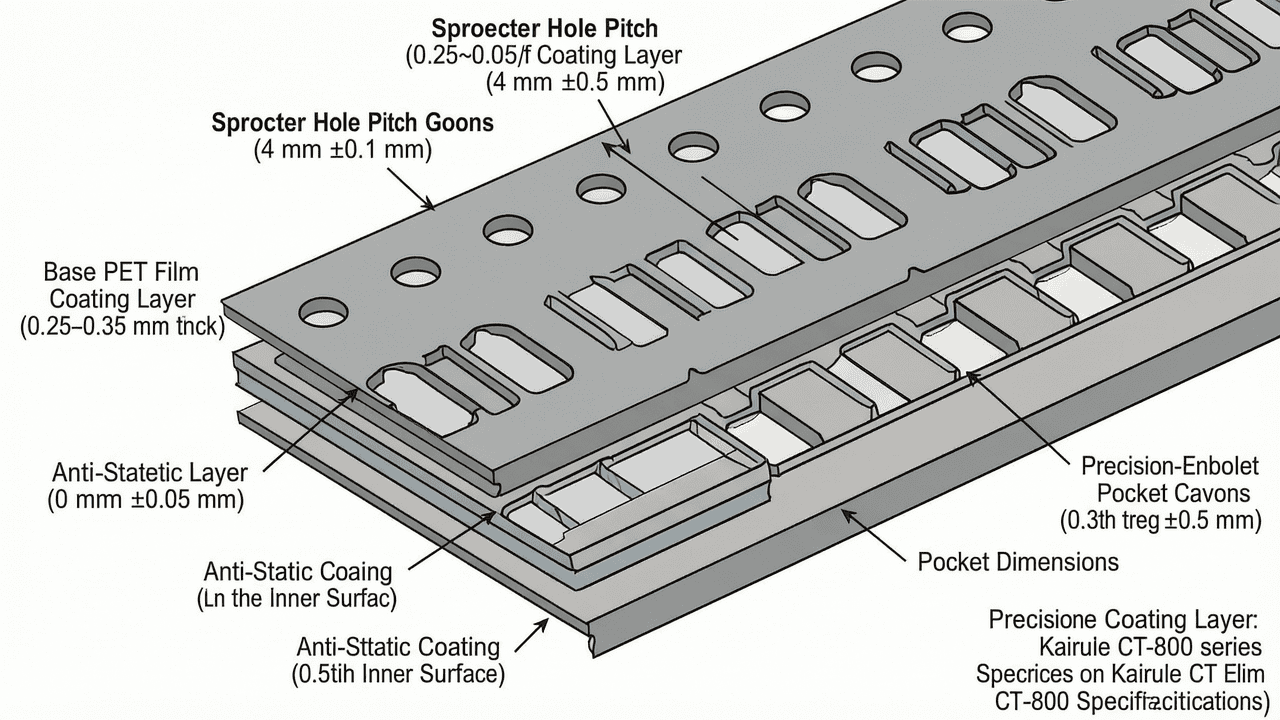
Kairuie’s carrier tape (e.g., CT-800 series) is engineered with a multi-layer structure. The base layer is typically a high-modulus polyethylene terephthalate (PET) film, chosen for its dimensional stability and mechanical strength. Standard PET thicknesses range from 0.25 mm to 0.35 mm (e.g., CT-800-025 for 0.25 mm, CT-800-035 for 0.35 mm). The inner surface is coated with a proprietary anti-static layer, achieving a surface resistivity of 106–109 Ω/sq (per ANSI/ESD S20.20), which safely dissipates electrostatic charges without causing component damage. For moisture-sensitive devices, a conductive carbon-filled polycarbonate version (CT-800-C) is available with resistivity <105 Ω/sq. The embossed pockets are precision-formed via thermoforming to maintain pocket depth tolerances of ±0.05 mm. The cover tape (CV-200 series) consists of a biaxially oriented PET base (thickness 48–62 μm) with a heat-activated adhesive layer. The adhesive is a specially formulated acrylic copolymer that seals to the carrier tape at low temperatures (110–130 °C), leaving minimal residue on the pocket edges. For transparent applications, the CV-200T offers optical clarity >90% transmission. The plastic reels (PR-330 series) are injection-molded from high-impact polystyrene (HIPS) or anti-static ABS. Standard reel diameters are 178 mm (7″), 330 mm (13″), and 381 mm (15″), with hub diameters of 60 mm or 76 mm. All reels meet EIA-481 standards, with anti-static options achieving surface resistivity of 106–109 Ω/sq.
2.2 Key Material Parameters
The synergy between these components rests on precise parameter matching. For carrier tape, the critical parameters are pocket dimensions (length, width, depth), sprocket hole pitch (4 mm ±0.1 mm), overall width (8–120 mm), and material resistivity. For cover tape, the seal width, seal strength (typical range 30–80 gf), heat activation temperature, and transparency are key. The reel’s inner hub diameter must match the carrier tape’s leader/trailer retention method, and the flange diameter must accommodate the tape length without overhang. Kairuie’s QA-Certified datasheets guarantee peel strength uniformity (CV-200 on CT-800 achieves 40–70 gf per EIA-481), and our PR-330 reels are stress-relieved to prevent warping under thermal cycling.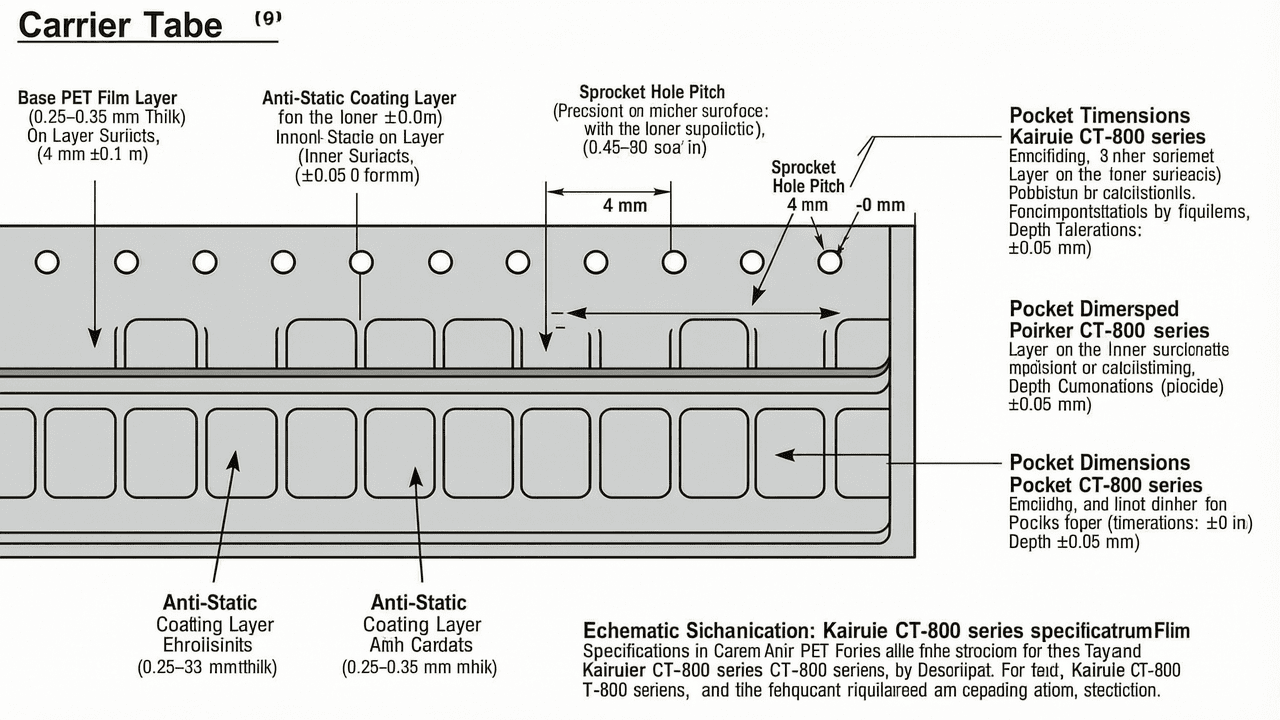
3. Core Process Parameter Control
3.1 Temperature Settings and Their Impact
The sealing temperature is the most critical parameter for cover tape application. For the CV-200 series on standard CT-800 carrier tape, the recommended sealing shoe temperature is 120 ± 5 °C when running at 60 cm/s. If the temperature is too low (<110 °C), the adhesive fails to flow, resulting in weak seals (<30 gf) and potential tape popping during re-reeling or transportation. Conversely, temperatures above 135 °C can cause PET crystallization in the carrier tape, leading to brittle pockets and edge curl, which disrupts feeder performance. Kairuie’s in-house testing shows that a sealing temperature of 122 °C provides optimal seal strength (55 ± 5 gf) with zero residue. When using conductive carrier tapes (CT-800-C), the recommended temperature drops to 115 ± 3 °C due to the slightly lower thermal conductivity of the carbon-filled material. Users should perform a seal strength verification at start-up and every 4 hours of continuous operation.
3.2 Pressure and Dwell Time Control
Sealing pressure, measured in N/mm² at the sealing shoe, should be maintained at 0.25–0.35 N/mm². Insufficient pressure (<0.2 N/mm²) results in intermittent sealing gaps, while excessive pressure (>0.4 N/mm²) can deform the carrier tape pockets, especially for thin-wall designs (pocket wall thickness <0.15 mm). Dwell time (the period the shoe presses the cover tape onto the carrier tape) depends on line speed. At a typical speed of 80 cm/s, a dwell time of 0.15–0.2 seconds is optimal. Kairuie’s process window study indicates that the product of pressure and dwell time (pressure impulse) should be above 0.035 N·s/mm² to ensure adhesive wetting. For wide tapes (>44 mm), we recommend a dual-zone sealing shoe to distribute pressure evenly, preventing center vs. edge sealing inconsistencies that could lead to “tenting” of the cover tape.
3.3 Process Window Optimization
Building a robust process window requires accounting for ambient conditions. In high-humidity environments (>60% RH), the carrier tape’s PET base can absorb moisture, altering its stiffness and affecting seal quality. Kairuie recommends storing tapes at 25 ± 3 °C and <40% RH for at least 4 hours before use. Using a design of experiments (DOE) approach, we validated that the optimal combination is: temperature = 123 °C, pressure = 0.30 N/mm², dwell = 0.18 s. This yields a Cpk >1.67 for seal strength. Our technical team can provide a custom process window for your specific component size and tape format upon request.