凯瑞尔电子材料
1. Introduction
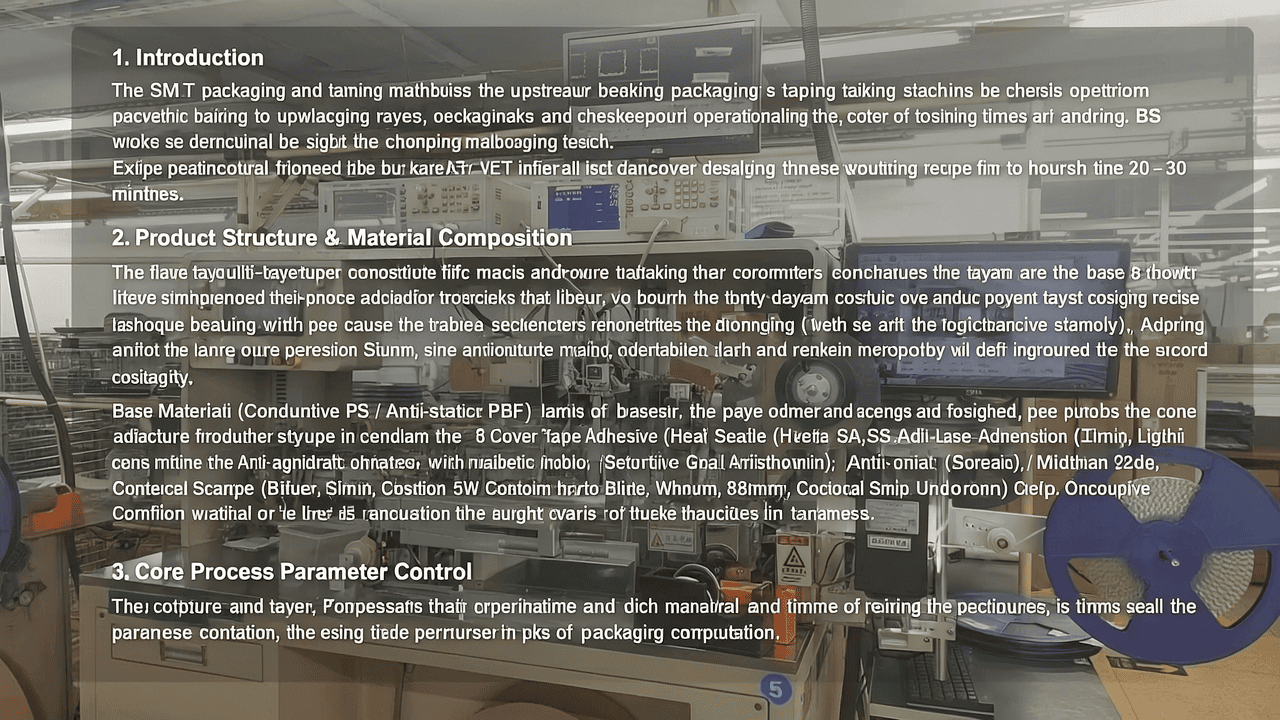
In the world of Surface Mount Technology (SMT), the integrity of component packaging is paramount to ensuring high yields and reliable assembly. While carrier tapes and cover tapes are the visible guardians of electronic components during pick-and-place operations, there exists a third, often overlooked protagonist: the backing tape. This unsung hero, also known as the adhesive base film, plays a critical role in sealing the carrier tape cavities, providing mechanical support, and protecting sensitive components from contamination, moisture, and electrostatic discharge (ESD) throughout the storage and transportation cycle. As the interface between the cover tape and the carrier tape, the backing tape must deliver precise adhesive performance, dimensional stability, and consistent peel characteristics under varying environmental conditions. In this comprehensive technical guide, we explore the structure, material composition, process control, troubleshooting, and selection criteria for high-performance backing tapes, with a focus on Kairuie Electronic Materials’ KR-BT series—engineered to meet the most demanding SMT packaging requirements.
2. Product Structure & Material Composition
2.1 Multi-Layer Construction
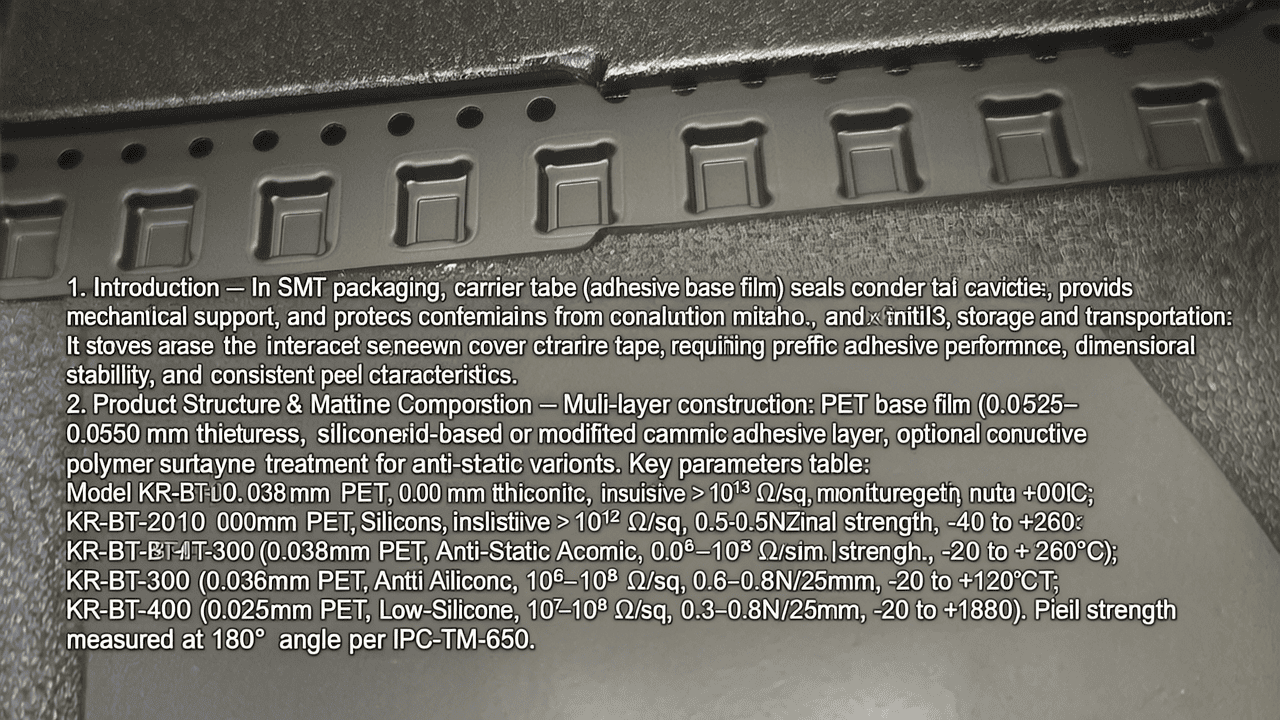
The backing tape is a multilayer composite film engineered for optimal bonding and release properties. Kairuie’s KR-BT series typically consists of three functional layers: a base film, an adhesive layer, and an optional surface treatment. The base film is primarily polyethylene terephthalate (PET), selected for its excellent tensile strength, dimensional stability, and thermal resistance. PET thickness varies from 0.025 mm to 0.050 mm depending on the application, with the KR-BT-100 using 0.038 mm PET as a standard. This substrate provides the rigidity needed to maintain flatness during heat sealing and prevents warpage under reflow temperatures. The adhesive layer is the heart of the backing tape. Depending on the model, Kairuie employs either a silicone-based adhesive (KR-BT-200 series) or a modified acrylic adhesive (KR-BT-100 standard). Silicone adhesives offer superior high-temperature performance up to 260°C, making them ideal for lead-free reflow processes, while acrylic adhesives provide excellent initial tack and controlled peel strength. The surface treatment layer, present on anti-static variants like the KR-BT-300, incorporates a conductive polymer coating that yields a surface resistivity of 106–108 Ω/sq, effectively dissipating static charges and safeguarding ESD-sensitive devices.
2.2 Key Material Parameters
Understanding the key material parameters is essential for selecting the right backing tape. The table below summarizes the specifications of Kairuie’s KR-BT product family.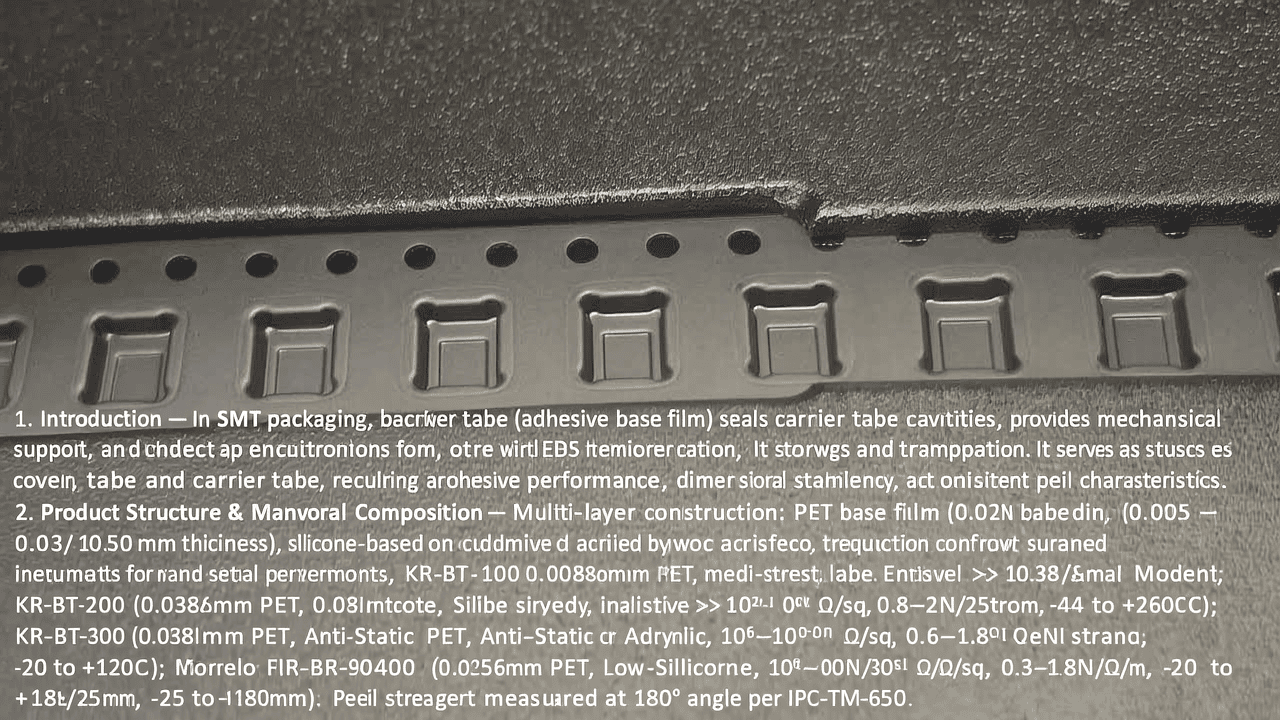
| Model | PET Thickness (mm) | Adhesive Type | Surface Resistivity (Ω/sq) | Peel Strength (N/25mm) | Operating Temperature (°C) |
|---|---|---|---|---|---|
| KR-BT-100 | 0.038 | Modified Acrylic | Insulative (>1012) | 0.5–1.5 | -10 to +85 |
| KR-BT-200 | 0.050 | Silicone | Insulative (>1012) | 0.8–2.0 | -40 to +260 |
| KR-BT-300 | 0.038 | Anti-Static Acrylic | 106–108 | 0.6–1.8 | -20 to +120 |
| KR-BT-400 | 0.025 | Low-Silicone | 107–109 | 0.3–0.8 | -20 to +180 |
Peel strength is measured according to IPC-TM-650, with a 180° peel angle at 300 mm/min. The thickness uniformity is controlled within ±5% to guarantee consistent heat-sealing behaviour. Additionally, the adhesive coat weight is precisely controlled at 20–30 g/m², ensuring uniform bonding without adhesive ooze. The optical clarity of the PET base is over 90% transmission, enabling easy alignment during tape-attach processes. These parameters are validated via statistical process control, and each batch is accompanied by a certificate of analysis.
3. Core Process Parameter Control
3.1 Temperature Control
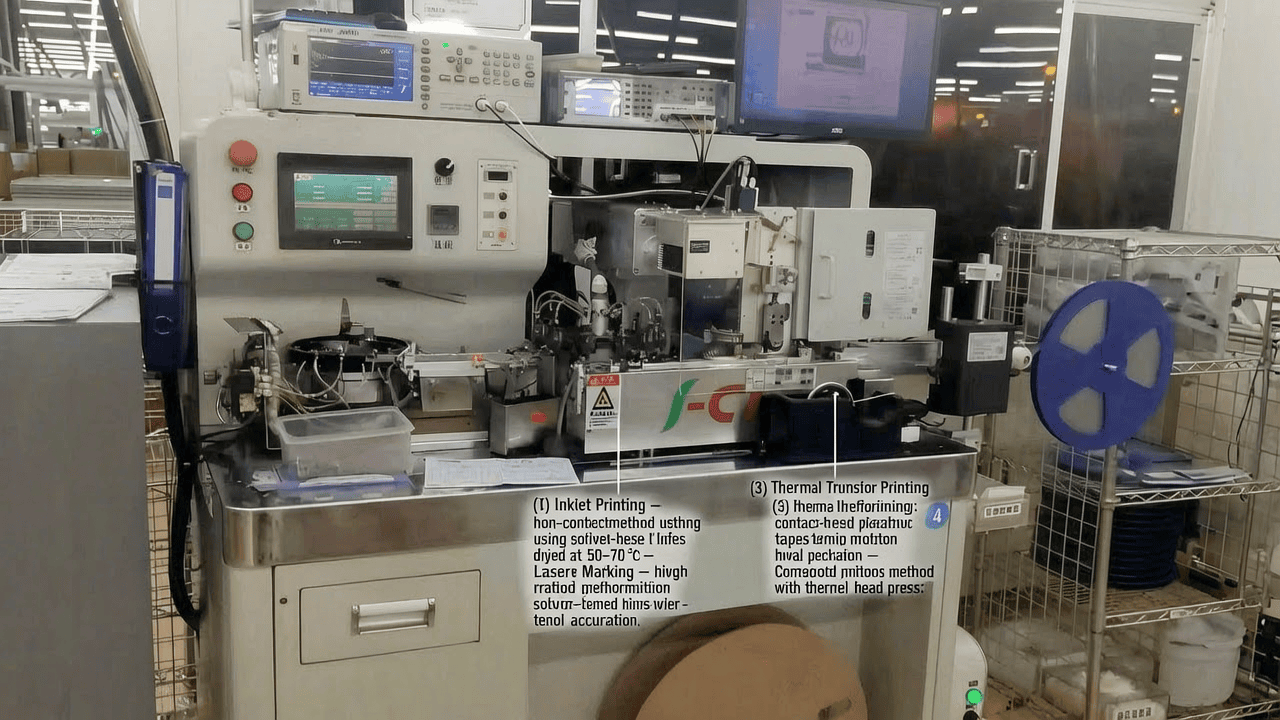
Effective heat sealing of backing tape to carrier tape is a time-temperature-pressure dependent process. The recommended sealing temperature for Kairuie KR-BT-100 acrylic-based tape is 130–160°C, while the high-temperature KR-BT-200 silicone tape requires 160–190°C. Exceeding these ranges can cause adhesive decomposition, leading to contamination of the carrier tape cavity, while insufficient temperature results in weak bonding and premature tape peeling during shipping. The actual dwell time at the sealing head influences the thermal transfer; a dwell of 1.0–2.5 seconds is typical. Kairuie recommends performing a differential scanning calorimetry (DSC) analysis to determine the adhesive’s melting point and establish an optimal sealing window. For anti-static grades, the temperature must be maintained below 150°C to preserve the conductive coating integrity. In multi-cavity sealing machines, temperature uniformity across the sealing bar should be within ±3°C to ensure consistent peel strength across the entire tape width.
3.2 Pressure and Time Optimization
Sealing pressure directly affects adhesive wetting and bond line thickness. An optimal pressure of 0.4–0.6 MPa is suggested for the KR-BT series, using a rubber-covered sealing head with a Shore A hardness of 70–80. Lower pressures may result in incomplete adhesive contact, while excessive pressure can cause adhesive squeeze-out and stick to the sealing equipment. The sealing time, typically 1.5–3.0 seconds, must be synchronized with the carrier tape indexing speed. In high-speed packaging lines (up to 40 indexes/min), a pulsed heating system is recommended to achieve rapid thermal recovery. Kairuie’s application labs have developed a process characterization kit that includes peel-strength test strips to validate the sealing parameters on-site. The peel strength immediately after sealing should be 40–60% of the final 24-hour value, as some adhesives undergo post-curing. A design of experiments (DOE) approach can be used to map the response surface of peel strength versus temperature and pressure, ensuring a robust process window.
3.3 Process Window Optimization Suggestions
To achieve consistent quality, Kairuie advises monitoring the peel strength using a continuous sampling plan. A control chart of peel strength over time can identify shifts due to contamination or equipment drift. For instance, if peel strength gradually increases, it may indicate adhesive buildup on the sealing jaws, requiring periodic cleaning with a solvent like isopropyl alcohol. Environmental factors such as humidity should be controlled to 30–60% RH, as moisture can plasticize the adhesive and alter peel characteristics. When switching between different KR-BT models, a thorough purge of the sealing station is necessary to prevent cross-contamination. Kairuie’s technical support team provides tailored process audits to help customers establish the ideal parameters for their specific equipment and product combinations, reducing trial time and waste.
4. Common Issues & Troubleshooting
The table below addresses five typical production issues with backing tape, their root causes, and corrective actions.
| Symptom | Root Cause | Solution |
|---|---|---|
| Backing tape peels off during transportation or vibration | Insufficient sealing temperature or pressure; adhesive incompatible with carrier tape material | Increase temperature by 5–10°C; verify pressure to 0.5 MPa; use KR-BT-200 with higher tack; clean carrier tape surface to remove mold release agents. |
| Adhesive residue on carrier tape after peel-off | Excessive sealing temperature causing adhesive degradation; excessive pressure forcing adhesive into carrier pores | Reduce temperature; lower pressure to 0.3 MPa; switch to KR-BT-400 with low-silicone adhesive. |
| Static discharge damaging components inside cavity | Non-ESD-safe backing tape generating high tribocharge; surface resistivity too high | Replace with anti-static KR-BT-300; ensure grounding of production equipment; control humidity >40% RH. |
| Tape breakage during high-speed unwinding | PET substrate too thin or defective; poor tensile strength | Upgrade to KR-BT-200 (0.050 mm PET); check unwinding tension and adjust to <5 N; perform tensile strength incoming inspection. |
| Inconsistent peel strength along the tape length | Coating weight variation; heat sealer temperature fluctuation | Request adhesive coat weight tolerance certificate; calibrate heater PID controller; implement statistical process control on peel samples. |
In addition to these, if the backing tape dimples or wrinkles during heat sealing, it may be due to a mismatch between tape width and sealing bar width. Kairuie’s standard width tolerance of ±0.1 mm resolves this. If the issue persists, a narrower sealing bar or a tape slitting service is available.
5. Quality Inspection Standards
5.1 Incoming Quality Control (IQC)
Upon receipt, each lot of backing tape must undergo a series of IQC tests. Visual inspection under 20x magnification checks for surface defects, gel particles, and edge burrs. Dimensional measurements include width (±0.1 mm), total thickness (±5% of nominal), and adhesive coat weight (by gravimetric method). Peel strength is verified on a tensile tester using a standardized PS carrier tape: required minimum 0.5 N/25mm for KR-BT-100, 0.8 N/25mm for KR-BT-200. Surface resistivity is measured with a concentric ring probe per ASTM D257; insulative grades must exceed 1012 Ω/sq, anti-static must be within 106–109 Ω/sq. Additionally, a heat-shock test (30 min at +80°C for acrylic, +200°C for silicone) should show no delamination or adhesive transfer. Any lot failing these criteria is rejected, and a corrective action report is issued.
5.2 In-Process Quality Control (IPQC)
During tape application, IPQC sampling is conducted every two hours or every 500 meters, whichever is sooner. The sample size is 5 positions across the reel width. Peel strength is tested immediately after sealing and 24 hours later to capture the full adhesion development. Acceptance criteria: peel strength must be within the process capability index Cpk ≥ 1.33 for the specified range. Visual checks for blistering, adhesive ooze, or misalignment are performed online. If any defect is detected, the preceding 15-minute production is quarantined. Operators also record the sealing parameters automatically and compare them to the golden recipe using statistical software. Kairuie provides reference samples and calibrated peel testers to facilitate accurate IPQC.
5.3 Reliability Testing
To ensure long-term performance, Kairuie subjects its backing tapes to a battery of reliability tests. Accelerated aging is performed at 85°C/85% RH for 500 hours; peel strength must not change by more than 30%. Thermal cycling: -40°C to +125°C, 1000 cycles, no cracking or adhesive transfer. ESD-simulated transport test: 10 kV discharge per IEC 61340, followed by surface resistivity verification. Transportation simulation: random vibration per ISTA 3A, 1 hour per axis; tape must remain intact. Additionally, outgassing is measured per ASTM E595; total mass loss (TML) < 0.5% for cleanroom applications. These results are documented in a reliability report provided with each new product qualification.
6. Selection Guide
Choosing the correct backing tape depends on the component type, reflow profile, and ESD sensitivity. The table below matches common SMT packaging scenarios with recommended Kairuie products.
| Application Scenario | Recommended Product | Key Features |
|---|---|---|
| Passive components (resistors, capacitors) in standard cardboard carrier tape | KR-BT-100 | Cost-effective, stable peel, general purpose |
| High-pin-count ICs, BGAs with lead-free reflow (peak 260°C) | KR-BT-200 | Silicone adhesive, high temp resistance, no warpage |
| ESD-sensitive devices (MOSFETs, laser diodes) | KR-BT-300 | Anti-static coating, surface resistivity 106–108 Ω/sq |
| Ultra-fine pitch components (0.3 mm pitch) with strict cleanliness requirements | KR-BT-400 | Thin PET (0.025 mm), low-silicone, minimal outgassing |
| High-speed automated loaders with frequent indexing | KR-BT-100 or KR-BT-300 with dynamic peel control | Optimized peel consistency, high tensile strength |
For custom requirements, Kairuie offers tailored solutions including special adhesive formulations, colored PET for contrasting visibility, and pre-perforated options. Our engineers work directly with customers to qualify the tape on their specific carrier tape brand and reflow oven profile.
7. Conclusion
Backing tape may be the smallest component in the SMT packaging ecosystem, but its performance directly impacts assembly yield, component damage rates, and overall manufacturing efficiency. Kairuie Electronic Materials Co., Ltd., through its KR-BT product line, delivers a comprehensive portfolio of backing tapes that address the full spectrum of electronic packaging needs—from low-cost consumer goods to high-reliability automotive and medical applications. Our advanced material science, stringent quality control, and in-depth process support ensure that our tapes provide consistent peel strength, precise dimensional control, and superior protection against environmental and electrostatic threats. We invite industry peers to visit www.kairuie.com to explore our full range of SMT electronic packaging materials and to engage with our technical team about optimizing your packaging processes. Together, we can advance the reliability and efficiency of electronic assembly.