凯瑞尔电子材料
1. Introduction
Pogo pins are miniature spring-loaded connectors widely used in test fixtures, battery connectors, and signal transmission modules. Their precise dimensions and delicate spring mechanisms demand robust protection during surface mount technology (SMT) assembly. Carrier tape—specifically PET-based embossed carrier tape—plays a critical role in securing pogo pins during tape-and-reel packaging, ensuring reliable feeding into placement machines. This article provides a comprehensive technical overview of PET carrier tape designed for pogo pin packaging, covering material composition, process parameter control, common defects, quality inspection, and selection guidelines. By referencing industry standards such as EIA-481 and specific product parameters, we aim to equip SMT engineers with actionable insights for optimizing packaging performance.
2. Product Structure & Material Composition
2.1 Layer Structure
PET carrier tape for pogo pins typically comprises three functional layers: a base layer of polyethylene terephthalate (PET), an adhesive layer, and an optional surface treatment layer. The base layer provides mechanical strength and dimensional stability. The adhesive layer ensures secure bonding between the carrier tape and the cover tape. A surface treatment layer may be applied to modify surface energy for improved adhesion or antistatic properties.
2.2 Key Material Parameters
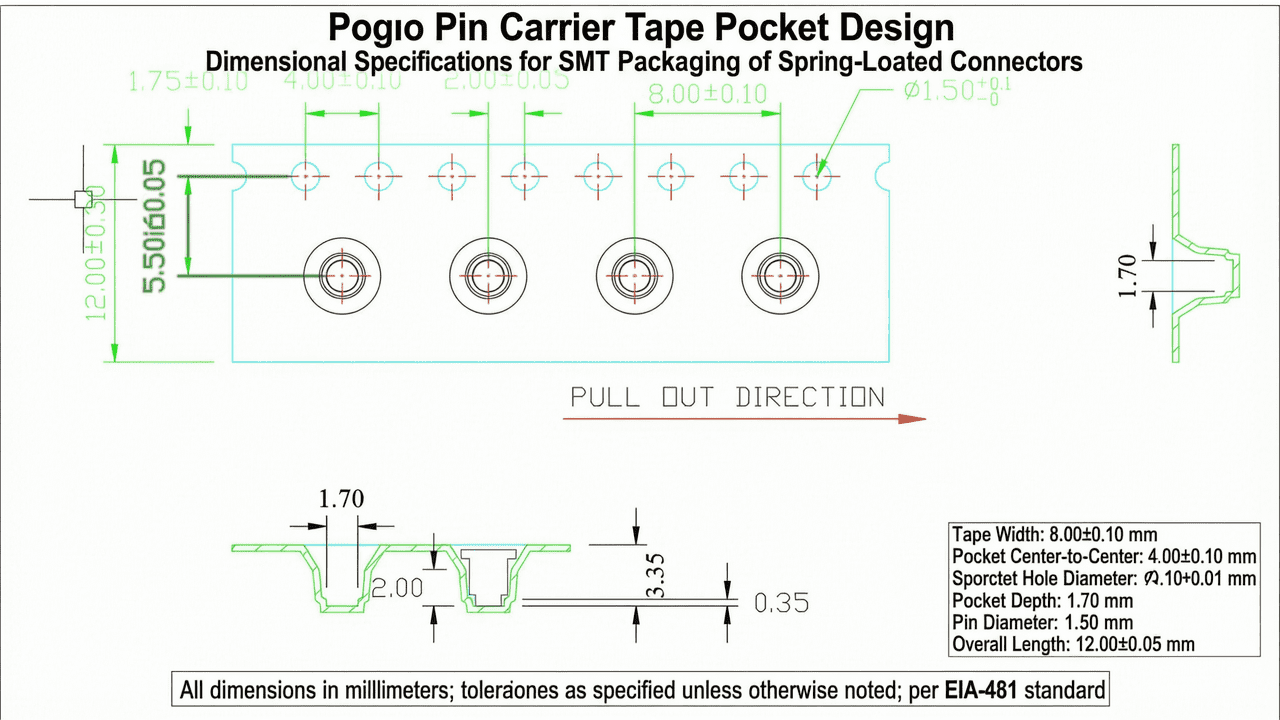
Typical PET carrier tape thickness ranges from 0.30 mm to 0.60 mm, depending on pogo pin height. For example, a common model KR-PET-040 has a base thickness of 0.40 mm ±0.05 mm. The adhesive type is usually a heat-activated acrylic or silicone-based system, with peel strength controlled between 0.2 N and 1.0 N (per EIA-481). Surface resistivity is maintained below 10^11 Ω/sq for static dissipation, often achieved by incorporating carbon black or antistatic coatings. Specific product parameters from Kairuie Electronic Materials include: KR-PET-050 (thickness 0.50 mm, peel strength 0.5 N, surface resistivity 10^9 Ω/sq) and KR-PET-060 (thickness 0.60 mm, peel strength 0.8 N, surface resistivity 10^10 Ω/sq).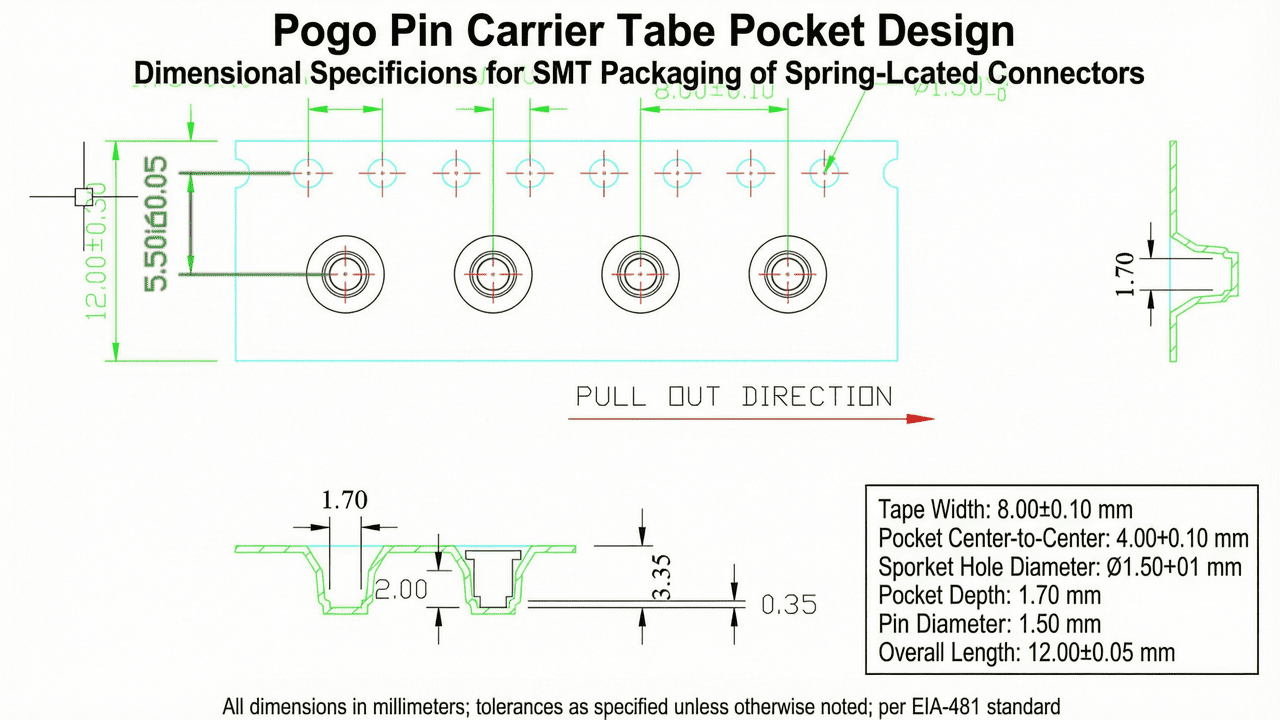
2.3 Pocket Design Considerations
Pocket dimensions must accommodate pogo pin length, diameter, and spring travel. Typical pocket depth is 1.2 times the pin height, with side clearance of 0.1 mm to 0.2 mm. For a pogo pin of 5.0 mm length and 1.0 mm diameter, the pocket would be approximately 6.0 mm deep and 1.2 mm wide. The sprocket hole pitch (P) follows EIA-481 standards, commonly 4 mm or 8 mm for 8 mm wide tape.
3. Core Process Parameter Control
3.1 Temperature, Pressure, and Time
For heat-activated cover tape sealing, the recommended temperature range is 160°C to 200°C, with a dwell time of 0.5 to 1.5 seconds and a sealing pressure of 2.0 to 4.0 bar. Too low temperature (<150°C) results in weak adhesion, while excessive temperature (>210°C) may warp the PET base. Pressure below 1.5 bar causes incomplete sealing; above 5.0 bar can crush pogo pins. Time shorter than 0.3 seconds leads to insufficient adhesive flow; longer than 2.0 seconds may degrade the adhesive.
3.2 Effect on Product Quality
Optimal sealing ensures peel strength within specification (0.2-1.0 N). Variations in temperature directly affect adhesive viscosity and bond line thickness. Pressure uniformity across the sealing head is critical to avoid localized weak spots. Process window optimization involves running a design of experiments (DOE) to define the acceptable range. For example, at 180°C, 3.0 bar, and 1.0 second, peel strength reaches 0.6 N ±0.1 N, which is ideal for pogo pins.
3.3 Process Window Optimization Suggestions
Start with center values (180°C, 3.0 bar, 1.0 sec) and adjust based on peel strength results. If peel strength is too high (>1.0 N), reduce temperature or time; if too low (<0.2 N), increase temperature or pressure. Use a thermocouple to verify actual sealing temperature, as heater variations can be ±5°C. Implement statistical process control (SPC) with hourly peel strength checks.
4. Common Issues & Troubleshooting
| Symptom | Root Cause | Solution |
|---|---|---|
| Cover tape lifts during handling | Low sealing temperature or pressure | Increase temperature by 10°C or pressure by 0.5 bar |
| Pogo pin stuck in pocket | Pocket depth too shallow or side clearance too tight | Redesign pocket with 0.05 mm extra clearance |
| Excessive camber (bowing) | Uneven cooling after sealing | Add cooling zone or reduce sealing temperature |
| Peel strength variation >0.3 N | Non-uniform pressure distribution | Calibrate sealing head parallelism |
| Antistatic property loss | Surface treatment degradation | Verify surface resistivity; replace tape if >10^11 Ω/sq |
5. Quality Inspection Standards
5.1 Incoming Quality Control (IQC)
Visual inspection checks for scratches, contamination, and color consistency. Dimensional verification includes pocket width, depth, pitch, and sprocket hole alignment using optical measurement (±0.05 mm tolerance). Peel strength is tested per EIA-481 at a 180° peel angle and 300 mm/min speed. Typical acceptance: 0.2-1.0 N.
5.2 In-Process Quality Control (IPQC)
Sampling frequency: every 30 minutes during production, with 5 samples per reel. Acceptance criteria: all dimensions within spec, peel strength within 0.3-0.8 N, no visible defects. If more than 1 sample fails, adjust parameters and resample 20 pieces.
5.3 Reliability Testing
Aging test: 85°C/85% RH for 168 hours; peel strength must remain within 80% of initial. High/low temperature cycle: -40°C to +85°C, 10 cycles; no delamination. Transportation simulation: vibration at 5-500 Hz, 2 hours; tape must not break or shift pockets.
6. Selection Guide
| Component Type | Recommended PET Thickness | Adhesive Type | Surface Resistivity | Example Model |
|---|---|---|---|---|
| Pogo Pin (height < 3 mm) | 0.30 mm | Heat-activated acrylic | <10^9 Ω/sq | KR-PET-030 |
| Pogo Pin (height 3-6 mm) | 0.40-0.50 mm | Heat-activated silicone | <10^10 Ω/sq | KR-PET-040, KR-PET-050 |
| Pogo Pin (height > 6 mm) | 0.60 mm | Heat-activated silicone | <10^11 Ω/sq | KR-PET-060 |
| High-frequency pogo pins | 0.40 mm | Low-outgassing acrylic | <10^9 Ω/sq | KR-PET-040HF |
7. Conclusion
PET carrier tape is indispensable for reliable pogo pin SMT packaging, offering precise pocket formation, controlled peel strength, and static dissipation. By understanding material composition, optimizing process parameters, and adhering to rigorous quality standards, manufacturers can achieve consistent feeding performance and reduce assembly defects. Kairuie Electronic Materials Co., Ltd. provides a full range of PET carrier tapes tailored to pogo pin dimensions and application requirements. For more information or technical consultation, visit www.kairuie.com. We welcome industry peers to exchange ideas and collaborate on advancing SMT packaging solutions.