凯瑞尔电子材料
1. Introduction
In the rapidly evolving field of surface mount technology (SMT), the packaging of miniaturized acoustic components such as MEMS microphones, speakers, and receivers presents unique challenges. These components often feature delicate diaphragms, precise acoustic ports, and ultra-small form factors that require specialized carrier tape solutions. The ultra-small acoustic housing protection carrier tape, incorporating mistake-proofing features and an intermediate platform (the so-called ‘middle platform’ or ‘center stage’), addresses these challenges by providing secure component retention, anti-static protection, and alignment assurance during automated assembly. This article explores the technical aspects of this innovative carrier tape, including its structure, process parameters, troubleshooting, quality standards, and selection guidelines, offering a comprehensive reference for engineers and procurement professionals in the electronics manufacturing industry.
2. Product Structure & Material Composition
2.1 Layer Structure
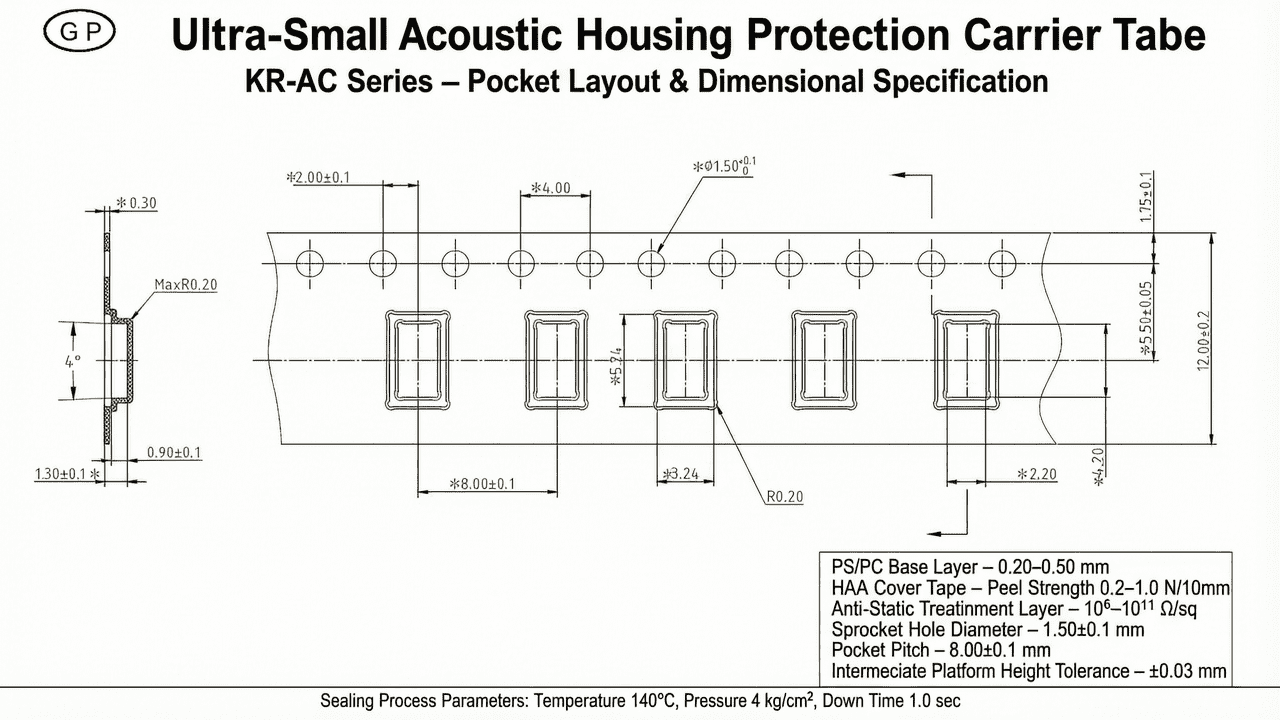
The ultra-small acoustic housing protection carrier tape consists of three functional layers: a base layer (carrier tape body), an adhesive layer (cover tape), and a treatment layer (anti-static or conductive coating). The base layer is typically made from high-precision embossed polystyrene (PS) or polycarbonate (PC) with a thickness of 0.20–0.50 mm, depending on component size. The cover tape is a heat-activated adhesive (HAA) or pressure-sensitive adhesive (PSA) type, with a peel strength range of 0.2–1.0 N (per 10 mm width) to ensure secure sealing without damaging components. The treatment layer provides surface resistivity of 10⁶–10¹¹ Ω/sq (static dissipative) or <10⁶ Ω/sq (conductive) for ESD protection.
2.2 Key Parameters
Specific product models from Kairuie Electronic Materials Co., Ltd. include the KR-AC series for acoustic housings. For example, model KR-AC1206 features a pocket depth of 1.2 mm, pitch of 8 mm, and sprocket hole diameter of 1.5 mm. The intermediate platform (center stage) is designed with a raised boss that supports the component’s acoustic port, preventing diaphragm contact with the pocket floor. The mistake-proofing feature includes a keying slot or asymmetrical pocket geometry that ensures correct component orientation (Pin 1 orientation) relative to feed direction.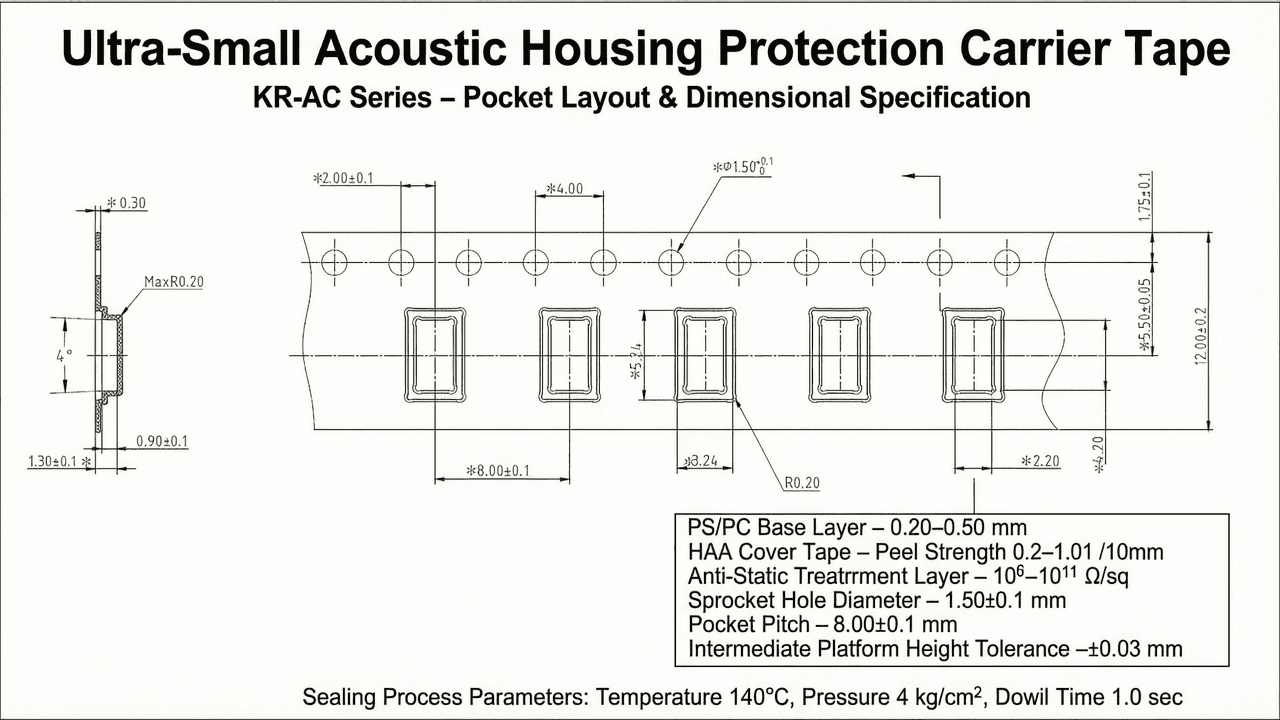
3. Core Process Parameter Control
3.1 Temperature, Pressure, and Time
For heat-activated cover tape sealing, the recommended temperature range is 120–160°C, with a pressure of 2–5 kg/cm² and dwell time of 0.5–1.5 seconds. For PSA tapes, room temperature (20–25°C) and pressure of 3–6 kg/cm² are sufficient. The intermediate platform requires precise temperature control to avoid warpage; a temperature gradient of ±2°C across the sealing head is critical.
3.2 Impact on Quality
Insufficient temperature or pressure leads to weak peel strength, causing cover tape detachment during handling. Excessive temperature can deform the carrier tape, altering pocket dimensions and causing component misalignment. The intermediate platform’s flatness must be maintained within ±0.05 mm to ensure proper acoustic port protection.
3.3 Process Window Optimization
To optimize the process, use a design of experiments (DOE) approach, varying temperature, pressure, and time while measuring peel strength and pocket dimensional stability. The optimal window for KR-AC series tapes is 140°C, 4 kg/cm², 1.0 second, yielding a peel strength of 0.5–0.7 N.
4. Common Issues & Troubleshooting
| Symptom | Root Cause | Solution |
|---|---|---|
| Cover tape peeling off during feeding | Insufficient sealing temperature or pressure | Increase temperature by 5–10°C or pressure by 0.5 kg/cm² |
| Component misalignment in pocket | Pocket dimensional variation or excessive camber | Verify carrier tape camber (<1 mm per 250 mm); adjust sealing head alignment |
| Acoustic port damage | Intermediate platform height incorrect | Check platform height tolerance (±0.03 mm); replace tooling if worn |
| Static discharge during pickup | Surface resistivity too high | Use conductive carrier tape (<10⁶ Ω/sq) or increase humidity |
| Cover tape residue on component | Adhesive transfer due to high peel strength | Reduce peel strength to 0.3–0.5 N by lowering sealing temperature |
5. Quality Inspection Standards
5.1 Incoming Quality Control (IQC)
IQC includes visual inspection for surface defects (scratches, contamination), dimensional measurement of pocket length/width/depth (within ±0.05 mm), sprocket hole diameter (within ±0.03 mm), and peel strength test (per EIA-481 standard). For acoustic housings, the intermediate platform height is measured using optical profilometry.
5.2 In-Process Quality Control (IPQC)
Sampling frequency: every 30 minutes or per reel. Acceptance criteria: peel strength within 0.3–0.8 N, no pocket deformation, cover tape seal width ≥1.5 mm. Any deviation triggers immediate process adjustment.
5.3 Reliability Testing
Aging test: 85°C/85% RH for 168 hours; peel strength change <20%. High/low temperature cycle: -40°C to 85°C, 10 cycles; no cover tape lift or component shift. Transportation simulation: 3-axis vibration at 1.5 G RMS for 2 hours; no pocket damage.
6. Selection Guide
| Component Type | Recommended Product Model | Key Features |
|---|---|---|
| MEMS Microphone (3×4 mm) | KR-AC0805 | Intermediate platform height 0.3 mm; conductive base; pitch 4 mm |
| Miniature Speaker (5×7 mm) | KR-AC1206 | Static dissipative; mistake-proof keying; pitch 8 mm |
| Receiver (6×10 mm) | KR-AC1610 | High-temperature PS material; peel strength 0.5 N; pitch 12 mm |
| Ultrasonic Sensor (3×3 mm) | KR-AC0605 | Ultra-small pocket depth 0.5 mm; conductive cover tape; pitch 4 mm |
7. Conclusion
The ultra-small acoustic housing protection carrier tape with mistake-proofing and intermediate platform design represents a critical advancement in SMT packaging for sensitive acoustic components. By ensuring precise component orientation, protecting delicate acoustic ports, and providing reliable ESD protection, this carrier tape enhances assembly yield and product reliability. Kairuie Electronic Materials Co., Ltd. (www.kairuie.com) offers a comprehensive range of carrier tapes tailored to acoustic applications, backed by rigorous quality control and technical support. We invite industry peers to explore our solutions and exchange ideas for further innovation in electronic packaging.