凯瑞尔电子材料
1. Introduction
In the realm of Surface Mount Technology (SMT) packaging, carrier tapes play a pivotal role in protecting and precisely delivering electronic components during assembly. Among the various materials used, transparent Polystyrene (PS) antistatic carrier tapes have gained prominence due to their excellent clarity, dimensional stability, and electrostatic discharge (ESD) protection. These tapes are essential for safeguarding sensitive components from static damage while enabling visual inspection of taped parts. This article provides a comprehensive technical overview of transparent PS antistatic carrier tapes, delving into their structure, material composition, core process parameters, common defects, quality standards, and selection criteria. By understanding these aspects, engineers and procurement professionals can optimize their packaging processes and ensure reliable component delivery.
2. Product Structure & Material Composition
2.1 Layer Structure
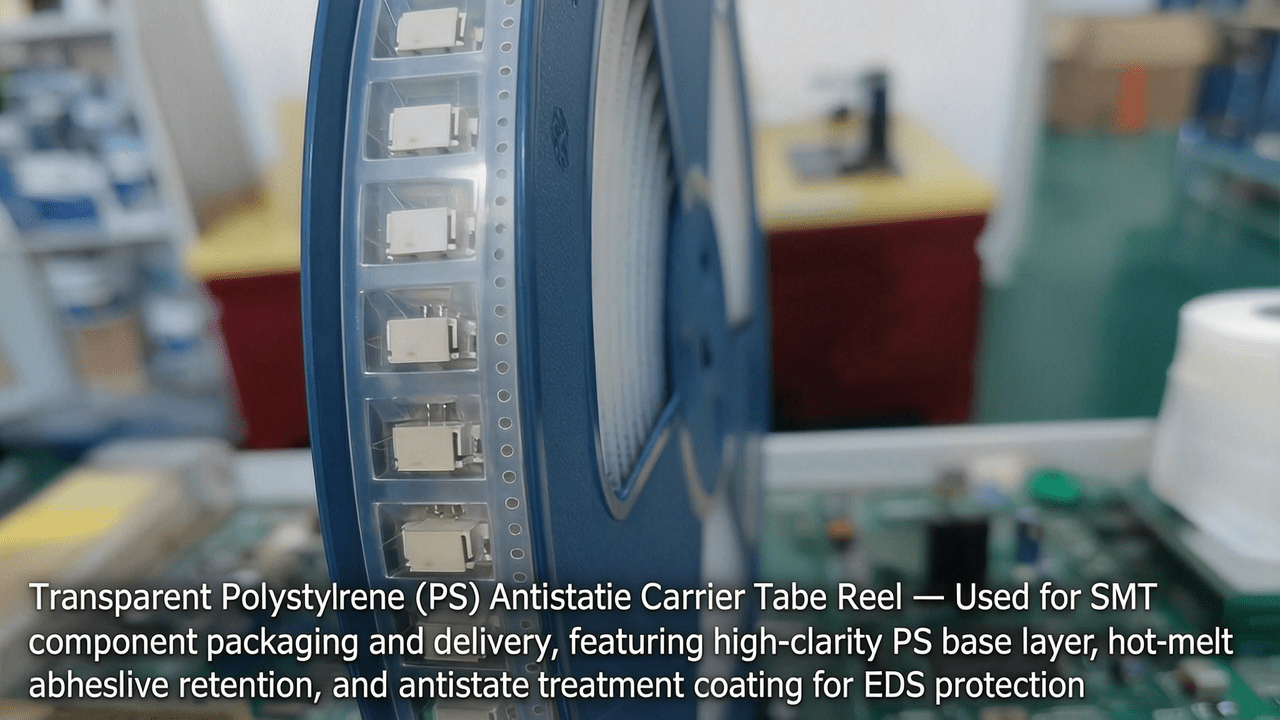
Transparent PS antistatic carrier tapes typically consist of three functional layers: a base layer, an adhesive layer, and a treatment layer. The base layer is made from high-clarity PS resin, providing mechanical strength and dimensional accuracy. The adhesive layer, often a hot-melt or pressure-sensitive adhesive, ensures secure component retention. The treatment layer, which may include antistatic coatings, imparts surface resistivity control and prevents static buildup.
2.2 Key Material Parameters
For Kairuie’s transparent PS carrier tapes, the following parameters are critical: PET thickness ranges from 0.30 mm to 0.50 mm, with tolerance of ±0.02 mm. The adhesive type is a synthetic rubber-based hot-melt, offering peel strength of 0.5–1.0 N/20 mm. Surface resistivity is controlled between 10^6 and 10^11 Ω/sq, meeting EIA-541 standards. Specific product models include KRT-PS-080 (8 mm width) and KRT-PS-120 (12 mm width), with sprocket hole pitch accuracy of ±0.05 mm.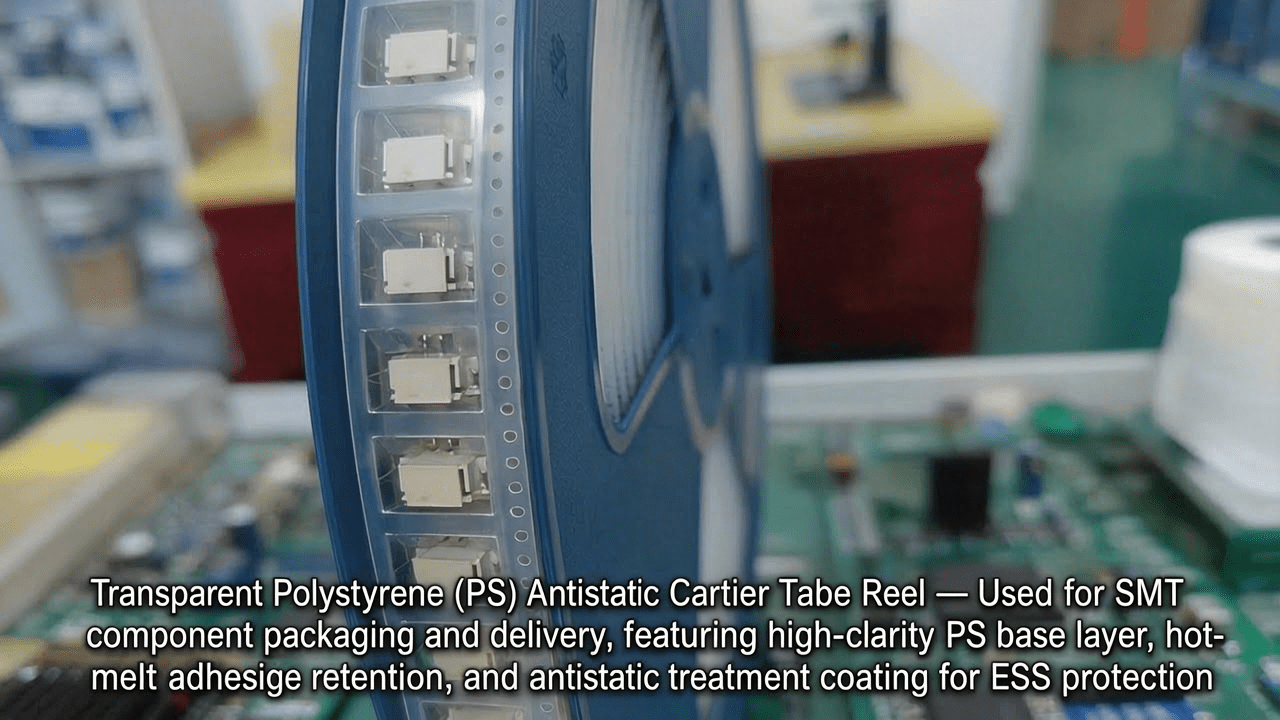
3. Core Process Parameter Control
3.1 Temperature, Pressure, and Time Ranges
Optimal sealing of carrier tapes requires precise control of temperature, pressure, and dwell time. For Kairuie’s transparent PS tapes, the recommended sealing temperature range is 160–180°C, with a pressure of 0.4–0.6 MPa and dwell time of 0.5–1.0 second. These parameters ensure proper adhesion without deforming the tape or damaging components.
3.2 Effect of Parameters on Quality
Inadequate temperature (<150°C) leads to weak peel strength and risk of component loss during handling. Excessive temperature (>200°C) can cause tape shrinkage or melting, compromising dimensional accuracy. Similarly, low pressure results in incomplete sealing, while high pressure may crush delicate components. Optimizing the process window—typically 165–175°C, 0.5 MPa, 0.8 seconds—yields consistent peel strength of 0.8 N/20 mm and zero tape deformation.
4. Common Issues & Troubleshooting
| Symptom | Root Cause | Solution |
|---|---|---|
| Weak peel strength | Low sealing temperature or pressure | Increase temperature to 170°C and pressure to 0.5 MPa |
| Tape deformation (warping) | Excessive temperature or dwell time | Reduce temperature to 165°C and dwell time to 0.6 s |
| Component misalignment | Improper sprocket hole pitch or tape tension | Verify hole pitch tolerance ±0.05 mm; adjust tension to 0.5–1.0 N |
| Static discharge damage | Surface resistivity too high (>10^11 Ω/sq) | Apply antistatic treatment; ensure resistivity 10^6–10^11 Ω/sq |
| Adhesive residue | Contaminated adhesive or excessive temperature | Clean sealing head; reduce temperature to 160°C |
5. Quality Inspection Standards
5.1 Incoming Quality Control (IQC)
IQC for transparent PS carrier tapes includes visual inspection for clarity, scratches, and contamination; dimensional checks (width, thickness, sprocket hole pitch) using a micrometer and optical comparator; and peel strength testing per IPC-TM-650 (minimum 0.5 N/20 mm).
5.2 In-Process Quality Control (IPQC)
During production, sampling is conducted every 30 minutes with an AQL of 0.65 (normal level II). Acceptance criteria include peel strength within 0.5–1.0 N/20 mm, no visible defects, and surface resistivity within spec.
5.3 Reliability Testing
Reliability tests include aging at 85°C/85% RH for 168 hours (peel strength retention >80%), high/low temperature cycling (-40°C to +85°C, 100 cycles), and transportation vibration simulation (10–500 Hz, 2 hours). All tests must show no degradation in performance.
6. Selection Guide
| Component Type | Recommended Product Model | Key Features |
|---|---|---|
| Small passive components (0402, 0603) | KRT-PS-080 | 8 mm width, 0.30 mm thickness, peel strength 0.5 N/20 mm |
| Medium ICs (SOIC, QFP) | KRT-PS-120 | 12 mm width, 0.40 mm thickness, peel strength 0.8 N/20 mm |
| Large connectors or LEDs | KRT-PS-160 | 16 mm width, 0.50 mm thickness, peel strength 1.0 N/20 mm |
| ESD-sensitive components | KRT-PS-120-ESD | Surface resistivity 10^6–10^9 Ω/sq, antistatic coating |
7. Conclusion
Transparent PS antistatic carrier tapes from Kairuie Electronic Materials Co., Ltd. offer a reliable and cost-effective solution for SMT packaging, combining high clarity, precise dimensions, and robust ESD protection. By adhering to recommended process parameters and quality standards, manufacturers can achieve consistent component delivery and minimize defects. Kairuie’s commitment to quality and innovation ensures that our products meet the evolving demands of the electronics industry. For more information or to discuss your specific packaging needs, please visit our website at www.kairuie.com. We welcome industry peers to exchange ideas and collaborate on advancing SMT packaging technology.